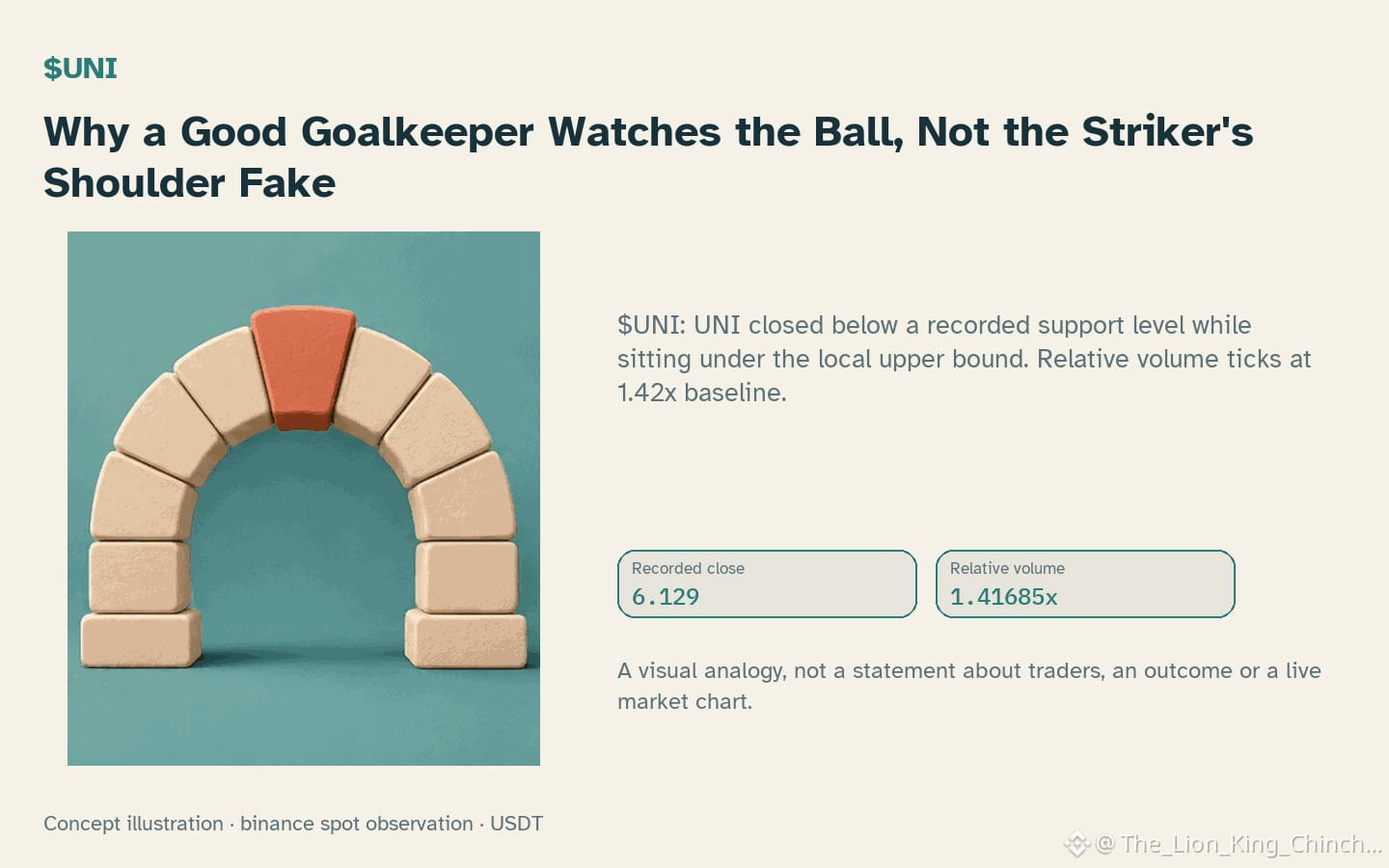
$UNI: Why a Good Goalkeeper Watches the Ball, Not the Striker's Shoulder Fake
$UNI: UNI closed below a recorded support level while sitting under the local upper bound. Relative volume ticks at 1.42x baseline.
This raises a simpler question: Do wicks or closed bodies show where the money actually rested?
Consider a soccer analogy. When a striker drops a shoulder, the ball stays in flight. A goalkeeper tracking the ball lands safely. One watching the move dives incorrectly. The move is the wick; the closed candle is the ball's location. This hypothetical mechanism asks whether wick spikes create false signals.
Observations show $UNI trading down hourly. Its relative volume measures 1.42x baseline. RSI reads 27.7. The asset rests below recorded support. The local resistance sits at 6.578.
Yet there is an alternative explanation. Volume above baseline could reflect a liquidation cascade rather than sustained directional trend. Extreme candles capture sudden pull-backs. The wick here might be a recovery attempt that failed.
How to verify this? Compare the last two hours. If close bodies stay below the prior low, the argument holds. If future candles close back above the resistance line, the lower wick was a false alarm. Volume matters less than where the candle actually settles. The body forms the true boundary. An assertion of control comes from closed boundaries, not thin wicks. It explains why relying on the tip of a spike can lead to premature exits. A sharp lower spike that closes mid-range is different from a close that resets near the minimum. The boundary is the close.
This analogy fails when markets gap beyond the wick entirely. If open exceeds wick, the whole analogy collapses. Local records only show one moment. Current measurements describe only the saved observation. Future closes are the necessary reassessment.
Probabilistic market research, not a recommendation or guaranteed return.
#UNI #CryptoEducation #CryptoLearning