

Folks, when people talk about DeFi, the first things that often come to mind are still APY, liquidity mining, and the TVL arms race. In the early days of DeFi Summer, the playbook was simple and blunt: protocols handed out tokens as subsidies, people deposited their coins to farm rewards, and TVL shot up. It all looked like a hive of activity. But there was a huge bubble underneath: the money was just lying asleep in pools, with hardly anyone borrowing. As soon as rewards were cut, funds fled en masse that very same day. The buzz was fake, and so was the demand.
But DeFi has quietly changed course. It no longer relies on token subsidies to stay alive. Instead, it’s waiting for real cash-flow-generating assets like stablecoins and RWAs to enter the picture, so it can build a self-sustaining onchain financial system: some people deposit funds to earn interest, some borrow to leverage, some use assets as collateral to access liquidity, and others trade interest rates and forward yields. In a nutshell, DeFi is shifting from a “mining game” to real infrastructure for credit and yield.
Today, rather than piling on dry formulas, we’ll take apart four representative players—Aave, Morpho, Pendle, and Euler—and talk through what each one does, what makes it attractive, and the major pitfalls hiding behind those glossy metrics.
First, let’s get the big picture straight: why is DeFi worth taking a closer look at again now? The first foundation is stablecoins. Stablecoins are the “base currency” of the entire on-chain financial system. As USDC and USDT grow in size, people holding stablecoins naturally develop financial needs: leaving them idle feels wasteful, so they want to deposit them and earn interest; when trading, they want to use stablecoins as collateral to borrow funds and add leverage; institutions holding stablecoins need on-chain treasury management and short-term lending tools. Stablecoins aren’t just a means of exchange for buying and selling crypto. They’re the continuous source of capital for DeFi lending markets.
The second source of growth is RWA, which everyone’s talking about. In traditional finance, Treasuries, money market funds, and corporate bonds are all assets with reliable cash flows, and their market is many times larger than that of crypto-native assets. Tokenizing these assets and bringing them on-chain matters enormously for DeFi: it expands the collateral pool, which is no longer limited to highly volatile crypto assets like ETH and BTC. Tokenized Treasuries carry lower risk and offer stable returns, making them ideal as underlying collateral and attractive to institutional capital. But here’s a crucial warning: tokenization ≠ direct ownership of the underlying asset. You need to check each detail individually: Who is the custodian? What do the legal agreements say? Can the asset be redeemed? Can it be frozen? How is bankruptcy remoteness handled? Many people see the letters “RWA” and rush in, overlooking legal and custody risks—and end up getting burned.
The third major shift: the benchmark is moving from TVL to capital utilization. In the past, people evaluating DeFi would open DeFiLlama and compare TVL; the protocol with the biggest number was considered the leader. That way of thinking is now outdated. TVL is just the money deposited. Active Loans shows how much is actually borrowed and generating financial activity. If billions of dollars sit in a pool with nobody borrowing, utilization is extremely low, and deposit yields rely entirely on protocol subsidies, that prosperity is an illusion. A healthy DeFi cycle needs three things: suppliers willing to deposit, genuine borrowing demand, and robust risk management and liquidation mechanisms—all of which ultimately generate sustainable revenue for the protocol.
I. These four projects aren’t competitors in the same lane
Many people compare these four as if they’re all lending protocols, but they play very different roles. Together, they form a complete on-chain financial cycle: Capital sources (stablecoins, RWAs, crypto assets) → Lending infrastructure (Aave, Morpho, Euler) → Yield splitting and pricing (Pendle) → Risk management, liquidations, and oracles → Interest, fees, and protocol revenue.
Aave: a full-service mega-bank, building huge liquidity pools with a focus on scale;
Morpho: underlying credit infrastructure that powers external platforms, with modular, customizable markets;
Pendle: an exchange specializing in trading “future yield” and interest rate expectations;
Euler: a customized lending factory focused on flexible market creation and strong risk isolation.
Let’s take them one at a time.
Aave (AAVE): a veteran giant in DeFi lending, with V4 as its defining battle
For most people, Aave is their first stop for DeFi lending. Its core advantage isn’t fancy code—it’s years of accumulated liquidity, brand recognition, and risk-management experience. With its presence across multiple chains, the trust barrier built up among users and capital is hard to overcome.
The biggest upgrade this time is Aave V4 and its Hub & Spoke architecture, a design that fits the RWA trend exceptionally well. Put simply, the Hub is a shared pool of overall liquidity, while each Spoke is a separate market. Each Spoke can have its own collateral ratios, liquidation rules, and oracle, keeping risks isolated while still sharing funds from the Hub. In the past, you’d never put Treasuries and highly volatile altcoins in the same pool—one blowup could take down the whole pool. With V4, tokenized Treasuries can have their own Spoke, stock assets another, and crypto assets a separate one: risks are separated, liquidity is shared, and the setup is a perfect fit for the needs of institutional RWA capital. Aave has now rolled out V4 across Avalanche, Base, and the Circle Arc network, and even launched markets for tokenized stocks. Its ambitions are clear: it wants to go beyond crypto-native lending and venture into traditional tokenized assets.
The numbers look solid: deposits are close to $30 billion, outstanding loans total $12 billion, and cumulative protocol revenue this year is over $80 million. The most compelling aspect of the AAVE token is the DAO-approved buyback program, with an annual budget of $50 million to buy back tokens using protocol revenue. But it’s important to stay realistic: a buyback budget ≠ actual buybacks. Watch whether protocol revenue holds up and the program is consistently carried out. Its risks are very real too: as the largest lending protocol, it would also take the biggest hit if a black swan event, a cascade of liquidations, or an oracle failure occurred.
In a nutshell, Aave is a blue-chip on-chain credit play. Track it like a traditional financial institution by watching loan volume, revenue, and bad debt—not just by trading the narrative.
Morpho (MORPHO): a quietly rising credit network with a distinctly different approach
Morpho’s approach is the complete opposite of Aave’s. Aave builds its own front end and brand and attracts users; Morpho focuses on underlying infrastructure with Morpho Blue, opening up customizable lending markets and pairing them with Vaults and Curators (strategy managers). Platforms, institutions, and strategy teams can all create their own lending markets on Morpho and customize collateral, interest rates, and liquidation parameters. Everyday users don’t need to research the risks themselves: they can deposit into a Vault, where professional managers allocate the funds according to predefined rules.
Its most compelling prospect is becoming the lending backend for fintech platforms like Coinbase and Charles Schwab. Everyday users tap “Earn” in a CEX or wealth-management app without ever knowing Morpho is there, while the underlying lending market is powered by Morpho. If this model takes off, Morpho won’t just be a DeFi protocol—it could become the credit infrastructure connecting all of Web3 and traditional finance.
Here’s a very common misconception to watch out for: people see that Morpho generated nearly $28 million in fees over the past 30 days and assume the protocol is making a fortune. But DeFiLlama’s Fees figure is the interest borrowers pay to depositors—not revenue retained by the protocol. Under current aggregator definitions, the protocol’s retained revenue is zero. MORPHO is essentially a governance token right now, and users don’t need to hold MORPHO to use its lending services. That leaves its biggest open question: as more of the ecosystem integrates with Morpho and lending volume explodes, can that growth translate into value for the token? If the business takes off but the token has no reliable value-capture mechanism, then no matter how strong the infrastructure is, the token thesis remains ungrounded.
Pendle (PENDLE): a one-of-a-kind outlier in the sector—the DeFi interest rate exchange
Pendle isn’t a lending protocol; it’s a tool for financializing yield. That’s what I like most about it—it’s highly differentiated. Its core mechanism is PT + YT. Many people are confused the first time they see it, so here’s the plain-English version: an asset that earns yield—such as a tokenized Treasury, stETH, or a stablecoin deposit receipt—is split into two parts: PT = principal token, redeemable for the principal at maturity; YT = the right to the yield over a future period.
Once split, principal and yield can be traded separately. Buying PT is like locking in a fixed return at a discount and collecting predictable interest. Buying YT means betting that the underlying asset’s yield will rise over the coming period—the more it rises, the more valuable YT becomes. Conversely, if the Federal Reserve cuts rates and Treasury yields fall, YT can plunge.
In traditional finance, yield curves and forward rate trading make up a massive market. Pendle is building that market on-chain. Once RWA Treasuries move on-chain at scale, people will want to trade Treasury yields across different maturities and hedge interest rate fluctuations, opening up a huge range of use cases for Pendle. Its revenue comes from YT yield sharing and PT trading fees, giving it a clear business model.
But Pendle’s risks are distinctive too: it depends on yield volatility. If the underlying assets’ APY drops sharply, market activity and trading volume can shrink directly. A high TVL won’t help—no trades means no fees. And since PT and YT both have maturities, liquidity can dry up easily. This is a high-beta, high-volatility asset.
Euler (EUL): a modular lending experiment—flexible, but still early
Euler’s role is somewhat similar to Morpho’s. It focuses on modular, configurable lending vaults called EVKs, allowing anyone to build an independent lending market, freely adjust parameters, and strongly isolate risk. It also offers EulerEarn, single-asset yield vaults that allocate users’ funds across strategies. Its strength is flexibility, making it suitable for building lending markets around niche assets and emerging ecosystems. For example, a large portion of its TVL is currently concentrated in Monad.
But its shortcomings are clear: it’s small, protocol revenue is negligible, and Fee Flow Auctions remain disabled, with the protocol fee set to zero. In other words, the protocol is operating but generating no retained revenue, while EUL is currently used mainly for governance and rewards. It’s a growth-stage project with an elegant architecture, but its commercialization, value capture, and cross-ecosystem expansion all still need time to prove themselves. It has less room for error and is clearly riskier than the previous three.
II. The five major catalysts for DeFi’s next cycle—and the key themes we’re watching
RWA-backed lending goes live. This is the biggest long-term story. The total value of RWAs may look substantial now, but only a small fraction is actually used as collateral to borrow against. When tokenized Treasuries and bonds are widely integrated into lending pools and generate real demand for collateralized loans, DeFi will see a genuine influx of institutional capital. Aave, Morpho, and Euler stand to benefit directly.
Stablecoins continue to expand. The larger the stablecoin market, the more idle capital there is—and the stronger the demand for lending and yield. Keep a close eye on stablecoin borrowing rates and capital utilization. If utilization is too low, it means there’s excess capital and deposit yields aren’t attractive. If utilization stays too high for too long, there’s a risk of a bank run.
The on-chain fixed-income market matures. This is Pendle’s home turf. As more institutions look to hedge interest rates and allocate to yields with different maturities, an on-chain yield curve will take shape and Pendle’s value could be repriced.
DeFi infrastructure gets embedded into fintech platforms. Instead of users connecting their own wallets to Dapps, CEXs and wealth-management apps will outsource lending functionality directly to underlying protocols like Morpho. This could unlock a new wave of users and significantly lower the barrier to using DeFi.
Tokenomics form a complete value loop. This is the ultimate test for every DeFi token. Many protocols have built sizable businesses, but their tokens are just governance votes, with no fee sharing, buybacks, or burn mechanisms. Business growth and token prices are completely disconnected. Aave has already established a buyback program, while Morpho, Euler, and Pendle are still being watched to see how their mechanisms take shape.
III. A checklist of metrics for doing your own DeFi research—and avoiding data traps
Stop looking only at TVL. From now on, evaluate protocols in this order: ✅ Active Loans (actual amount borrowed): indicates real borrowing demand; highest priority ✅ Capital utilization = funds borrowed / total deposits: measures capital efficiency ✅ Fees (interest / fees paid by users): market activity ✅ Revenue (net income retained by the protocol): whether the protocol can make money—the most important metric ✅ Net token issuance, unlocks, buybacks / fee distribution: token supply and demand
It’s essential to distinguish between Fees and Revenue. This is where 90% of people get tripped up: Most of the interest paid by borrowers goes to depositors—that’s Fees. What remains in the protocol after paying LPs and strategy providers is Revenue. Morpho generates massive fees, but the protocol retains none of them; Euler charges fees, but collects no protocol fees. A busy protocol ≠ a profitable protocol, and a profitable protocol ≠ money flowing to its token holders.
IV. Risks you can’t ignore in DeFi—keep them firmly in mind
Smart contract risk: Lending protocols manage enormous sums. No matter how many audits they undergo, the risk of an exploit or black swan event is always there;
Liquidation and bad debt risk: In an extreme market crash, collateral can plummet and liquidation slippage can be massive, leading to bad debt;
Oracle risk: An incorrect price feed can trigger wrongful liquidations and directly cause asset losses;
RWA custody and legal risk: The underlying rights to tokenized assets aren’t protected by on-chain contracts—the risks exist in the real world;
Interest rate risk: Especially for Pendle, a falling-rate cycle can directly suppress the yield trading market;
Liquidity run risk: Even a high TVL can’t prevent a liquidity crunch if large numbers of users withdraw at once.
In closing
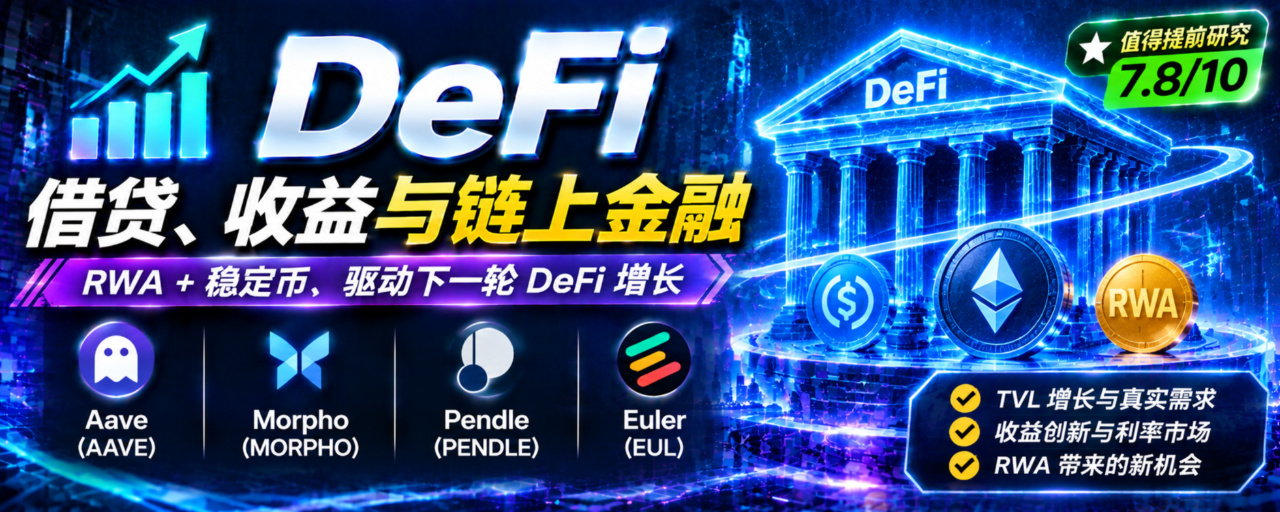
Overall, I’d rate the DeFi sector 7.8 out of 10. The core reason: the business models have been proven, but value capture for tokens remains weak across most projects. This isn’t a one-off bull-market narrative—it’s foundational infrastructure for crypto finance. Aave is a blue-chip cornerstone; watch V4 and RWA adoption. Morpho is an under-the-radar contender in credit infrastructure; watch integrations with external platforms and its token mechanism. Pendle is a unique interest rate play, offering exposure to the on-chain fixed-income market. Euler is a modular lending experiment, best followed with a small position.
In DeFi’s next cycle, it won’t be about who offers the highest farming rewards or has the prettiest TVL figure. The real theme is genuine credit demand: stablecoins and RWAs flow on-chain, people borrow, people pay interest, protocols generate recurring revenue, and tokens share in the upside. That’s also the most important yardstick we’ll use to track these projects going forward.
A friendly reminder: This is only my personal take on the industry and does not constitute investment advice.
If you’re interested in trading too, feel free to leave a comment or join the chatroom to discuss, learn, and grow together.
