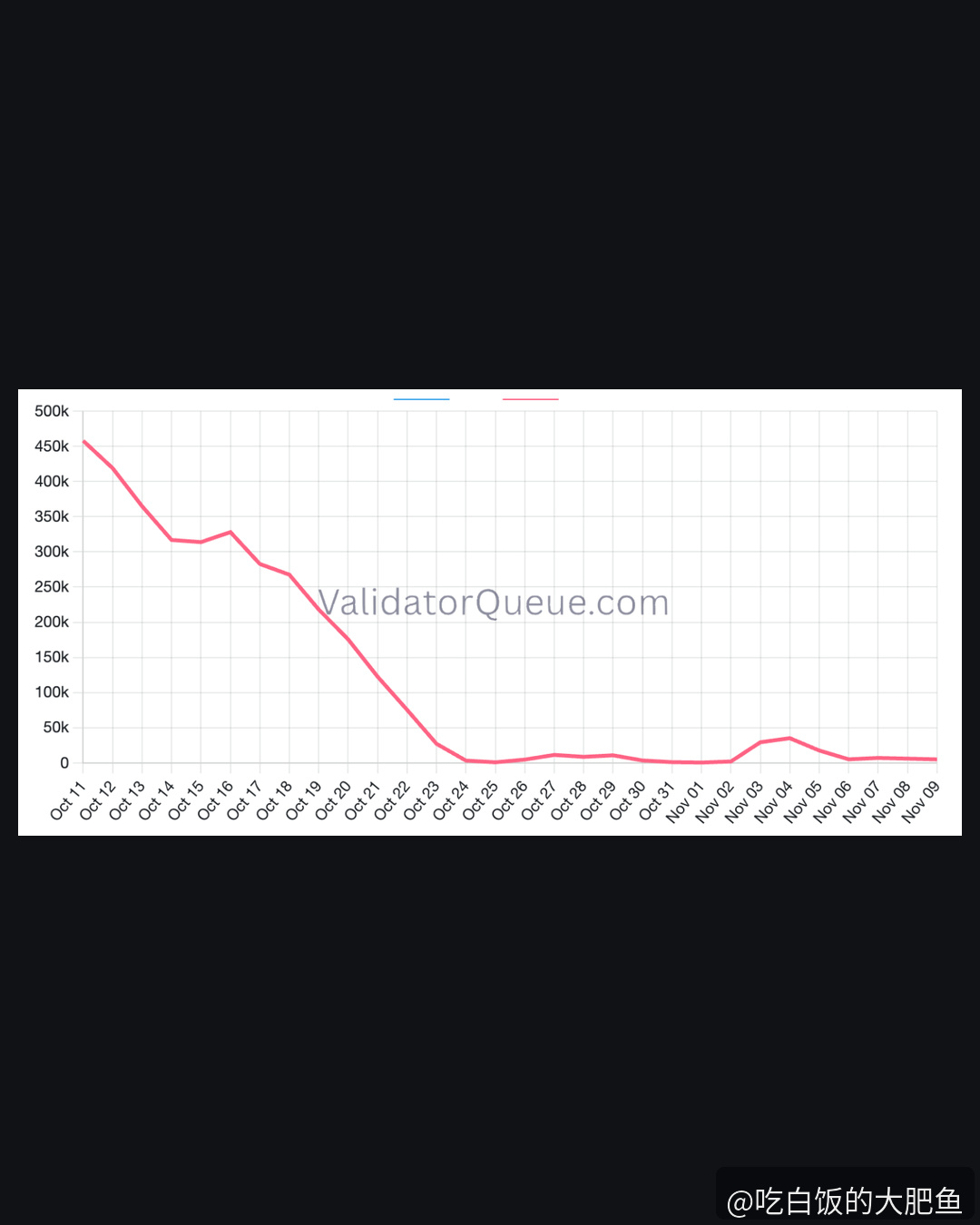
ETH has pulled back about 20% from its high this cycle, yet stakers are getting less likely to leave as prices fall—the queue of people waiting to exit has shrunk by 99%.
$ETH briefly slid toward $2,000 on Tuesday and is now around $2,060. On-chain data tells the opposite story: ETH waiting to exit staking stood at 457,800 on October 11, but by November 9, that figure had fallen to just 5,061—down about 99%. It has since recovered to around 66,000, still 86% below the October peak.
Meanwhile, about 44.5 million ETH remains locked in staking across the network, accounting for 36.4% of the circulating supply, and that share is still rising.
There are also some sobering signs elsewhere: the queue of ETH waiting to enter staking has shrunk from over 4 million in February to around 910,000, suggesting new money is becoming more cautious. Spot ETH ETFs saw net outflows of $185 million on November 9 alone. Among large holders, there were over 630 large stETH trades worth more than $100,000 each in early November—the most active stretch since April—and leverage from borrowing ETH against stETH is building up too.
This whale’s take: stakers aren’t rushing for the exits, suggesting long-term holders haven’t panicked and that staking-related selling pressure isn’t driving the market for now. But “nobody’s selling” alone can’t sustain a rebound. ETFs are still seeing outflows, and new money isn’t rushing in. Whether the key $2,000 level holds depends on whether buyers return. To the upside, reclaiming $2,200 would be a sign of relief; to the downside, if $2,000 breaks, leveraged positions backed by borrowed ETH will be the first to wobble. Dinner can wait—this game is about patience, not nerve.