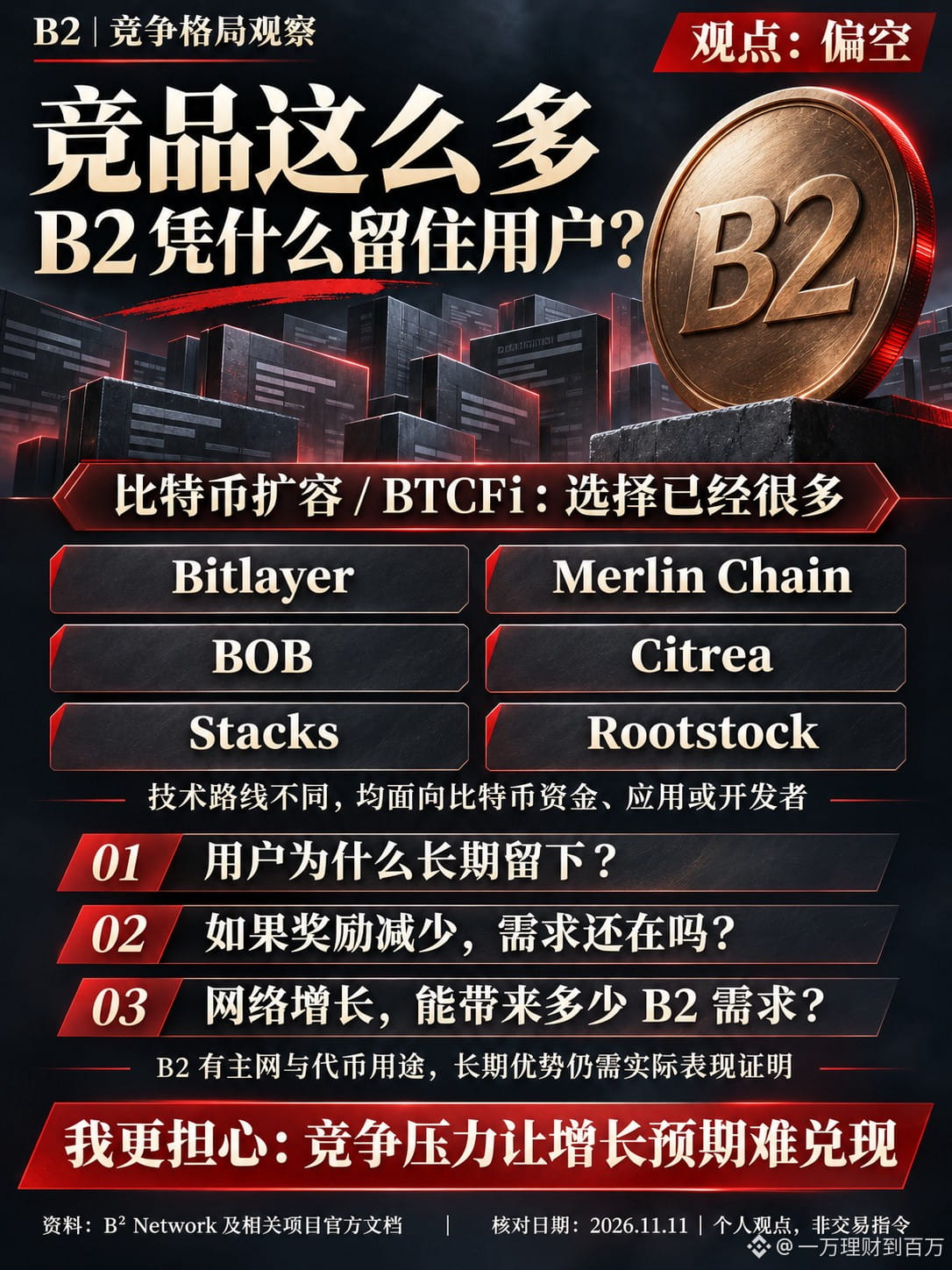
$B2 There are plenty of competitors, so why should users choose you?
I’m bearish on B2’s growth prospects, and competition is my biggest concern.
There are already plenty of options in the Bitcoin scaling and BTCFi space:
Bitlayer, Merlin Chain, BOB, Citrea, Stacks, and Rootstock.
These projects follow different technical approaches, but in terms of product direction, they’re all vying for capital, developers, and applications in the Bitcoin ecosystem. B2 is up against competitors that are already building products and ecosystems.
① With so many competitors, B2 needs to offer concrete advantages.
Why would users put their BTC here? Why would developers prioritize building applications here? If users can already trade, borrow, lend, and deploy contracts elsewhere, what more compelling experience can B2 offer?
Security, fund deposits and withdrawals, liquidity depth, fees, and application quality all need to be compared. The “Bitcoin Layer 2” label alone isn’t enough to make me bullish.
② After attracting capital, B2 still needs to prove it can keep it.
B2’s official tokenomics include liquidity incentives and early-stage TVL mining. Rewards can attract participants, but what I care more about is this: once the rewards decrease, how many users will stick around and continue using the platform and paying fees?
In a market with plenty of options, if users are mainly following rewards, the platform may need to keep spending on incentives. Customer acquisition costs, user retention, and real revenue are the metrics that will ultimately determine who wins the competition.
③ The network’s growth also needs to translate into sustained demand for B2.
B2 has use cases including Hub fees, staking, and governance. My question is: how much demand can these use cases generate, and for how long?
How many users genuinely need to use it? How many applications can generate transactions and fees over the long term? Can this demand keep growing amid competition?
B² is also expanding into AI and stablecoin settlement, but these new directions will likewise need to prove their competitiveness through real adoption.
What worries me most right now is that the market has priced in growth expectations, while fierce competition makes them harder to deliver.
If B2 can consistently demonstrate stronger user retention, real growth in fees, and compelling applications, I’ll reassess. Until then, I remain bearish on the idea that it deserves a higher valuation based on hype around the sector alone.
With competitors right there in front of them, B2 needs to give users a reason to choose it for the long term.