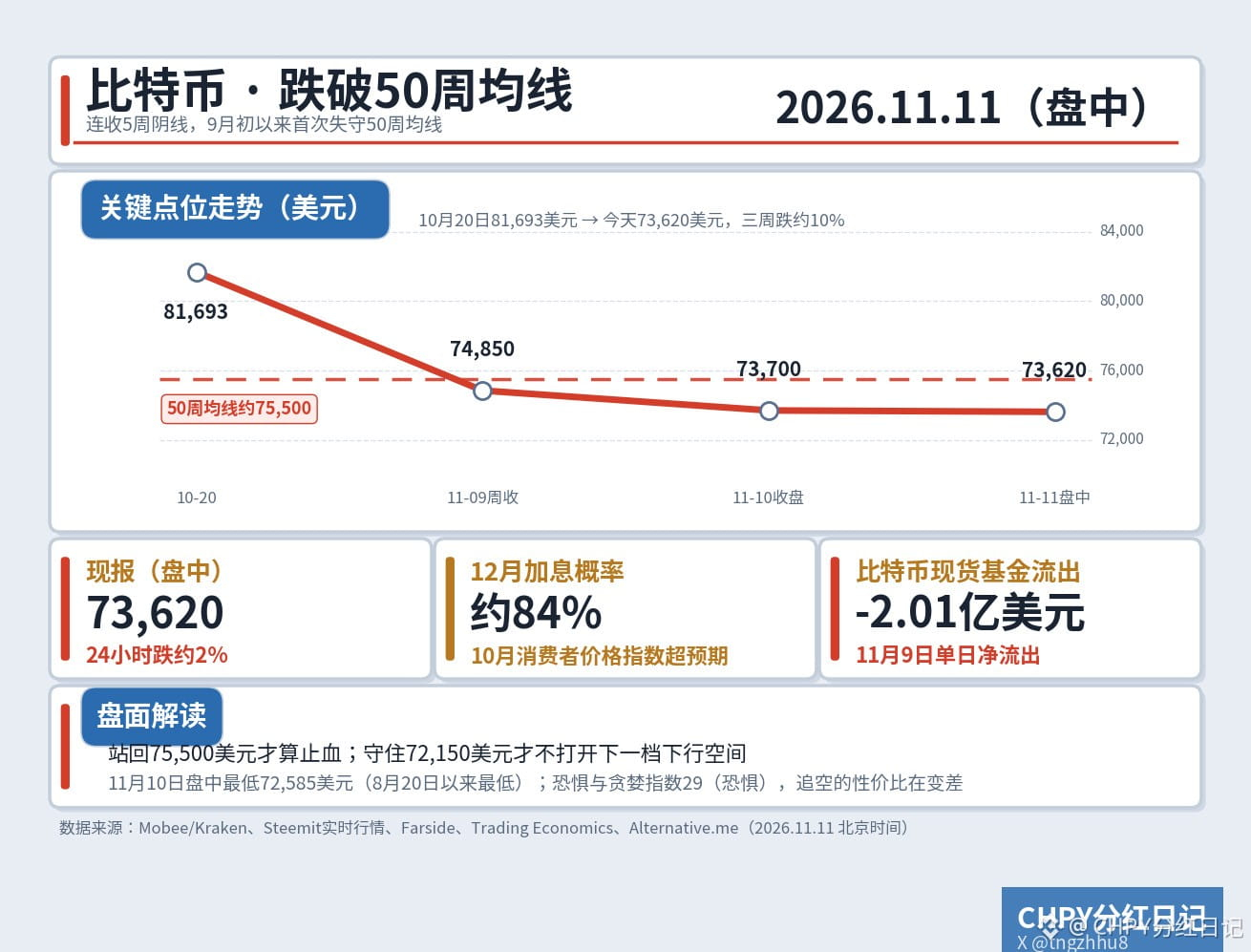
The trigger for Bitcoin’s latest drop was the U.S. Consumer Price Index for October.
The U.S. CPI rose 0.4% month over month in October, above expectations of 0.3%; core CPI rose 0.3%, also above expectations of 0.2%. After the data came out, market bets on a Fed rate hike in December climbed to about 84%, and the yield on 10-year U.S. Treasuries returned to 4.99%.
The chain reaction is straightforward: hotter-than-expected inflation → rising rate-hike expectations → a stronger dollar and higher Treasury yields → pressure on risk assets. Bitcoin briefly fell to $72,585 on Tuesday, its lowest level since August 20, and closed near $73,700. It is still hovering around $73,600 intraday today.
The technical picture is more concerning: Bitcoin has now closed lower for five straight weeks, with the weekly close near $74,850—below the 50-week moving average (around $75,500) for the first time since early September. The 50-week moving average is a dividing line between the medium- and long-term bulls and bears. Until Bitcoin gets back above it, any rebound should be viewed as an oversold recovery.
Money is also flowing out: spot Bitcoin ETFs saw net outflows of $201 million on Monday, with BlackRock’s IBIT alone shedding $213.2 million. Since November began, BlackRock’s crypto portfolio has shrunk by $4.77 billion.
But don’t jump to conclusions: the Crypto Fear & Greed Index has fallen to 29, in fear territory, signaling bearish market sentiment. That makes chasing the decline less attractive at these levels. U.S. bond markets are closed today for Veterans Day, leaving one fewer pricing anchor and potentially amplifying volatility.
Keep an eye on two levels: a move back above $75,500 would signal that the bleeding has stopped; holding $72,150 would keep the next leg down from opening up. Friday’s October Producer Price Index is the next data point to watch.
$BTC #Bitcoin