


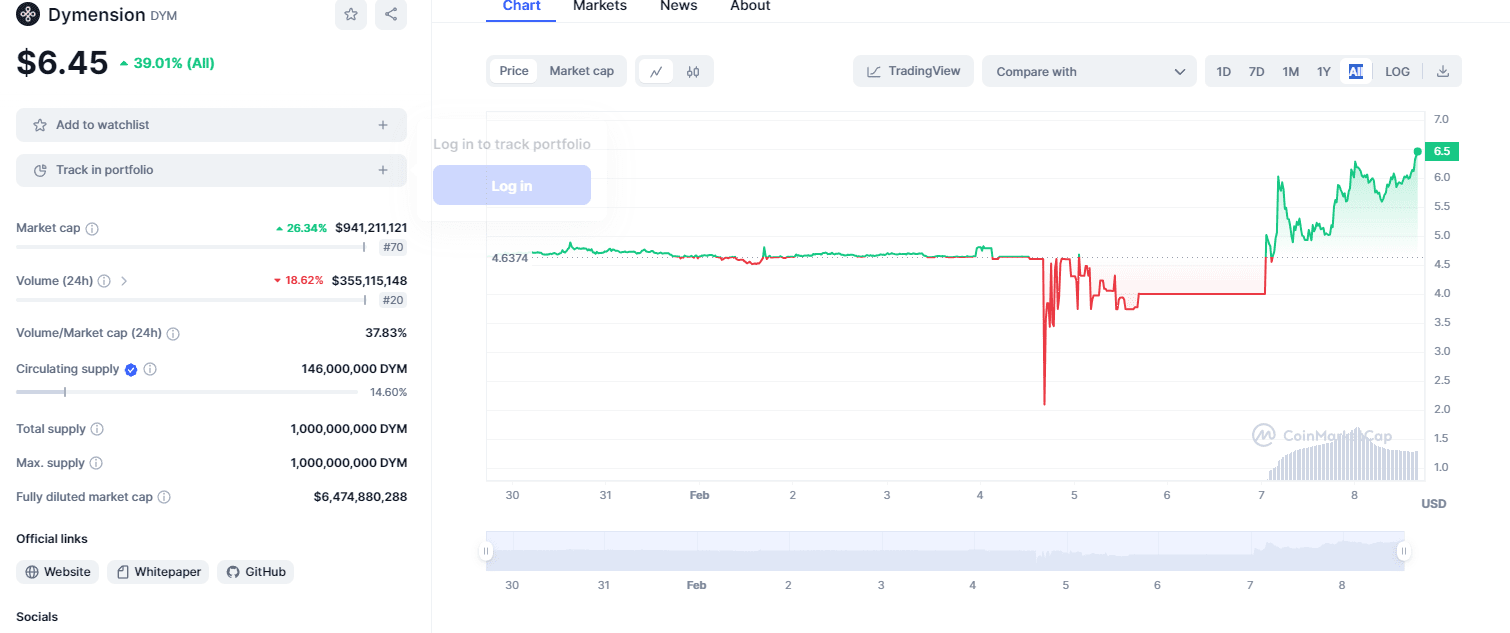
Today we will start the last issue of the year and talk about a recently launched modular public chain DYM. We have talked about a TIA before. What we didn’t expect at the time was that the capital market would be so popular. Because it is a new modular narrative, there is room for speculation. So today’s project is also a modular public chain based on COSMOS. Can it replicate the trend of TIA? The current price on the shelves is about 5 US dollars, and it has entered the top 100 in one breath. The current market value is 900 million US dollars, and the FDV is 6 billion US dollars. TIA’s current FDV is 20 billion US dollars, so there is still a 3-4 times gap. Let’s take a look at it. Is there any chance.
Introduction
What is Dymension?
Dymension is a modular blockchain network designed to ensure RollApp security and interoperability using the Inter-Blockchain Communication (IBC) standard. Dymension uses Data Availability Networks to enhance data processing capabilities.
As part of the Cosmos ecosystem, this modular settlement layer provides the ability to enable Enshined Rollups (the Rollup logic incorporated into the protocol), which opens up decentralized use cases.
Dymension is a sovereign Rollup built on Cosmos, aiming to make the development of RollApp (RollApp with a focus on custom applications) through Dymension Chain (settlement layer), RDK (RollApp Development Kit) and IRC (Inter-Rollup Communication) Simple.
Dymension is optimized for maintaining rollup status, verification and fraud proof, while only accepting rollup transactions and basic transfers.
On Dymension, developers can focus on business logic needs and quickly deploy application-specific rollups using the RDK and specialized billing layer, while benefiting from IRC, shared security and data availability.
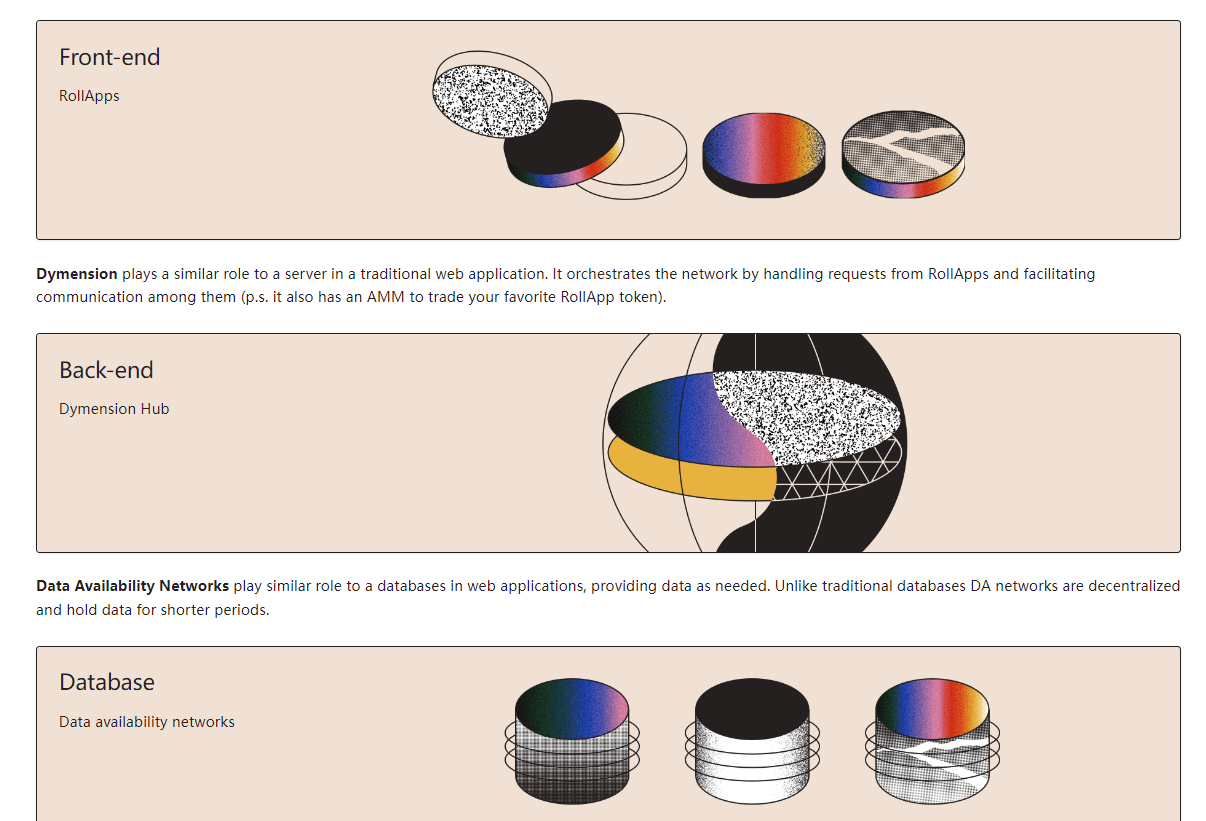
The current blockchain, as a shared bandwidth system, hinders the growth of decentralized applications. Dymension decouples resource consumption by introducing a multi-layered blockchain protocol and providing powerful tools for building and deploying permissionless application-specific rollups. Dymension is like a hub and factory for these applications, called RollApps.
Feature introduction
1.RollApp Development Kit(RDK)
In Dymension, a RollApp instance is a Rollup of a specific application, built using the Dymension RollApp Development Kit (called RDK). The SDK is a set of prepackaged, generic modules for common functions such as account creation and token management. RDK simplifies the process of deploying RollApp on Dymension Hub.
2.Dymension Hub
A Cosmos SDK proof-of-stake chain using the Tendermint Core state replication model for networking and consensus. As opposed to a single blockchain, Dymension’s settlement layer, also known as Dymension Hub, is specifically designed to provide optimized services for Rollups. Therefore, the Rollup service logic is embedded in the settlement layer, forming the center of native interoperability between RollApps.
3.Inter-Blockchain Communication(IBC)
RollApps interact natively with the Inter-Blockchain Communication (IBC) protocol, which provides the secure transmission of messages between Dymension RollApps. RollApps utilize the common communication foundation for all Dymension RollApps, the Dymension Hub.
4.RollApp Virtual Machine(RVM)
Dymension introduces a novel dispute resolution mechanism that simulates the RollApp execution environment within Dymension Hub. Dymension Hub launches an RVM instance that is fed the exact context of a given transaction, producing deterministic output. Therefore, Dymension is able to support various execution environments.
5.Embedded Hub AMM
Dymension embeds a native Automated Market Maker (AMM) within Dymension Hub to enable shared liquidity based on shared security. AMM is specially designed for RollApp convenience and is considered as the infrastructure of RollApps. The embedded AMM is the only application logic on the Dymension Hub that is not limited to use by RollApp.
system structure
dYmension adopts a modular blockchain architecture design to decouple the different functions of a "single" blockchain to achieve higher performance, efficiency and scalability. The monolithic blockchain is responsible for handling transaction execution, state settlement, data processing, and reaching consensus on the chain's canonical history.
In dYmension, each application is its own execution environment, and dYmension Hub is the settlement layer. In a modular future, there will be various data availability providers; therefore, dYmension is designed to be data availability agnostic, allowing RollApps to easily select a data availability provider based on security and cost considerations.
In dYmension, hierarchical specialization is decoupled as follows:
• Execution layer: processing transactions
• Settlement layer: dispute resolution, state root maintenance, connecting different environments
• Data availability layer: ensures all data is available after release
1.Execution layer
The application deployed on dYmension is an autonomous execution environment called RollApp. RollApps have their own autonomy, meaning they retain the advantages of building their own blockchain, such as having their own native network fee token, fully flexible application logic, and minimal interaction with other RollApps and IBC-enabled blockchains. Trust interoperability. Nonetheless, autonomy is not interchangeable with sovereignty. The differences between the two are rooted in security sources. A sovereign chain relies on and subsidizes its own security, and autonomous instances inherently inherit this security.
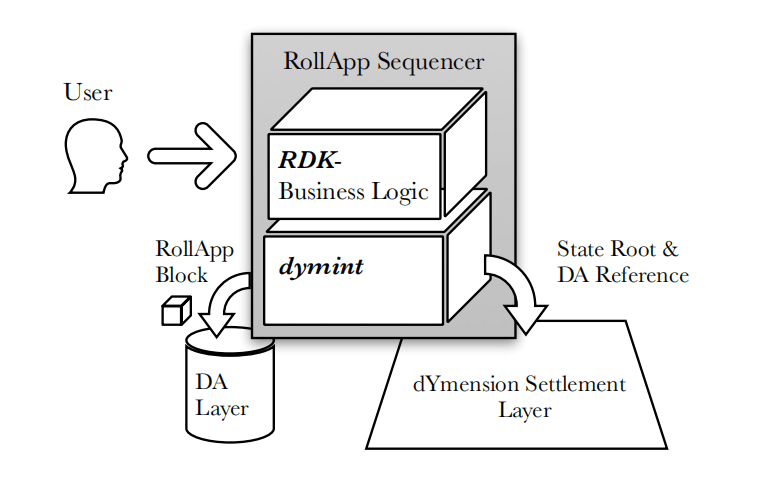
dYmension RollApps exist as their own sharded execution environment, where Sequencers process transactions off-chain. A RollApp can be operated by a single Sequencer or a group of Sequencers that take turns calculating transactions. As its name suggests, RollApps are derived from rollups and are designed to reduce latency and computational costs. Rollups process transactions off-chain and then publish transaction data and updated state roots on-chain. The publication of data and state roots guarantees that any actor, whether motivated by distrust or financial incentives, can independently verify that the RollApp Sequencer performs authentic computations and honest state transitions.
2. Settlement layer
dYmension’s settlement layer was built from the ground up to support RollApps with the highest security, liquidity, and seamless interconnectivity. The settlement layer maintains a registry of deployed RollApps, along with corresponding key information such as status, sequencer list, currently active sequencers, execution module checksums, etc. This enables the settlement layer to provide first-class services to RollApps.
3. Data availability layer
The dYmension protocol pursues robustness by effectively dividing responsibilities. The modular design focuses on offloading data bottlenecks to provide a highly scalable and resource-separated system. The DA layer enables any participating party to verify that calculations on published data produce the same state transitions specified by the sequencer. dYmension RollApps feature a common interface for integrating various data availability (DA) providers based on security and cost preferences. In dYmension’s protocol, a checkpoint is defined as a block batch published to the DA layer and the corresponding state root to the settlement layer. It is critical to have available and uncorruptible data after a checkpoint, as corrupted data can cause inconsistent state between RollApp nodes. We note that reliance on a specific DA solution has a significant impact and should be considered an important consideration when deploying RollApp.
Token economy
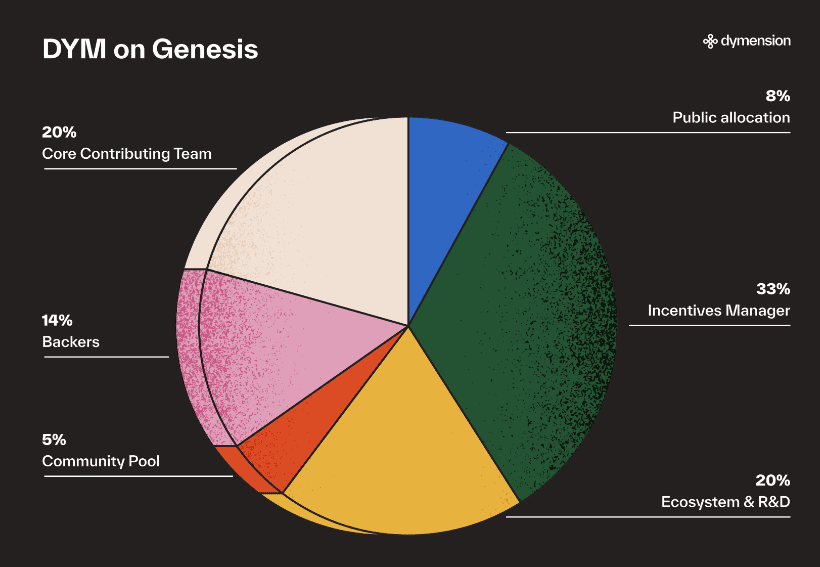
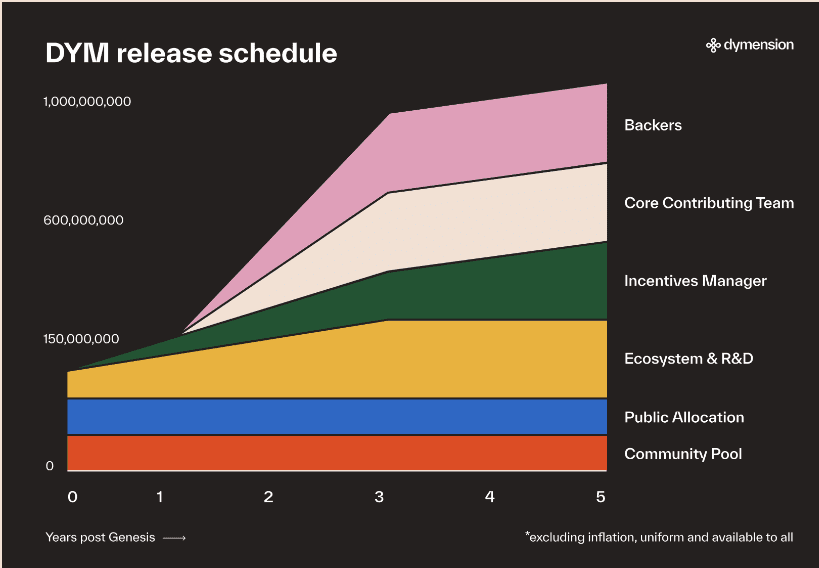
The total number of tokens is 1,000,000,000, of which 146,000,000 are currently in circulation, with a circulation rate of 14.6%. The current currency price is US$6.4. As can be seen from the token distribution, 20% are core contributors, 33% are incentive management, 20% are ecological research and development, and 14% are reserves. %, public allocation (airdrop) 8%.
Finally, we can summarize this project. It is currently a modular public chain and is also built on Cosmos. It is definitely stronger than TIA in terms of technical features because it has RDK, which makes it easy for developers to create applications on it. For this point, you can refer to the Cosmos SDK. We have talked about many projects that are built based on the Cosmos SDK. And it has just been launched. Currently, compared with the benchmark TIA, the market value is much smaller than TIA, and technically it is stronger than TIA, because the total number of tokens is actually the same as TIA, so it will copy TIA. Trend, all the way to 20? We will wait and see. Finally, I wish you all a happy New Year and great fortune in the New Year. #DYM #内容挖矿