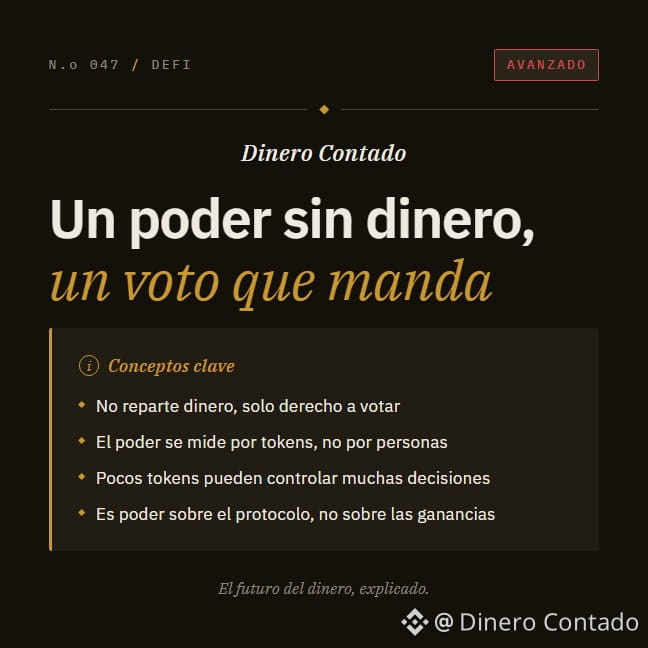
A governance token doesn’t pay you anything: it gives you a vote.
A DAO has no boss. It has rules written into a smart contract, and those rules decide who can propose a change and who can approve it. Participation isn’t measured by person; it’s measured by the number of tokens in a wallet. Imagine a DAO with one million governance tokens in circulation. The rule says a proposal needs a quorum of four percent—that is, forty thousand tokens voting. If only forty-five thousand tokens participate in total, and a single wallet controls twenty-three thousand of them, that wallet already has a majority in the vote. It controls just 2.3 percent of all tokens issued, but it decides the entire outcome. That’s how simple it is. That’s how harsh it is.
That’s what they call a governance token: a token that doesn’t distribute profits, but rather grants shares of power to make decisions about the protocol.
KEY CONCEPTS
- Holding a governance token doesn’t guarantee income or profit distributions: it only gives you the ability to vote on changes to the protocol.
- A governance token is not the same as a utility token or a security token: each follows a different logic and different rules.
- Voting power in a DAO is measured by the tokens in a wallet, not by the number of people: whoever holds more tokens has more decision-making power.
Buying a governance token is more like buying a share that gives you voting rights at a shareholders’ meeting than buying a ticket with a promise of payment. The power is there. The profits, not necessarily.
Transparency: Binance may pay us a commission if you trade after clicking an asset symbol or a price link in this post.
#Gobernanza #DAO #TokenDeGobernanza #DecentralizedFinance