
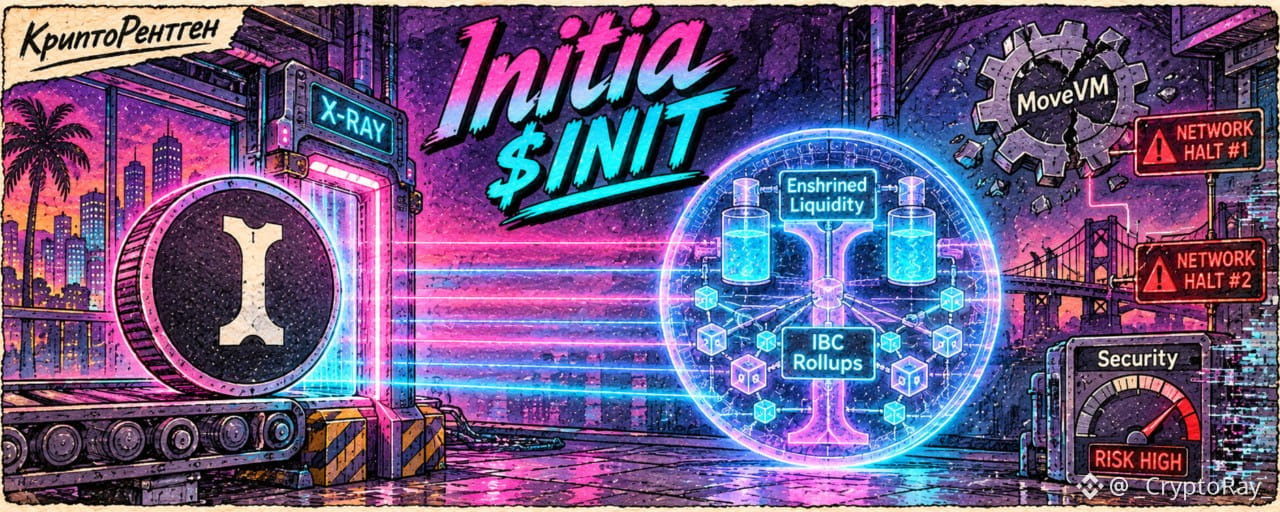
Initia - an L1 on the Cosmos SDK with the idea of an Interwoven Economy: one base layer and a set of rollup networks connected by shared liquidity. $INIT - the native L1 token.
The main conflict: the architecture is interesting, but security failed twice. On October 23, the network was halted after an exploit; on November 10, after unauthorized transfers from escrow accounts. During the second halt, the price rose, and the reason for the rise has not been proven.
A guide for those studying infrastructure L1s who want to understand exactly where a project’s weak points are.
Technology
Interwoven Rollups. Rollup networks are built on the Interwoven Stack, while the L1 remains a shared settlement layer. Networks connect through IBC.
Enshrined Liquidity. This is not literally a replacement for PoS. Liquidity positions can be used as staking assets for validators. The same capital secures the L1 and participates in revenue and VIP incentives.
In practice, capital serves two roles, but the attack surface is also broader: VM, bridges, IBC, and rollup infrastructure keys. Both incidents targeted precisely these areas.
Tokenomics
Max supply: 1 billion INIT, fixed.
Circulating supply: about 219 million (~21.9%) according to aggregators.
Enshrined Liquidity & Staking: 250 million (25%).
VIP Rewards: 250 million (25%).
Protocol Developers: 150 million (15%).
Investors: 152.5 million (15.25%).
Foundation: 7.75%.
Listing campaign: 6%, Airdrop: 5%, Echo.xyz Sale: 1%.
Emissions. Enshrined Liquidity releases 5% of the pool per year, or 12.5 million INIT. That’s about 5.7% of the current circulating supply. VIP Rewards are distributed over 26 two-week stages as esINIT, tied to KPIs. Some sources cite an initial rate of about 7% of the pool per year (up to 17.5 million). Adding the base rates gives up to ~30 million INIT per year, about 13.7% of the circulating supply. This is a distribution of tokens reserved in advance, not inflation beyond the max supply. The claim of “10–12% emissions per year” doesn’t align with this logic.
Vesting. The TGE took place on April 24, 2025. Developers and Investors had a 12-month cliff, followed by 25% and then a linear release of 75% over 36 months. The cliff has already ended, and linear vesting is underway.
Next unlock: November 24, approximately 8.8 million INIT (0.9% of the max supply, ~2.6% of market cap according to the tracker’s methodology).
No burn mechanism is described in the documentation.
Investors
The investor allocation is 152.5 million INIT (15.25%) through Protocol Sales. The public sale on Echo.xyz was 10 million INIT (1%). The listing campaign and airdrop (11% combined) were fully unlocked at TGE, so these tokens have been on the market from the start.
On-chain activity
Price: $0.17–$0.23, depending on the source and time.
Market cap: about $41–51 million, with an FDV of around $170–230 million.
24-hour volume: about $52–99 million. Trading volume exceeds market cap.
ATH: $1.44. ATL: about $0.047. The price is roughly 85% below its ATH.
Trading volume exceeding market cap means most trading is being done by short-term participants.
The inside story
Facts
October 23. A MoveVM script-caching exploit bypassed checks and created unbacked WETH, iUSD, and USDC balances. About $2.7 million was withdrawn through bridges ($2.73 million according to Bitquery). The assets were converted into 1,135.52 ETH. No native INIT was created. The network resumed operations on November 2 after a patch.
November 10, 06:18 UTC. The L1 was halted as a protective measure following unauthorized escrow transfers.
Preliminary damage: Initia estimates ~$615,000; CertiK estimates ~$636,000 across 16 transactions. Breakdown: $605,000 in USDC through Noble and about $10,000 in other tokens.
Proposed mechanism: compromise of rollup infrastructure keys and forged IBC transfers. This is still speculation.
Price: INIT rose to $0.234 while the network was halted. CoinGecko reported a gain of more than 60% in 24 hours.
Rumors and insider information
“The rally is a short squeeze or a bet on a rapid recovery.” Unconfirmed; the cause of the rise has not been established.
“Users will be compensated for their losses.” Unconfirmed; there is no official decision.
Strengths
Enshrined Liquidity. Liquidity and L1 security in a single mechanism.
The network needs the token for gas, staking, governance, and participation in Enshrined Liquidity.
Fixed max supply of 1 billion.
Response time: the October incident was resolved with a patch in 10 days, while in the second case the network was halted immediately as a protective measure.
No native INIT was issued during the October exploit, and the total supply was unaffected.
Weaknesses
Two halts in three weeks. A serious blow to confidence in the infrastructure.
Different attack vectors: a VM vulnerability in the first case, keys and IBC in the second. The problem goes beyond a single bug.
The damage estimate is preliminary. The final amount, recovery, and compensation have not been determined.
There is no revenue share or fee burn for holders.
Ongoing distributions: staking, VIP, linear vesting, plus the November 24 unlock.
Small market cap and trading volume above 100%. The price depends on short-term flows.
Sources
docs.initia.xyz/home/core-concepts/init-token/tokenomics
crypto.news/initia-blockchain-halt-615k-exploit-init-price/
app.tokenomics.com/tokenomics/initia/unlocks
