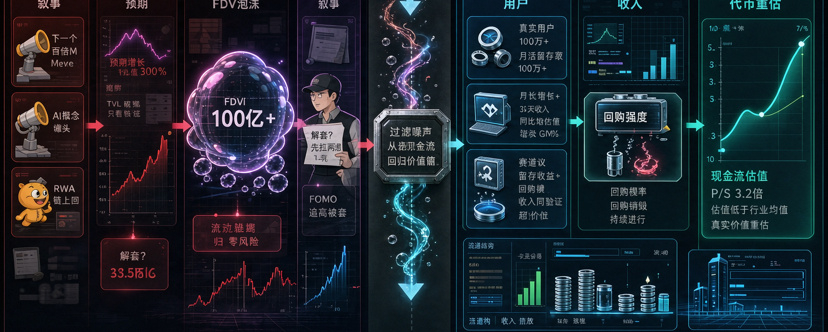

Since 2025, the crypto industry has been undergoing a fundamental shift: from "narrative valuation" to "cash flow valuation." Stablecoins, RWA, perpetual DEXs, on-chain lending, AI computing power, and prediction markets are no longer just conceptual tracks, but are beginning to generate real revenue and real users. This article, based on the latest market conditions in November 2026, analyzes eight major industry trends, five coin selection criteria, and provides an actionable strategy for early-stage investment and risk control.
I. Where is the market currently located?
Before talking about 10x coins, let's first look at the current market sentiment.
As of November 10, 2026, Bitcoin fluctuated below $75,000, briefly dipping into the $73,200-$75,000 range; Ethereum fell back to around $2,120, and SOL dropped back to around $86. The Fear & Greed Index dropped to 28, placing it in the "fear" zone. The US spot Bitcoin ETF experienced net outflows for two consecutive weeks, with approximately $1.28 billion withdrawn in a single week, and the cumulative net inflow for 2026 has already turned negative.
The macro environment is equally challenging: the US October non-farm payrolls exceeded expectations, and the market has priced in a December rate hike to over 70%; regulatory uncertainty has returned after the midterm elections, and AI technology stocks and crypto assets are deleveraging in tandem, with over $1.2 billion in margin calls occurring within 24 hours.
what does that mean?
We are not currently in the "bull market peak" or the absolute bottom of a bear market, but rather in a high-volatility, sentiment-clearing, and capital-driven asset re-selection phase.
This stage is the least suitable for going all-in; it's best to do three things:
• Clear out narrative assets;
• Reduce the observation pool to projects that generate revenue;
• Use phased buying instead of bottom fishing, and use stop-loss instead of faith.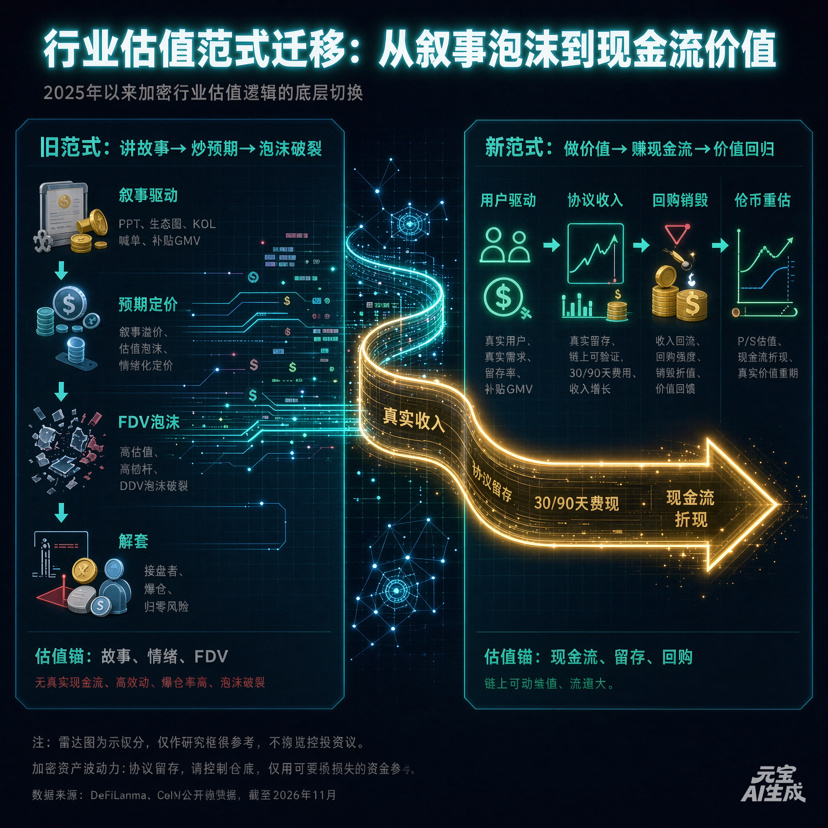
II. Underlying Changes in the Industry: From "Speculating on Expectations" to "Speculating on Cash Flow"
In the past two cycles, the market was willing to pay a premium for PowerPoint presentations, ecosystem diagrams, and KOL endorsements. After 2025, this logic began to collapse.
One of the most intuitive data points is that among tokens that have implemented or announced value return mechanisms, HYPE, PUMP, and others have outperformed BTC this year. The core reason is not that the concept is new, but that protocol revenue flows directly back to the tokens.
Eight real changes are happening in the industry:
1. Stablecoins: From medium of exchange to financial infrastructure
The total market capitalization of stablecoins is approximately $281.6 billion, with USDT+USDC still accounting for over 87%. However, the focus is not on scale, but on "spillover applications"—cross-border payments, on-chain wages, RWA settlements, and AI Agent wallets.
Coinbase's acquisition of a U.S. national trust bank license means that stablecoin custody, issuance, and payments are beginning to be integrated into the federal regulatory system; Circle explicitly stated in its Q3 earnings call that it would develop USDC, Arc, and CPN into an institutional-grade payment network.
2. RWA: Traditional finance moves its balance sheet onto the blockchain.
The tokenization of US Treasury bonds, private credit, gold, and stocks is accelerating.
• Excluding stablecoins, RWA's size is approximately $39.6 billion, with US Treasury bonds accounting for more than 35%;
• Coinbase Borrow uses PAXG as collateral to borrow USDC;
• Robinhood Chain integrates tokenized US stocks into the Morpho credit market.
RWA is not an "on-chain gimmick," but rather a move by traditional fixed income and equity firms to use blockchain as a clearing layer.
3. Perpetual DEX: The Crypto Sector Most Like a "Business"
Hyperliquid uses approximately 97%–99% of its contract fees to repurchase HYPE, with cumulative repurchases exceeding $1.3 billion; its protocol revenue ranked among the top three in the entire network over the past 30 days, second only to Tether and Circle.
Jupiter, Aerodrome, and Orca are also channeling transaction fees and aggregation revenue to the token side. The characteristics of this sector are:
• TVL is available;
• There is transaction volume;
• There is a handling fee;
• Income is verifiable.
4. AI Agent: From Chat Tools to On-Chain Economic Entities
The next step is not "AI writing copy," but rather AI owning wallets, autonomously purchasing computing power, data, and APIs, and making predictions and betting. The CPN and Agent settlement layer mentioned by Circle will turn USDC into "machine-to-machine USD."
5. Market Prediction
Political, sports, and macroeconomic events are being turned into tradable assets. It caters to the demand for traditional gambling and derivatives, with blurred regulatory boundaries but genuine user demand.
6. Decentralized AI computing power
Projects like AKT, ATH, and IO address the issues of GPU scarcity and inference costs. The logic is sound, but they are still in their early stages, and the quality of revenue is questionable.
7. On-chain lending returns to "credit pricing"
DeFi lending has shifted from "mining subsidies" to stablecoin lending, institutional credit, and RWA collateral. Aave earns 80% of its net profit with about half of the total TVL in the entire sector; Morpho uses tokenized assets as collateral and has begun to accept traditional assets for lending.
8. Buyback and Burn: From Marketing Phenomenon to Valuation Anchor
Uniswap activates the fee switch and destroys UNI; Aave initiates automatic buybacks; HYPE and PUMP programmatically buy tokens with their earnings.
However, note that buybacks are not a panacea. If the selling pressure from unlocked tokens exceeds the buying pressure from buybacks, the price will still fall. In 2025, the entire industry conducted over $1.4 billion in buybacks, yet many cryptocurrencies still declined. The problem lies in the "small and discontinuous scale of buybacks, and the continued expansion of the circulating supply."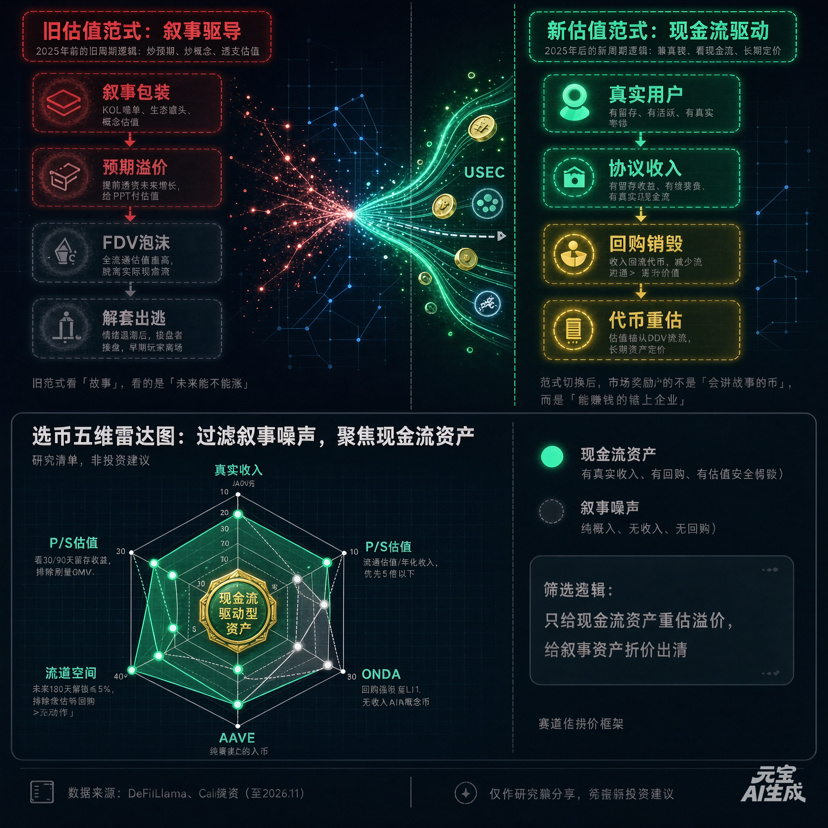
III. Where are the opportunities for tenfold growth? Not in specific sectors, but in the "filter."
If the next bull market arrives, it won't be a general rise in counterfeit goods, but rather a revaluation of cash flow assets.
I've divided the opportunity pool into five groups (this is just a research list, not a buy recommendation):
Perpetual DEX and Trading Layer
• HYPE: The highest revenue conversion rate, but whales at high levels face significant pressure to cash out.
• JUP: Solana trading portal, buyback in progress.
• AERO: The liquidity hub of the Base chain
• ORCA: Solana spot + aggregation
RWA and On-Chain Finance
• LINK: Oracle infrastructure, essential for RWA settlement
• ONDO: A Leader in US Treasury Tokenization
• HUMA, SPK: Payment and Credit Experimental Warehouse
AI computing power
• AKT, ATH, IO: The sectors are correct, but the revenue generated by nodes and the authenticity of demand need to be examined.
On-chain lending
• AAVE: Most stable cash flow + buybacks + market share
• MORPHO: Rapid innovation in collateral, clear institutionalization path
• KMNO: High elasticity but large volatility
Issuance platforms and new transaction ecosystems
• PUMP: Real revenue + buybacks, but dependent on meme cycles.
• FORM, STONK: Observe product retention without pre-setting valuation.
IV. I only look at five key indicators.
1. Real income, and income is growing.
This is not GMV after subsidies, nor is it transaction fees from inflated trading volume. Look at DeFiLlama-like data: protocol retention yield, 30-day/90-day fees, and revenue slope.
2. The P/S ratio is reasonable, preferably below 5 times.
A rough calculation can be made using the ratio of "market capitalization / annualized revenue".
• Less than 5 times: There is a safety margin
• 5-10 times: Wait for a pullback
• More than 10 times: Must be validated by high growth
3. Revenue truly flows back into tokens.
Buyback and burn > Just announcing the buyback > Just "considering future allocation".
4. Clean distribution structure
No large-sum unlocking expected in the next 180 days;
Circulation rate is higher than 40%;
The team/investors release information linearly and transparently.
5. The track has a demand of 3 years or more.
Stablecoin settlement, trading, lending, RWA, and AI payments are superior to purely conceptual memes and purely narrative L1.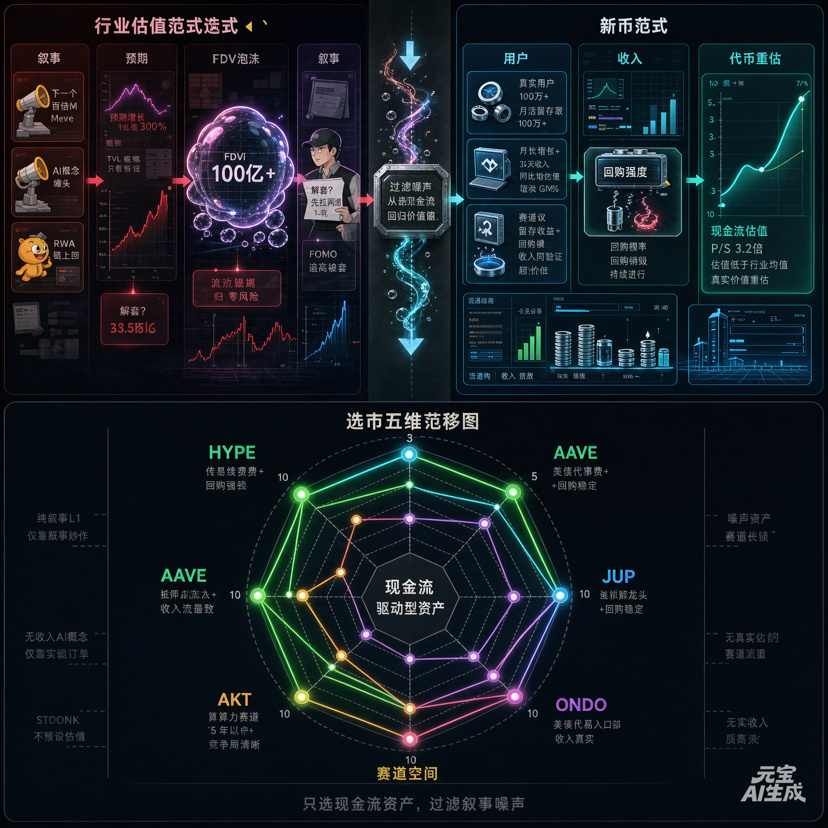
V. Trading Strategy: Replace the "Bottom-Fishing Illusion" with Position Management
Anyone who has experienced the temptation of the bottom knows that the real difficulty is not finding the coin, but holding onto it, avoiding liquidation, and not being shaken out.
1. Position stratification
• Core holdings (50%): BTC + ETH, as the underlying exposure
• Revenue Warehouse (30%): AAVE, HYPE, JUP, ONDO, LINK
• Flexible holdings (15%): MORPHO, AERO, ORCA, PUMP, IO
• Observation Position (5%): Early-stage targets such as STONK, ATH, and HUMA
2. Position Building Method
Instead of guessing the lowest point, divide the data into 3-4 segments:
• Create 1 entry in the current sentiment area
• BTC held above 74,000 and formed a large volume entry.
• Sector revenue data shows two consecutive months of growth, establishing one transaction.
• Breakout above key trendline to establish the final move
3. Stop-loss discipline
• Maximum drawdown stop loss for a single currency pair: 15%–20%
• Sector logic broken (continuous revenue decline/buyback suspension): Reduce holdings by half
• Unexpected interest rate hikes + continued ETF outflows: Total holdings not exceeding 60%
4. Selling points are based on sentiment, not valuation.
• People around me started recommending cryptocurrencies
• New project with zero revenue, valued at over 1 billion
• The repurchase program has begun to cease repurchase.
• Social media is full of "100x coins"
That wasn't about adding to your position; it was about exiting the market.
VI. Several common pitfalls
Pitfall 1: Mistaking "buyback" for "guaranteed price increase"
If the repurchase volume is less than the daily selling pressure, it's just psychological comfort.
Pitfall 2: Treating RWA as a sure thing
RWA is affected by US Treasury interest rates, compliance, and custodians, and is not a risk-free return.
Pitfall 3: Treating AI Coins as AI Businesses
Many "AI concepts" do not have real computing power orders; they have only accepted model APIs.
Pitfall 4: Ignoring the unlock calendar
Even the best projects will see a price drop once 20% of their circulating shares are unlocked next week.
Pitfall 5: Using a bull market mindset to trade on the left side
What we need now is survival rate and win rate, not leveraged all-in betting.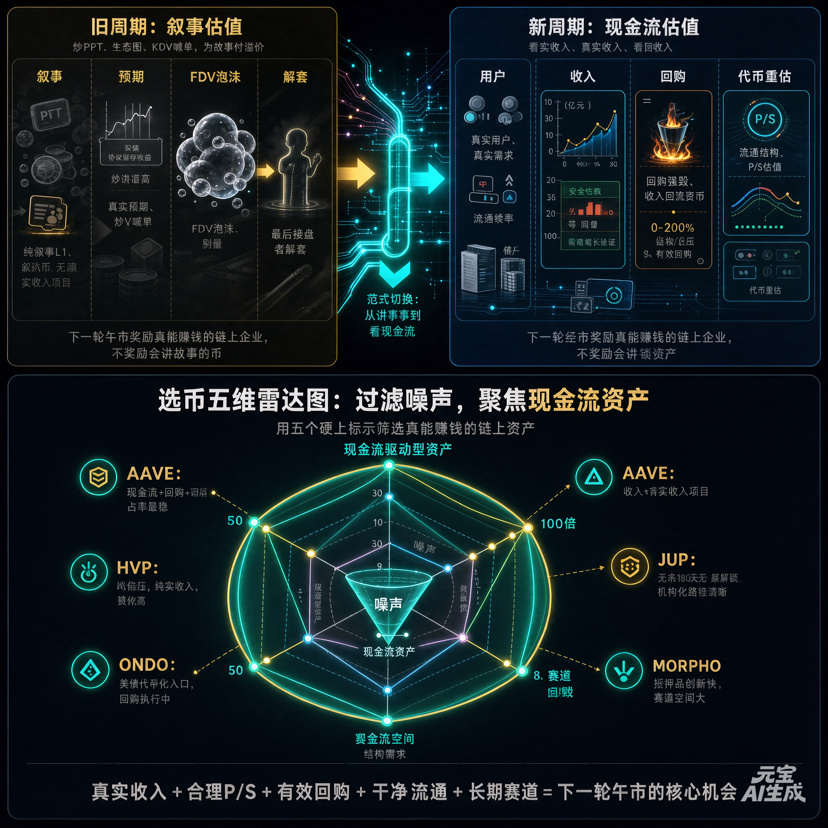
VII. Conclusion: What kind of money will be made in the next round?
In the past, we made money from narratives that others hadn't discovered.
The future lies in making money from "cash flow that others haven't understood".
In the next bull market, the stocks that will truly rise 5-10 times won't be the ones that shout the loudest, but rather:
• A DEX that generates millions of dollars in transaction fees daily, yet has not been fully priced in by public offerings;
• An RWA agreement that compliantly distributes U.S. Treasury yields to holders;
• A settlement network that allows AI agents to make payments autonomously;
• A DeFi pool that keeps its lending default rate even more stable than traditional banks.
An investment framework can be very simple:
Leave in batches when panic approaches, and in batches when madness approaches.
Use income to find assets, and use emotions to find selling points;
We don't gamble on taking over assets; we gamble on value creation. #CPI前瞻,12月利率走向迎关键考验 #Anthropic拒绝延期IPO,本周路演估值几何? #黄仁勋因婚外情致歉,英伟达启动独立调查 #英伟达Q3财报将至:能否化解市场疑虑? #美伊和谈提振市场,美股强势反弹 $MEME