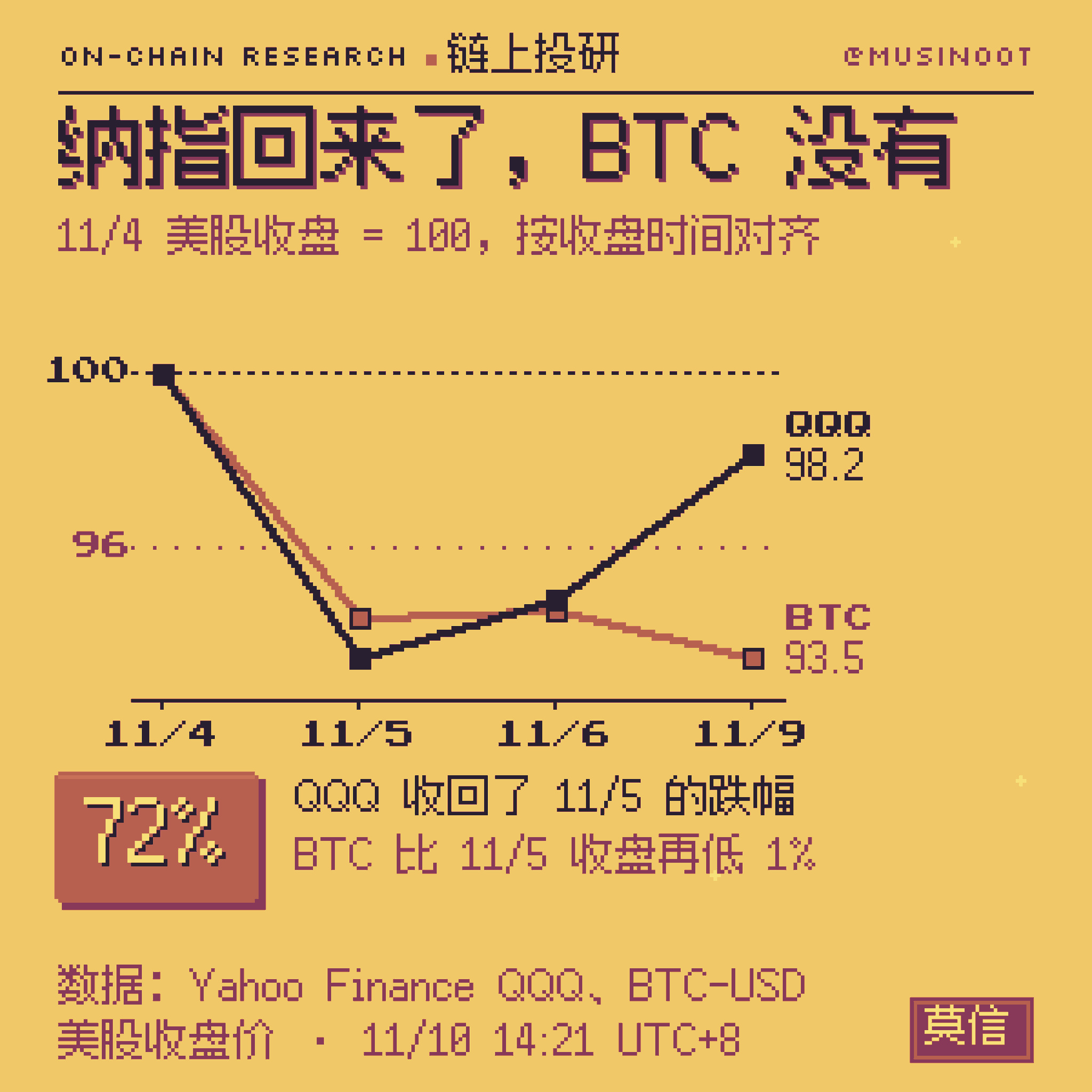
On November 5, the day U.S. stocks plunged, the Nasdaq and $BTC fell together.
Two trading days later, the Nasdaq 100 ETF (QQQ) had already recovered 70% of that day's losses. Bitcoin was still hovering around $74,000, a little lower than its closing price on November 5. In the early hours of yesterday, it briefly fell to just above $73,000.
The mood on Chinese-language Twitter these past few days has probably been one of feeling left behind.
Some people couldn't hold back: Gold, futures, even broad-based A-share indexes—and even some large-cap U.S. stocks—have all done far better than Bitcoin. Why keep watching crypto? Others said many of their friends were in a lot of pain, as if the future had suddenly turned bleak: the AI bubble was about to burst, altcoin narratives were doomed, and nobody was interested in Memes anymore.
Attention is also shifting elsewhere. Anthropic is about to go public, and some are already reminding people to keep their eyes on Anthropic over the next couple of weeks.
There are also calmer voices. @Murphychen888 looked at on-chain data: on November 5, the amount of Bitcoin moved to exchanges at a loss by long-term holders was higher than at any point in the past year except in February and June. Even the most resilient holders have started selling. But he also said this often means panic selling is accelerating and being flushed out. Short-term holders' average cost is between $75,000 and $76,000, and the current price is right around their break-even point, so most are choosing to hold and wait.
I think what everyone is waiting for now is Bitcoin to catch up.
My guess is that U.S. stocks recovered so quickly because people believe that day's plunge was just a fluke. Bitcoin is waiting for the same kind of belief: after the Binance incident on October 30 and the plunge on November 5, the two blows have landed back to back—and there won't be a third.
That kind of belief won't appear on its own; it needs a catalyst. Murphy's take is that people will gradually realize the actual situation may not be as bad as expected.
Until then, the $75,000 mark will be crucial. If the price holds above it, those who just got in will still be willing to hold. If it falls below, those waiting on the sidelines may turn into sellers.
Do you hold more Bitcoin or more U.S. stocks right now?
——
Originally published on X by @musinoot