
Why do so many wealthy people seem to have no particular talents, yet still make a fortune?
You meet some big-shot business owners, and after chatting with them, you realize they can’t even make a spreadsheet, don’t speak logically, and don’t understand professional jargon.
Yet they’re worth hundreds of millions, while you can do everything and are still stuck earning a fixed salary.
Today, let’s take a look at what these clueless rich people actually got right, from the perspectives of economics, psychology, and history.
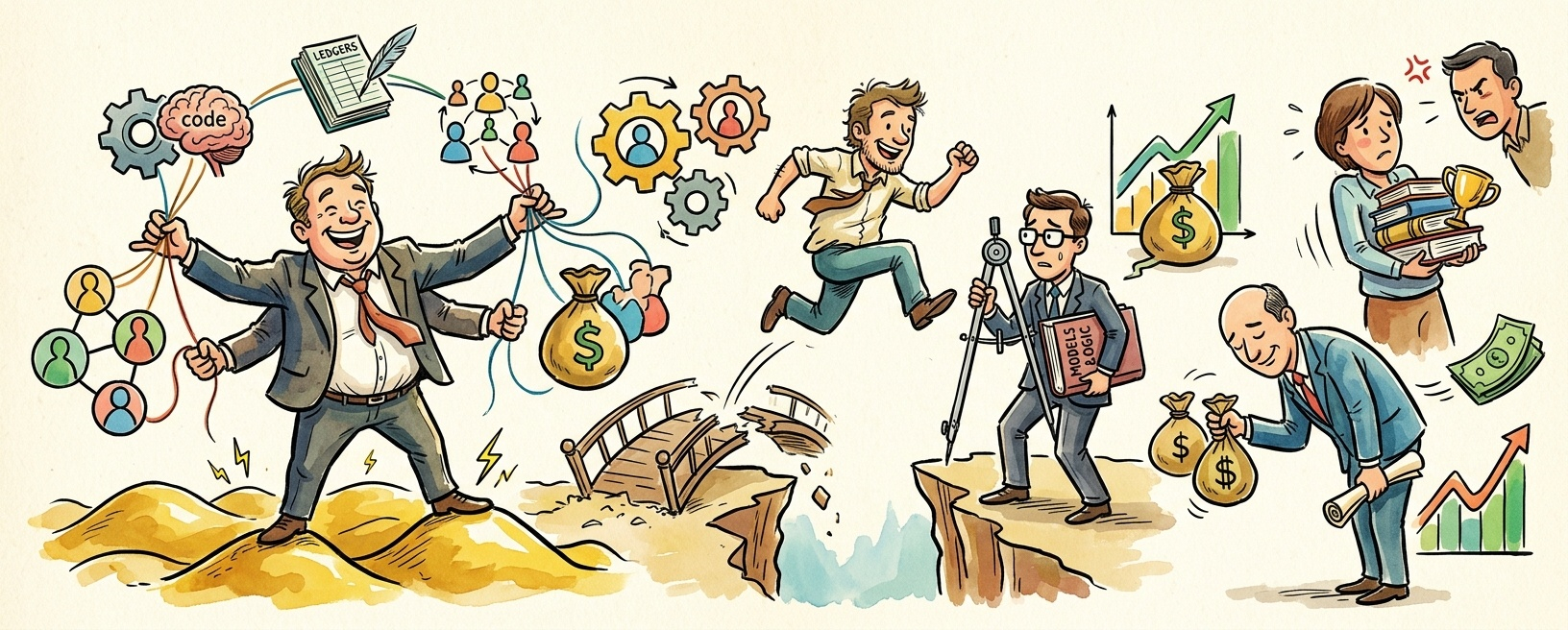
First, real ability isn’t about skills—it’s about bringing resources together.
Nobel laureate Ronald Coase once said that the purpose of a business is to reduce transaction costs.
A boss’s core skill is bringing together the people who can write code and the people who can keep the books—and making sure they don’t undermine each other.
Any skill you can learn in a four-year degree or a training course has a clearly marked price in the market.
Liu Bang was no match for Zhang Liang in strategy, Xiao He in governing, or Han Xin in warfare—who left him miles behind.
But he said, “I may not know how to lead soldiers, but I know how to lead generals.”
That’s what top-tier insight looks like: if you want to make serious money, stop focusing on honing a single skill and start taking on transaction costs and managing complex relationships.
The sharper your skills, the more useful a tool you become—but a tool can never become the master.
Second: people who are too smart often can’t make serious money.
A ten-year study found that executives with IQs above 130 were 28.4% less likely to succeed as entrepreneurs than average people.
Because clever people calculate everything too precisely.
An older guy in the building-materials business couldn’t even make sense of a contract, yet ten years ago he dared to mortgage his house and jump into a development-zone project.
A finance friend who graduated from a top university ran the numbers using a model: a 70% chance of losing everything. Absolutely not worth touching.
But the old guy caught the infrastructure boom and made 80 million yuan in a single year.
In the business world, certainty means zero profit.
By the time all the clever people have figured out how to make money, the opportunity is long gone.
Third: all outsized profits come from uncertainty.
Economists say that what you can calculate is called risk; what you can’t calculate is uncertainty. And all outsized profits come from the latter.
Two boxes: one gives you 100,000 yuan for sure; the other gives you a 90% chance of losing 10,000 yuan and a 10% chance of winning 20 million.
Salaried workers choose the first, because they want a guaranteed income no matter what.
The rich choose the second—and borrow money to take the bet ten times.
You only see him struggling to read the English wine label on his yacht. You didn’t see him back when his cash flow dried up and he stood on a rooftop in the cold, with the kind of nerve it takes to put your life on the line.
Wealth is, at its core, a reward for bearing uncertainty.
Fourth: ruthless pragmatism and absolute self-assurance.
An older relative in the import-export business, worth hundreds of millions, was publicly called a nouveau riche by a young director who pointed right at his nose.
He stood up with a smile and raised his glass: “You’re right to criticize me. I’m just an uneducated farmer. Bottoms up.”
The next day, he landed a 30-million-yuan order through the young director’s boss.
He said, “He can insult me all he wants—I won’t lose a bit of skin. He got it off his chest, I got the deal, and I couldn’t be happier.”
The biggest flaw intellectuals have is caring too much about their dignity.
Someone says one thing about you, and you want to argue for three days and nights to prove yourself right.
But the rich have long since shed their pride, self-respect, and moral scruples. They cling only to their practical interests.
You think he’s a pushover. But in the cutthroat arena, this is the most devastating way to beat someone by playing on a completely different level.
They gave up being mere tools. With blind courage, they crossed the traps that clever people calculate their way into, took on the world’s most terrifying uncertainties, and trampled their pride and self-respect underfoot.
The world is fair. If you want dignity, certainty, and people praising you for being clever, you have to give up the possibility of getting rich quick.
We all understand the logic. But if you were really told to grovel tomorrow and risk losing everything, most people couldn’t do it.
Still, that’s okay. Seeing the cards this world is holding can at least leave us with less resentment about our talents going unrecognized, and a little more clarity about how to move forward.
May you fare better and grow stronger with every hand you play in life.