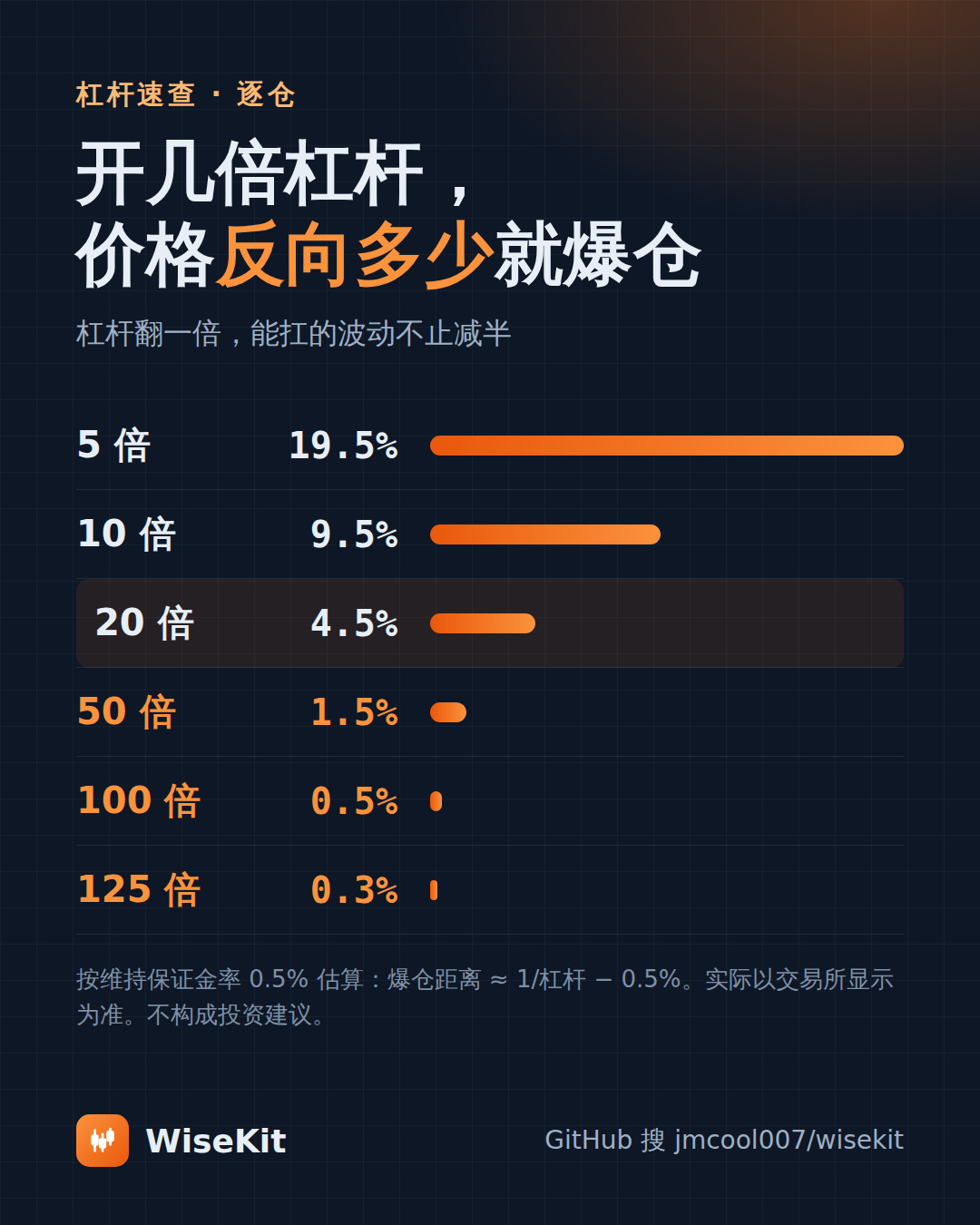
At 20x leverage, a 4.5% move in the wrong direction will liquidate you.
Before using leverage, many people only calculate “how much they could make,” without considering “how much they can withstand.” Here’s how much of a move against you common leverage levels can handle (isolated margin, assuming a 0.5% maintenance margin rate):
- 5x: 19.5%
- 10x: 9.5%
- 20x: 4.5%
- 50x: 1.5%
- 100x: 0.5%
- 125x: 0.3%
When leverage doubles, the adverse move you can withstand drops by more than half. At 100x, a single ordinary candlestick could wipe out your position—and it has little to do with whether your directional call was right.
A few things I’ve learned:
1. Set your stop-loss first, then choose your leverage. Leverage only determines how much margin is used; the real risk in a trade is “position size × stop-loss distance.”
2. Your stop-loss price must be reached before your liquidation price. Otherwise, the stop-loss is effectively useless.
3. Fees are charged based on position size. The higher your leverage, the larger the fees are relative to your margin.
I’ve turned these calculations into a set of free calculators on the WiseKit toolkit site: contract profit and loss, take-profit and stop-loss prices, quick liquidation estimates, position sizing, average entry price after adding to a position, funding rates, investment returns, and more. They’re ready to use—no registration required, and calculations are performed only in your own browser. GitHub: https://jmcool007.github.io/wisekit/
What leverage do you usually use? What other calculators are you missing? Let me know in the comments, and I’ll make the ones people ask for most.
#合约交易 #杠杆 #RiskManagement
This is not investment advice.