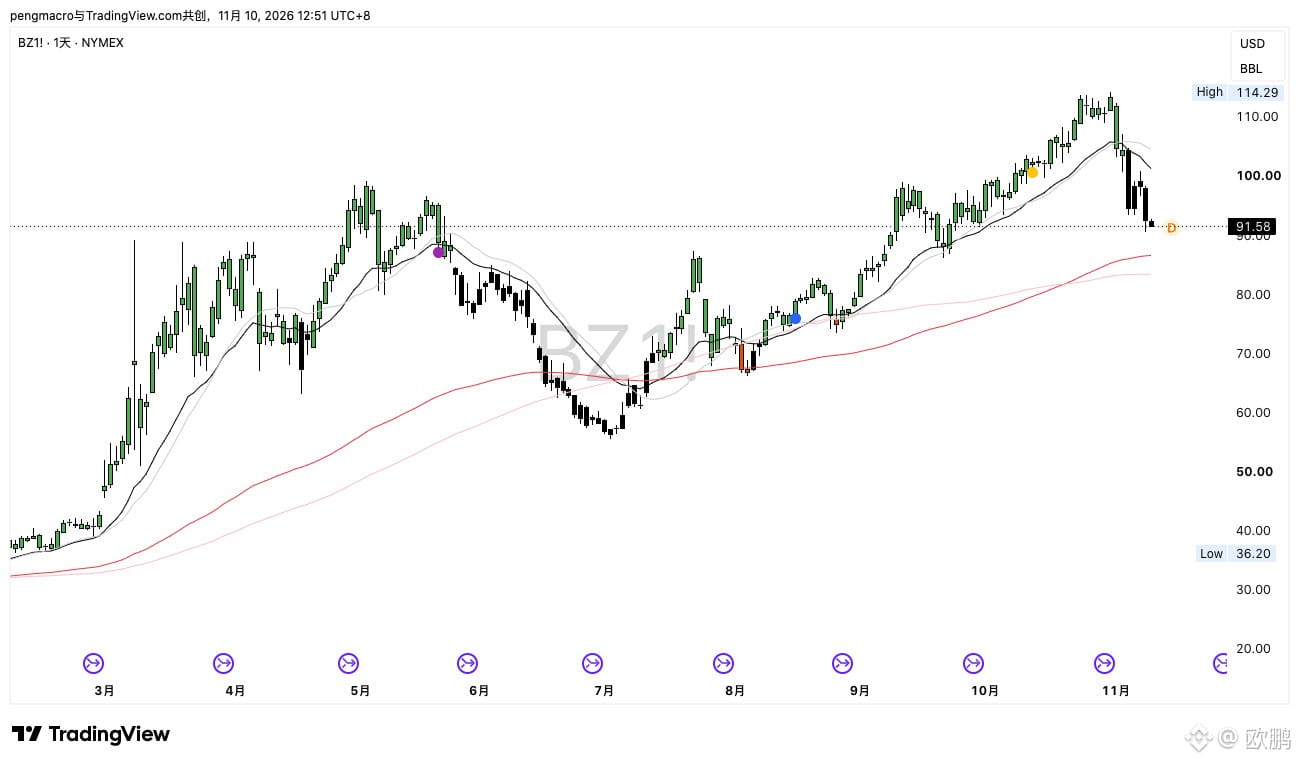
Down nearly 10% in two days, crude oil $BZ has given back all its “war premium.”
Brent crude fell nearly 6% last night and continued to slide during the day, hitting its lowest level since August. The reason for this drop is very different from previous ones, and there’s a particularly useful concept to understand here: the war premium.
The war premium is the extra amount added to oil prices because of the prospect of war. When tensions rise in the Middle East, the market worries that oil shipments could be disrupted and supply reduced, so a fear-driven markup gets added to oil prices. This premium was substantial over the past two weeks. But starting yesterday, Trump repeatedly signaled that “the Middle East conflict is nearing an end” and that “military action against Iran is unnecessary.” The market immediately understood: the risk of a supply crisis has dropped sharply, so that fear-driven markup should come out of the price. So this drop isn’t about real demand—it’s the air coming out of market sentiment.
Let’s lay out the winners and losers clearly.
On the losing side: companies that sell oil directly are hit the hardest. For upstream producers like CNOOC and PetroChina, every 10% drop in oil prices means a significant downward revision to profit expectations. Demand for oilfield service providers like COSL and Offshore Oil Engineering will also cool.
There are actually more winners, but the effects take a little longer to show.
First, airlines: fuel can account for a third of an airline’s operating costs, so a sharp drop in oil prices means a steep fall in costs. Air China, China Southern Airlines, and Spring Airlines all stand to benefit. Second, express delivery and logistics: cheaper oil directly lowers transportation costs.
Third, the chemicals industry: crude oil is a raw material for many chemical products. Cheaper raw materials open up more room for profit downstream in plastics and textiles.
Fourth, consumers as a whole: falling oil prices mean cooling inflation. If tonight’s US CPI data looks better because of lower oil prices, pressure on the Federal Reserve to raise rates will ease—an indirect positive for both stocks and Bitcoin.
My take: the drop in oil prices driven by this “easing of geopolitical tensions” is good news for the global economy overall, because it helps contain the most vicious “wolf” lately: inflation. But don’t expect oil prices to keep falling indefinitely. OPEC could cut production at any time to support prices, and the situation in the Middle East can change in an instant. Once the premium has been squeezed out, prices may fluctuate around the bottom. If you want to get involved, rather than chasing oil and gas stocks that have already fallen sharply, it may be better to keep an eye on airlines and chemical companies that haven’t yet rallied despite being poised to benefit.