
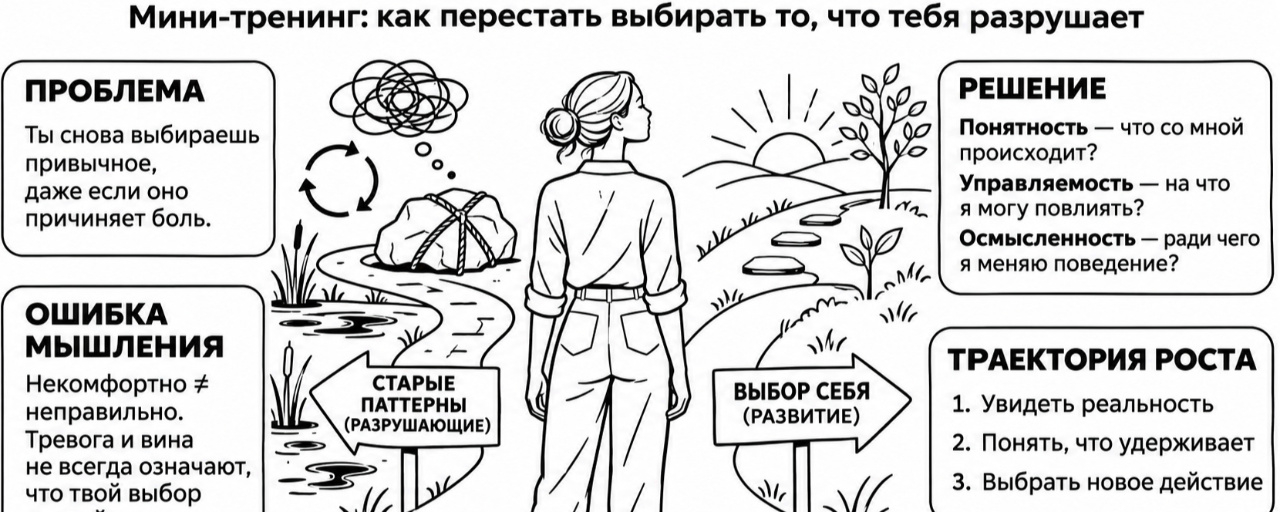

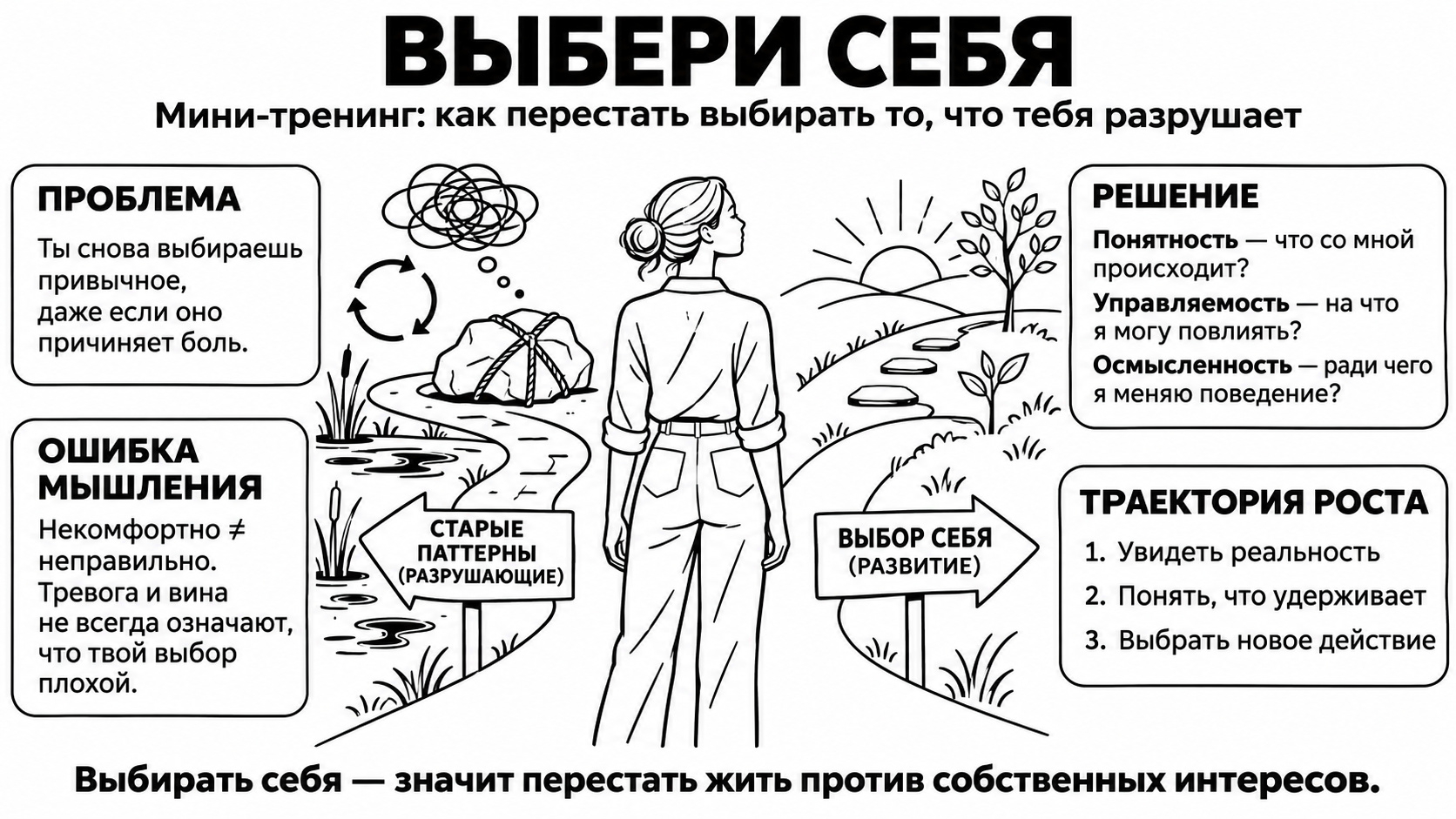
MINI-TRAINING “CHOOSE YOURSELF”
1. THE PROBLEM. WHY DON’T YOU CHOOSE YOURSELF?
You understand that certain relationships, decisions, and habits hurt you.
You get tired. You get irritated. You lose confidence. But you keep doing the same things.
Why?
Because familiar behavior can ease your anxiety in the moment, even if it makes you feel worse in the long run.
Let’s look at a specific situation.
People constantly ask you for help. You agree, even when you don’t have the energy or time.
Then you get angry. You feel like people are taking advantage of you.
But the next time, you agree again.
Why don’t you say no?
Because a thought comes up: “If I say no, they’ll think badly of me.”
And once again, you choose other people’s expectations over your own needs.
2. WHERE IS THE THINKING ERROR?
Let’s look at the situation through the lens of CBT.
Situation: someone asks you to do something you don’t want to do.
Automatic thought: “If I say no, they’ll stop respecting me.”
Emotion: anxiety, guilt, fear.
Behavior: you agree against your wishes.
Result: you feel calmer temporarily, but stress and resentment build up.
Two cognitive distortions may be at work here.
Mind reading: you’ve already decided that others will think badly of you, even though you don’t know that.
Emotional reasoning: you feel guilty and take that as proof that saying no is wrong.
And now the key question:
Are you making a decision based on the actual circumstances, or trying to get rid of an unpleasant feeling?
3. THE SOLUTION: A SALUTOGENIC APPROACH
The goal isn’t simply to stop experiencing negative emotions.
The goal is to understand what’s happening, identify the resources available to you, and start acting in line with your values.
To do this, we’ll use three pillars.
1. COMPREHENSIBILITY — what’s happening to me?
Separate facts from interpretations.
Fact: someone asked me for help.
Interpretation: if I say no, they’ll reject me.
These are not the same thing.
2. MANAGEABILITY — what can I influence?
You can’t control what others think of you.
But you can control your response, how you manage your time, and your own boundaries.
3. MEANINGFULNESS — why am I changing my behavior?
Ask yourself:
“What really matters to me?”
“What decision aligns with my values?”
“What am I protecting or developing when I stop acting against myself?”
Not every unpleasant feeling means you’re doing something wrong.
4. THE “GROWTH TRAJECTORY” EXERCISE — 3 DAYS
DAY 1. SEE YOUR REALITY
Choose one area of your life where you regularly act against your own interests.
Write down:
What exactly is happening?
What decisions do I keep making?
What am I losing because of these decisions?
If nothing changes, what will the outcome be in six months?
Result: you see the problem through facts, not just emotions.
DAY 2. UNDERSTAND WHAT’S HOLDING YOU BACK
Choose one recurring situation.
Answer these questions:
What am I afraid of if I do things differently?
What belief makes me repeat the same behavior?
What do I get right now by doing things the old way?
What price will I pay for this in the future?
Result: you uncover not only the habit, but also the reason you keep reinforcing it.
DAY 3. CHOOSE A DIFFERENT ACTION
Now you need a specific behavioral experiment.
For example, instead of automatically agreeing, say:
“I need to check my schedule. I’ll get back to you later.”
Don’t automatically justify yourself. Give yourself time to assess the situation.
Before the experiment, write down what you’re afraid might happen. Afterward, write down what actually happened.
Check:
Was my prediction confirmed?
How did I feel differently?
Was I able to take my own interests into account?
What action am I willing to repeat?
Result: you get your first real experience of behaving differently.
5. THE KEY TAKEAWAY
Choosing yourself doesn’t mean ignoring the people around you.
It means no longer automatically giving up your own needs because of familiar fears and beliefs.
And you don’t have to change your whole life all at once.
Start with one decision you used to make against yourself.
Awareness is the beginning. Changing your behavior is the next step.
INDIVIDUAL “GROWTH TRAJECTORY”
In this mini-training, you got your first framework for working on your own.
But everyone has their own beliefs, fears, and recurring patterns.
In individual sessions, we explore your real-life situation, identify what keeps the old behavior going, find the resources available to you, and create a concrete plan for change.
Not just “start loving yourself.”
But exactly what to change, what action to take, and how to measure the result.
Want to work through your situation?
Message me “TRAINING” — I’ll send you access personally.#Motivation #Psychology #Strategy #RiskManagement #ОшибкиМышления