
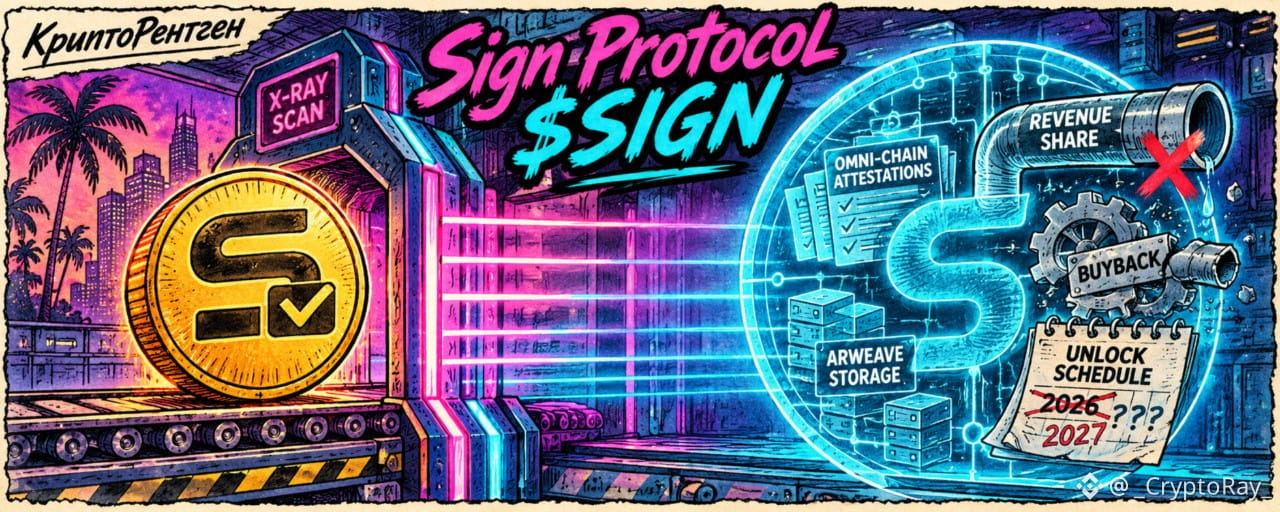
Sign is building infrastructure for digital attestations and token distribution. Its main product is Sign Protocol. The project has working technology, but the token's economic role $SIGN is poorly defined.
The main conflict is that the product exists, but no mechanism has been established for transferring its value to token holders. This article is for those studying infrastructure tokens with micro-capitalizations who want to understand which claims are supported by evidence and where sources disagree.
Technology
Sign Protocol is an omni-chain attestation protocol. An attestation is a structured, signed confirmation of a fact. It can be stored:
on-chain;
on Arweave;
in a hybrid setup, where some data is stored on-chain and some in decentralized storage.
SignScan indexes attestations and provides them through an API. Consensus is not the main concern here: Sign operates as a protocol on top of existing networks, not as a separate blockchain with its own validators.
In practice, it is a universal layer for proofs that can be used in various scenarios, not just identity verification. But the verified data contains no independent metrics of widespread use, so it is not possible to claim that the infrastructure has already demonstrated adoption.
Tokenomics
Max supply: 10 billion SIGN.
According to Tokenomist, around 3.215 billion tokens have been unlocked, or 32.15% of the maximum supply.
Aggregators report a lower circulating supply than the unlocked supply. Unlocked tokens are not necessarily already freely tradable.
Burns: Tokenomist reports no burned tokens.
Market data for November 9, 2026, varies by source:
CoinMarketCap: price around $0.00835, circulating supply around 2.387 billion, market cap around $19.93 million.
CoinGecko: price around $0.00845, circulating supply around 2.843 billion, market cap around $24 million.
Binance as of November 7: around $0.01064, circulating supply 2.4 billion, market cap $25.4 million.
These are different snapshots in time and use different methodologies. The working price range is $0.0083–0.0085. At that price, FDV is approximately $83.5–84.5 million. Market cap depends on the circulating supply used: $20–24 million.
A full breakdown by category (team, investors, community) is not provided in the verified data. I won't make one up.
Unlocks
The schedule for the next unlock has not been verified:
DefiLlama: November 15, 2026, around 298.24 million SIGN.
Tokenomist: November 28, 2026; the amount is not specified in the available excerpt.
CoinGecko: November 28, 2026, 50 million SIGN.
The difference between 50 million and 298.24 million is too large to be explained by ordinary rounding. Choosing one figure and presenting it as fact would be inaccurate. The original distribution chart and recipient addresses need to be checked. That will clarify whether the tokens will enter the market.
Investors
Rounds, funds, and entry prices are not confirmed in the verified data. Any figures here would be guesses, so this section will remain empty until primary sources become available.
On-chain activity
TVL is not very informative for Sign: it is not a DeFi protocol, but an attestation infrastructure. More useful metrics include:
number of attestations created;
number of unique schemas and integrations;
active issuer addresses;
the share of payments that actually goes through the token.
No such independent data is available in the verified materials. This is an analytics gap that will need to be addressed using the SignScan indexer and third-party dashboards.
The Details
Facts
Sign Protocol and SignScan are described in the official documentation.
Max supply is 10 billion.
Sources differ on circulating supply (2.4–2.84 billion) and unlock dates.
Tokenomist reports no burned tokens.
Rumors and insider information
Burning stolen tokens. The original report claimed that stolen SIGN had been permanently removed from circulation by being transferred to an immutable contract. This has not been confirmed. Confirmation would require:
the contract address;
verification of the bytecode and administrative controls;
the on-chain transfer history;
proof that the action is irreversible.
Until this information is available, it cannot be recorded as a burn. This also does not prove that the incident did not happen.
Value accrual. The materials do not confirm mandatory payment for attestations in SIGN, revenue sharing, systematic buybacks, or regular burns. This does not mean the token has no utility. But no direct value-return mechanism has been established.
Strengths and weaknesses
Pros
A working product with documentation: Sign Protocol and SignScan.
Flexible storage architecture: on-chain, Arweave, or hybrid.
The omni-chain approach does not tie the protocol to a single network.
Applications go beyond identity verification.
Fixed max supply of 10 billion.
Cons
No established link between protocol usage and demand for SIGN.
No confirmed revenue sharing, buybacks, or regular burns.
Unlock schedule discrepancy: 50 million versus 298.24 million.
Aggregators' circulating supply figures differ by one-fifth.
No independent adoption metrics.
A micro-cap market valuation of around $20–24 million implies high volatility.
Sources
DefiLlama — unlock schedule
Tokenomist — unlocked supply and burns
Sign documentation (docs.sign.global)
