

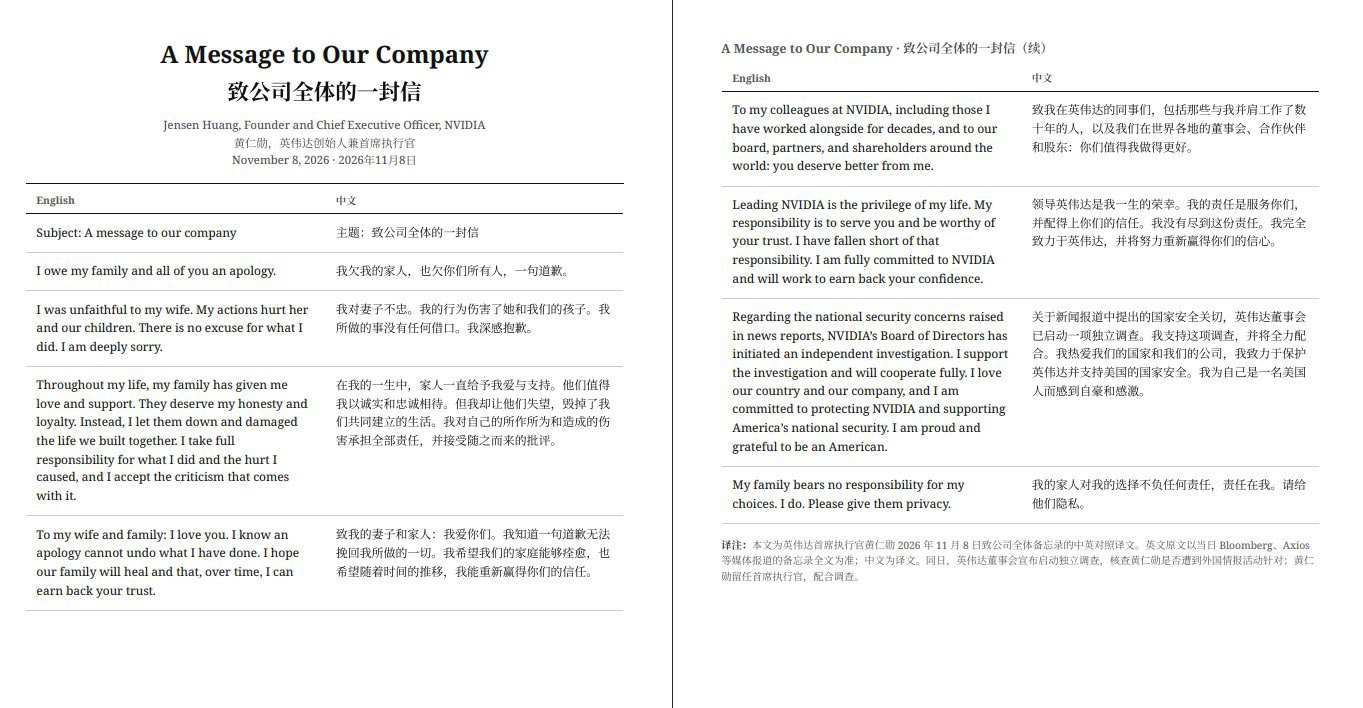
On November 3, Democrats swept back control of both chambers of Congress, ending the Republican “unified government” they had enjoyed since Trump returned to the White House. Just five days later, Nvidia’s website posted an apology letter from Jensen Huang to all employees. He admitted to being unfaithful to his wife and said there was “no excuse.” That same day, Nvidia’s board announced an independent investigation and hired outside counsel. The focus was not just the affair, but also his “close relationship” with a woman whom U.S. officials suspected was a target of Chinese intelligence. Nasdaq was still closed, but the crypto market had already started trading on Nvidia: on-chain contracts fell nearly 4% in an hour, and prediction markets quickly opened a market on “Jensen Huang’s departure.”
The fuse on this storm was lit well before the midterm elections; what set it off was the shift in Washington’s balance of power.

Jensen Huang’s “Double Trouble”: The Affair Is Only the Surface
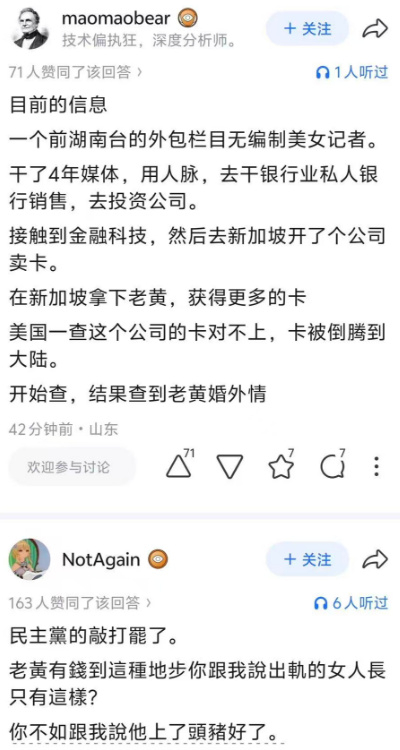
The story’s central figure is Alice Huang (Huang Le). Her résumé has been repeatedly scrutinized by foreign media and private-equity databases, revealing an almost tailor-made path across industries: four years in media, where she claimed to have worked as a reporter for Hunan Television and China Central Television; eight years in finance, moving between HSBC Private Banking, securities firms, and a Shanghai private-equity firm; and finally a role as managing director at Singapore data-center company Megaspeed—a major Nvidia buyer in Southeast Asia. One Hunan Television executive gave a blunt response: “I’ve never heard of this person.” A search of the company’s official website turned up nothing, either. But none of that stopped the résumé from serving its main purpose: allowing someone with no semiconductor background to take a seat at one of Jensen Huang’s business dinners as “someone from the chip world.”
During Computex Taipei in June 2024, Huang Le boasted in a bar, “I can get Jensen to come over.” Not long afterward, Jensen Huang showed up in his signature leather jacket, drinking whisky and posing for photos with the group. In May 2025, she appeared again on Huang’s Taipei itinerary, photographed talking with her arm over his shoulder and leaning close to his face. The irony was striking: on that same trip, Huang’s wife, Lori, and their two children were in Taipei. He had just publicly declared his love for his wife, saying, “I tell her every day, ‘Honey, I love you,’” while Taiwanese media ran headlines about how he “spares no effort in doting on his wife.”
If this were simply an extramarital affair, Wall Street might have treated it like most CEO scandals involving private conduct: apply a discount, then move on. What took the story beyond gossip was Megaspeed. Trade data show that from June 2024 to February 2026, Megaspeed’s affiliated company in Malaysia purchased at least $4.8 billion worth of advanced AI equipment containing Nvidia chips. U.S. officials suspect the chips were routed through Southeast Asia to circumvent export controls on China. As a former Megaspeed executive who had been close to Jensen Huang, Huang Le is viewed by intelligence agencies as a potential “information conduit.” Whether she obtained inside information from Huang about supply allocations or export-control red lines has not been established legally. But the allegations alone were enough to set Capitol Hill in motion.
The Republican chairs of the House Foreign Affairs Committee, the Select Committee on China, and the Intelligence Committee jointly sent a letter demanding that Jensen Huang attend a closed-door briefing on November 18 to explain his dealings with Huang Le and Nvidia’s counterintelligence safeguards. Notably, these committees had largely taken a hands-off approach to the tech industry. Now, however, they have quickly shifted course after the midterms. The New York Times spelled out the political logic: anti-tech sentiment helped Democrats in the midterms, and Republicans do not want to hand over an issue with political clout. Huang has become a ready-made target for both parties to demonstrate toughness on “chip controls on China.”

$149.5 Billion in Shares, and a Divorce That May Never Happen
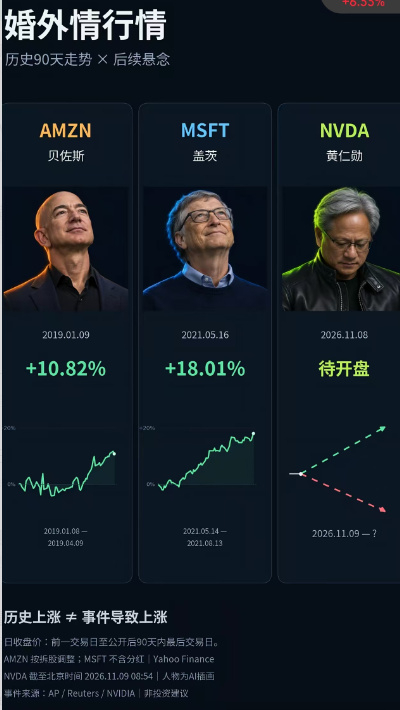
Compared with the congressional investigation, the market’s reaction was more immediate—and it showed up in the share price. In overnight trading after the apology letter was released, Nvidia fell nearly 6% at one point, to $175.74, wiping out its gains for the year. The $4.5 trillion company’s share price embeds a substantial “Jensen Huang premium”: his personal brand, industry judgment, and strategic continuity are themselves part of Nvidia’s valuation.
If Lori chooses to divorce him, California’s community-property laws could put roughly $149.5 billion worth of Nvidia shares in Jensen Huang’s name on the table for division. According to regulatory filings, the 801 million shares are explicitly registered as jointly held by the couple, through the “Huang Living Trust” and several irrevocable trust structures. The two share voting and disposition rights. If divided equally, Lori could theoretically receive around $75 billion to $80 billion, placing her among the world’s wealthiest women.
But “splitting the shares equally” does not mean “splitting control equally.” Jeff Bezos’s divorce offers a key precedent: MacKenzie received the economic benefits of Amazon shares but gave Bezos the voting rights, allowing him to retain firm control of the company even after his stake was diluted. Nvidia has no dual-class share structure, and Jensen Huang owns just 3.58% personally. Even if divided equally, neither would hold as much as 2%, so neither could control the company through share ownership alone. Real control comes from the board’s trust, industry standing, and irreplaceable strategic capabilities. The board’s current position is that Huang will remain CEO during the investigation; only confirmed major leaks or improper transfers of benefits would trigger a removal process.
Vanguard and BlackRock are Nvidia’s two largest institutional shareholders, with a combined stake of more than 16%. But they are financial investors that follow the voting conventions of passive index funds and have rarely joined forces to intervene in corporate governance. Huang’s real risk is not in the shareholder ballot box, but in the closed-door meeting rooms on Capitol Hill.
Prediction markets reflect the same view: “manageable in the short term, uncertain in the medium term.” On Polymarket, the odds of Huang resigning by year-end are around 16%, while the odds of a divorce this year are 13%. But on Kalshi, the odds of him leaving by July 2027 have jumped to 32%, and exceed 50% for a departure by 2029. The market is saying: he is not going anywhere for now, but the tail risk of this story has by no means disappeared.

Musk: Trump’s “Pardon” Won’t Save Him from Democratic Subpoenas
Jensen Huang’s troubles stem from a personal relationship entangled with the sensitive terrain of chip controls. Musk’s troubles are more straightforward: he is the Republican Party’s biggest donor and the business-world symbol Democrats most want to “settle scores with” now that they have retaken Congress.
Before the midterms, Musk poured nearly half a billion dollars into the Republican camp and described the election on X as an existential battle in which “Democrats will turn America into a permanent one-party state.” Democrats, for their part, had already said that if they retook Congress, they would investigate Musk’s role in the Trump administration, the federal contracts and subsidies awarded to SpaceX and Tesla, and whether his “government efficiency” operation improperly benefited his companies.
Trump’s response was to propose a “preemptive pardon.” In an interview after the election, he said explicitly that if Democrats launched an investigation or tried to seize Musk’s assets, he would be willing to sign a pardon in advance, as he had for defendants in the Capitol attack cases. But a pardon can only block federal criminal charges; it cannot stop a congressional subpoena. In a November 9 report, Axios wrote that Democrats “have subpoena power” and are preparing to investigate Musk’s DOGE operation and its access to sensitive government data, as well as whether his companies have improperly benefited from his extraordinary influence over Trump. That “heh” from the Clinton camp carries an implicit message: you can pardon him all you like; we’ll investigate him all the same. Congressional hearings, legislative pressure, and state-level lawsuits are all beyond the reach of a pardon.
Musk has not backed down, either. He has said, “Live by the sword, die by the sword,” and warned those who want to investigate him that they “should understand who they’re dealing with.” But once Democrats truly have subpoena power, that kind of threat is yielding diminishing returns.

This Isn’t the End of the Gossip; It’s the Beginning of a Political Cycle
In his apology letter, Jensen Huang wrote, “Leading Nvidia is the greatest honor of my life.” In the current context, the line sounds more like a defensive declaration. Nvidia’s AI chips power some of the world’s most critical computing infrastructure, and the revenues of Taiwanese suppliers such as TSMC, KYEC, and Wistron are closely tied to Nvidia’s roadmap: 36% of KYEC’s revenue, 21% of Wistron’s, and 19% of TSMC’s are Nvidia-related. Huang’s personal fate is no longer just a matter for his family.
The real storyline behind this storm is how the shift in Washington’s balance of power after the midterms has turned two business magnates who once thrived at Trump’s side into convenient political targets on Capitol Hill. Huang’s affair escalated from gossip to a national-security issue because it landed squarely on the sensitive issue of “chip controls on China,” where both parties want to push for tougher restrictions. The “reckoning” Musk faces is looming because he is both one of Trump’s biggest donors and the best example Democrats can point to as proof that “the Republican Party has been captured by the wealthy.”
At the November 18 closed-door briefing, Jensen Huang will face not entertainment reporters, but the chairs of three committees with subpoena power. Nvidia’s earnings report is due soon, and there is still no timeline for the independent investigation. Crypto markets have already priced in the first five hours of this crisis through on-chain contracts. The real price discovery will begin only after the door on Capitol Hill closes.