Morgan Stanley: The U.S. stock market correction is nearing its end; a sharp sell-off would be an ideal buying opportunity
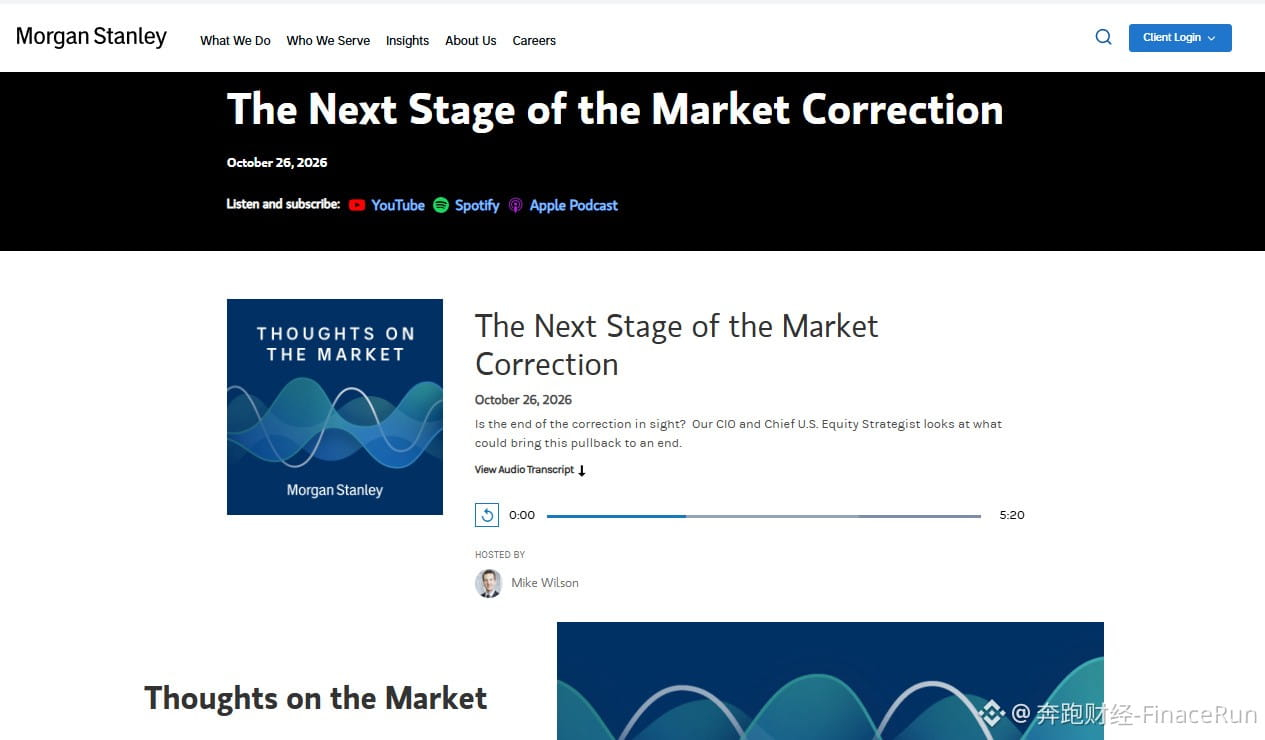
Recently, Michael Wilson, Morgan Stanley’s chief investment officer and chief U.S. equity strategist, said on a podcast that the stock market correction that began in June is nearing its end, but the final stage could be very difficult, and the S&P 500 may still need to endure one last drop.
The correction has been quite substantial so far. Nearly 60% of the stocks in the Russell 3000 have fallen more than 20% since June, and hedge fund positioning has dropped to a one-year low. However, overall sentiment has not yet reached the extreme pessimism typically seen at historic market bottoms.
If the indexes continue to fall, Wilson sees the 7,100–7,200 range for the S&P 500 as an important support level. A drop into this range would mark a stabilization zone worth watching closely.
He believes the market must clear three more hurdles before it bottoms. The first is the AI sector: the market still needs to absorb more supply pressure, credit spreads for lower-quality companies may continue to widen, and the semiconductor index could fall another 10%–15% by mid-November.
However, the analysis also offers an optimistic outlook: once supply pressures ease, these headwinds will lessen and the related market risks will gradually be released.
The second hurdle is the U.S. midterm elections. A sweeping Democratic victory has already been fully priced in by the market; the real uncertainty lies in what happens afterward, including how geopolitical tensions develop (for example, whether the U.S.–Iran conflict could escalate).
Historically, however, sell-offs triggered by this kind of geopolitical disruption have often presented opportunities to build positions, because U.S. stocks have typically performed strongly after the midterm elections are over.
The third, and most important, hurdle is liquidity. Rising interest rates, slower balance sheet growth, and higher energy prices are rapidly tightening financial conditions, and the situation is beginning to resemble 2018.
In effect, the market may be carrying out the Fed’s tightening policy for it, potentially triggering funding pressures or further deteriorating credit market conditions.
Based on the above, the market may still need to go through another decline in the indexes and a period of heightened volatility. But this could be a catalyst for a shift in Fed policy and the next leg higher in stocks.
He advised investors to continue holding high-quality stocks, adding that if a liquidation event triggers a sharp sell-off, that is no reason to flee risk, but rather the long-awaited buying opportunity.
#宏观策略观点
Recently, Michael Wilson, Morgan Stanley’s chief investment officer and chief U.S. equity strategist, said on a podcast that the stock market correction that began in June is nearing its end, but the final stage could be very difficult, and the S&P 500 may still need to endure one last drop.
The correction has been quite substantial so far. Nearly 60% of the stocks in the Russell 3000 have fallen more than 20% since June, and hedge fund positioning has dropped to a one-year low. However, overall sentiment has not yet reached the extreme pessimism typically seen at historic market bottoms.
If the indexes continue to fall, Wilson sees the 7,100–7,200 range for the S&P 500 as an important support level. A drop into this range would mark a stabilization zone worth watching closely.
He believes the market must clear three more hurdles before it bottoms. The first is the AI sector: the market still needs to absorb more supply pressure, credit spreads for lower-quality companies may continue to widen, and the semiconductor index could fall another 10%–15% by mid-November.
However, the analysis also offers an optimistic outlook: once supply pressures ease, these headwinds will lessen and the related market risks will gradually be released.
The second hurdle is the U.S. midterm elections. A sweeping Democratic victory has already been fully priced in by the market; the real uncertainty lies in what happens afterward, including how geopolitical tensions develop (for example, whether the U.S.–Iran conflict could escalate).
Historically, however, sell-offs triggered by this kind of geopolitical disruption have often presented opportunities to build positions, because U.S. stocks have typically performed strongly after the midterm elections are over.
The third, and most important, hurdle is liquidity. Rising interest rates, slower balance sheet growth, and higher energy prices are rapidly tightening financial conditions, and the situation is beginning to resemble 2018.
In effect, the market may be carrying out the Fed’s tightening policy for it, potentially triggering funding pressures or further deteriorating credit market conditions.
Based on the above, the market may still need to go through another decline in the indexes and a period of heightened volatility. But this could be a catalyst for a shift in Fed policy and the next leg higher in stocks.
He advised investors to continue holding high-quality stocks, adding that if a liquidation event triggers a sharp sell-off, that is no reason to flee risk, but rather the long-awaited buying opportunity.
#宏观策略观点