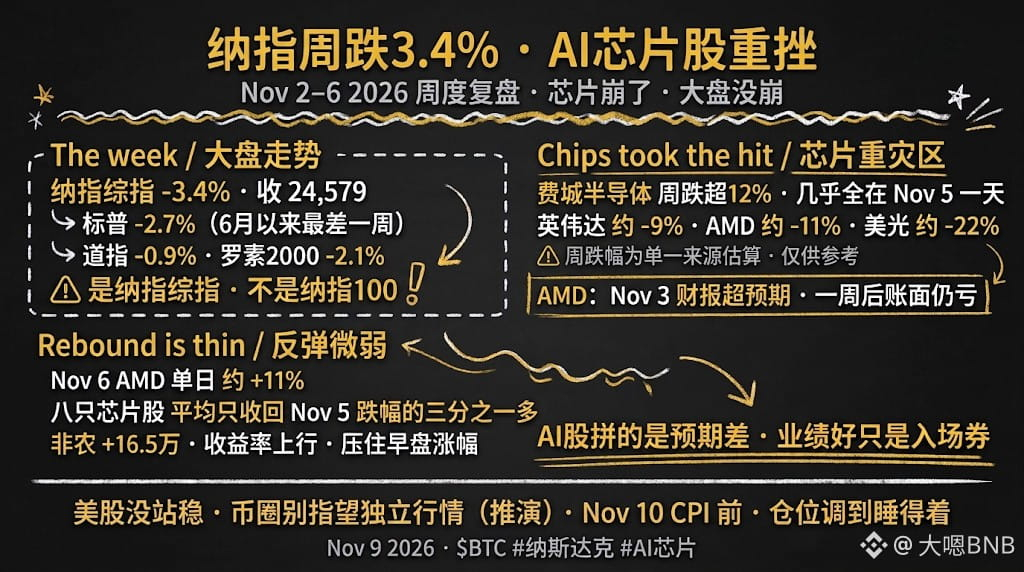

I took a quick look at the weekly candlestick for November 2–6. The most striking thing wasn’t the big bearish candle—it was AMD.
First, the broader market. According to CoinCentral and Alain Guillot’s weekly reports, the Nasdaq Composite fell 3.4% that week, closing at 24,579; the S&P 500 dropped 2.7%, its worst week since June; the Dow fell just 0.9%, and the Russell 2000 lost 2.1%. The broader market didn’t collapse—the chips did. According to Alain Guillot, the Philadelphia Semiconductor Index fell more than 12% for the week, with nearly all of the losses coming on November 5 alone. Nvidia fell close to 9%, AMD about 11%, and Micron about 22%. Those weekly declines are estimates, so take them as a rough guide.
AMD was the most painful. Its earnings beat expectations on November 3, and the stock briefly rose 7.5% after hours. But by the end of the week, investors were still in the red. It bounced about 11% on November 6 alone, but that still wasn’t enough to make up the losses.
And that’s not all. How flimsy was the rebound? According to StockTitan, eight major chip stocks recovered only a little more than a third, on average, of their November 5 losses by the close on November 6. One analyst said the November 5 sell-off looked more like a knee-jerk reaction than a reset in fundamentals. That same day, October payrolls came in up by 165,000, pushing Treasury yields higher and limiting the morning rally.
My take is that this week laid one thing bare: AI stocks are all about the gap between expectations and reality. Strong earnings are merely the price of admission. As for crypto, my view is that BTC is being dragged around by U.S. stocks. It briefly fell below $76,000 intraday on November 5. If U.S. stocks can’t find their footing, don’t expect crypto to make a move of its own—that’s my read.
I don’t know how it’ll play out, but when the weekly chart grows a wick like that, adjust your position to a level you can sleep with. CPI is also due on November 10. Don’t try to weather two storms at once.
$BTC
#ai芯片股重挫纳指周跌3.4%