
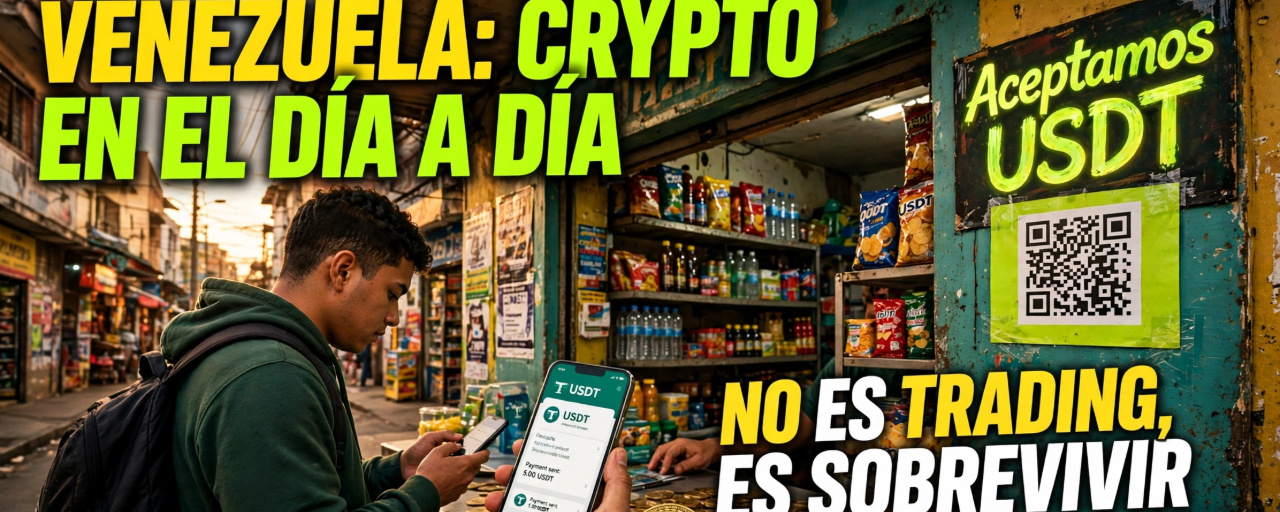

It’s not trading, it’s survival
In Venezuela, crypto isn’t a chart.
It’s how you pay for coffee and rent, and send money to your mom.
If people in other countries ask you, “Do you invest in crypto?”, in Venezuela they ask, “How do you get paid? In bolívares, USDT, or Pago Móvil?”
And that’s the difference. THE FACT THAT CHANGES EVERYTHING
Venezuela moved $39.100M in crypto over the past year and grew by +107.2%, the fastest growth in all of Latin America, according to Chainalysis 2026.
But the number means nothing if you don’t understand everyday life.
People here don't buy BTC to get rich.
They buy USDT to NOT lose money in one day.1.
MORNING: THE PAYCHECK ARRIVES IN USDT Most freelancers, remote workers, and businesses no longer get paid in bolívares.
You get up, open Binance, Bybit, or OKX, and there you have your USDT.
90.2% of ALL P2P listings in bolívares are in USDT.
BTC accounts for just 1.9%. BTC is for long-term saving; USDT is for living.
Your paycheck? Many people get it like this:
They pay you in USDT via TRC-20 (Tron, ∼$1 fee, arrives in seconds) or through Binance Pay.
If you're an employee at a local company, they may pay you in bolívares through Pago Móvil, but you convert it to USDT right away.
Because if you leave it in bolívares, it's worth less by the afternoon.
The bolívar lost more than 80% of its value in 2025.
USDT reached 1,000 bolívares on P2P on October 7.
No one wants to be left holding bolívares.
2. MIDDAY:
PAYING AT THE STORE You go to buy lunch in Caracas, Maracaibo, or Valencia and see the sign: "We accept USDT" with a QR code. Here's how it works:
You scan the store's QR code, send the USDT, and that's it. In seconds.
Many stores use Crixto + Binance Pay: you pay in USDT, and they receive bolívares instantly at the BCV rate.
They don't have to handle crypto if they don't want to
What can you pay for with USDT today? Supermarkets: ∼10% of purchases are already paid for in crypto Restaurants, cafés, and stores Rent, condo fees, and maintenance fees Doctors, dentists, private schools Gas, appliances, spare parts Phone top-ups, delivery Merchants interviewed by Chainalysis said that nearly 40% of their revenue already comes in USDT.
And it's not just Caracas. It's happening inland too. The phrase you hear everywhere: "With prices changing all day, getting paid in USDT is the only way not to lose your margin between morning and night." 3. AFTERNOON: P2P IS THE BANK The bank in Venezuela isn't the bank. P2P is. Here's the routine:
You've got USDT, but need bolívares to pay for something small.
You go to Binance P2P, look for a seller with a 95%+ reputation and 1,000+ trades, send them USDT, and receive bolívares through Pago Móvil in under 7 minutes.
Pago Móvil handles 63% of ALL commercial transactions in the country, more than 8,500 transactions per minute.
And it's projected to handle $70,000M in 2026.
But USDT is competing on equal terms.
Ecoanalítica estimates that $44M in USDT moves DAILY on Binance P2P alone, almost as much as the Central Bank's own dollar sales.
That's why people call USDT "the Binance dollar." It's the real price people use, not the BCV's. Today, the P2P premium over the BCV rate is ∼13.7%. And there's a new game: arbitrage.
People compare Binance vs. Bybit vs. OKX to buy USDT at the lowest price.
It's become a common and legal practice—the "second crypto wave" in Venezuela.
4. NIGHTTIME: REMITTANCES AND FAMILY
7 million Venezuelans live abroad. Remittances mean life. It used to be Western Union: a 6–10% fee, days of waiting, a line.
Now it's: you buy USDT in your country, send it via TRC-20 to your family's wallet, and they sell it for bolívares on P2P at the parallel rate.
Total fee: less than 1.5%. Nearly 9% of the $5,400M in annual remittances already comes in through crypto, and the share is growing.
It's so common that Tether itself says Venezuela is one of the 4 countries where USDT is growing fastest in the world, alongside Argentina, Bolivia, and Turkey.
AND BITCOIN? Bitcoin is around, but not for everyday use.
It's volatile.
A 19% drop like the one in February 2026 could wipe out a week's wages.
That's why Venezuelans use BTC as a reserve, like digital gold, not to pay for groceries.
The unwritten rule is:
USDT to live on, BTC to save.
THE RISKS NO ONE TELLS YOU ABOUT
It's not all sunshine and roses: regulation is a vacuum.
SUNACRIP has been paralyzed since 2023.
Only 2 exchanges have formal licenses: Crixto and Kontigo
.There are P2P scams, frozen accounts, and the risk of sanctions if you move money from PDVSA or state-owned companies.
The digital divide leaves many older people who don't use smartphones behind.
But even so, people keep going.
Because they have no alternative.
THE BOTTOM LINE:
In Venezuela, USDT didn't replace the bolívar because it was trendy.
It replaced it because the bolívar stopped working as money.
When your currency loses 80% of its value in a year, you don't need a white paper to understand crypto. You need a QR code that works.
That's why Venezuela ranks No. 9 in the world for per-capita adoption, even though it's a country of 28 million people.
Because here, crypto isn't an investment.
It's the cash register, the bank, the paycheck, and the remittance.
Do you live in Venezuela?
Do you get paid in USDT or still in bolívares?
What's the last thing you paid for with USDT?
I'm reading your replies 👇
Source: Chainalysis 2026, CriptoNoticias, Ecoanalítica, Cointelegraph#Venezuela
#USDT #AdopcionCrypto #PagoMovi #Stablecoins #LatamCrypto
