
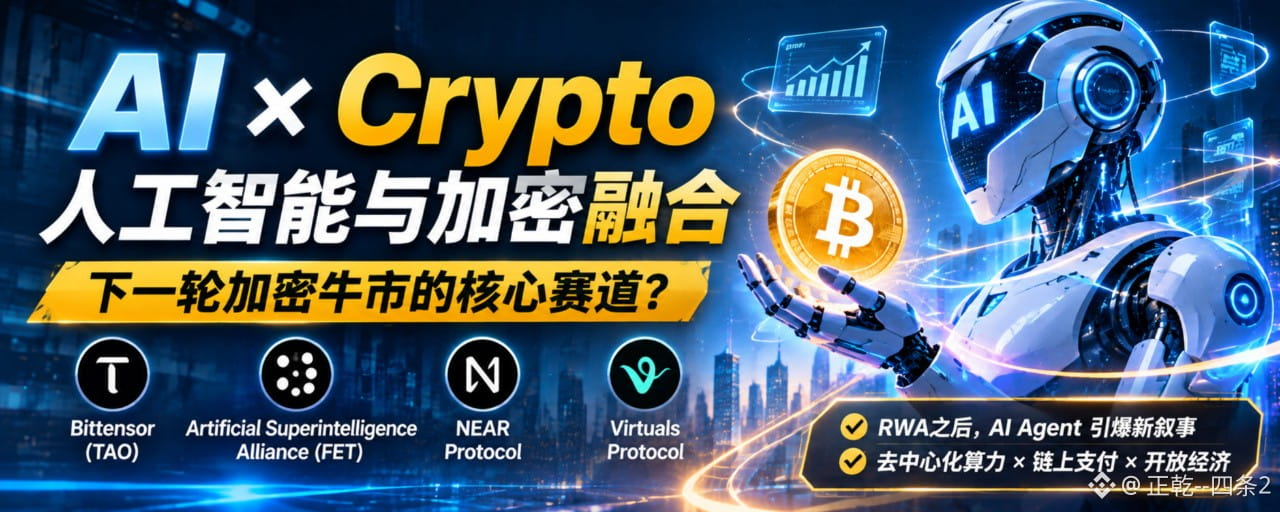

AI × Crypto: The New Infrastructure for the Next Cycle? A Look at AI Agents, Decentralized Computing Power, and the Machine Economy
Hey everyone, today we’re diving into one of the hottest sectors in our community: AI × Crypto.
First, let me be clear: I’m not here to bombard you with a bunch of fancy buzzwords, or to jump straight in and shout, “This is a hundred-bagger—just buy in!” When people first see this topic, many instinctively think it’s just mashing together AI hype and crypto hype to cash in on a trend. But that’s not the case. The interesting core idea behind this sector is that these two technologies can complement each other: AI handles thinking, decision-making, and getting things done; blockchain handles the flow of value, automated settlement, ownership verification, and distribution of payments, while keeping verifiable records.
Put simply, AI Agents will be able to compare prices, rent GPUs, buy data, call large language model APIs, pay for services, and even trade automatically. But AI itself can't manage money or transfer it automatically, and it can't settle payments across platforms. That's where crypto's programmable, 24/7 payment and settlement system comes in as the underlying infrastructure.
But here's a word of caution: even if AI Agents are everywhere in the future, that doesn't mean related tokens will necessarily go up. Our focus should always be on whether a project solves a real need, whether the network is genuinely being used, and whether that usage can translate into real demand for the token. Keep that in mind.
1. Why could AI × Crypto become the leading narrative of the next market cycle?
Let's look back at the main narratives from previous crypto bull markets: DeFi, NFTs, Layer 2, Memes, and RWAs. Most of these narratives created new kinds of on-chain assets for people to trade and hold.
But AI × Crypto is different: it aims to bring a new kind of economic participant into being—AI Agents.
AI tools like ChatGPT that we use every day are essentially still just tools: people ask questions, AI gives answers, and people have to manually handle everything else—placing orders, making payments, and finding resources. AI Agents, by contrast, aim to complete entire tasks end to end. Here's a simple example: You tell an Agent, “Find the most cost-effective GPU computing power for running a model.” The Agent compares prices and computing specs from different providers, places an order via API once it has chosen one, pays the computing costs automatically with stablecoins, then passes the results to another Agent for further analysis. Once everything is done, it sends you the report and a breakdown of expenses.
See the difference? AI is no longer just a tool that answers questions. It becomes an “economic actor” that can buy services, spend money, and even earn money on its own.
So why does this require blockchain? When Agents work autonomously, they run into a range of problems that centralized platforms struggle to solve:
How can an Agent automatically pay when it needs to connect to many different service providers? Stablecoins and on-chain payments are a natural fit.
Smart contracts can handle programmable, automatic settlement for large numbers of small, frequent payments.
Open protocols can break down barriers and enable collaboration across different platforms and service providers.
When multiple Agents work together, how can they automatically split the revenue? On-chain rules are set in advance, so there's no need for manual reconciliation.
All transactions and payment records need to be traceable and verifiable.
Assets are spread across multiple chains, so cross-chain routing and automatic fund transfers are needed.
Here's another industry signal worth paying attention to: in July 2026, the Linux Foundation officially launched the x402 Foundation and introduced an open, HTTP-native payment standard. The goal is to let Agents make payments at the same time as they send network requests. Of course, it's still in the early stages of development and a long way from widespread adoption. But it shows that automatic payments between machines have moved from an idea within the crypto community to the protocol standards layer.
The underlying logic in one sentence: AI creates demand, while crypto provides the infrastructure for payments, settlement, and collaboration. Put the two together, and an entirely new machine economy could emerge.
2. The five layers of the industry value chain—don't chase every AI-themed token
To understand this sector, start by breaking down the entire value chain. It has five layers, from foundational infrastructure to applications, each with its own role: Layer 1: Computing infrastructure. AI training and inference both require large amounts of GPU power. Decentralized computing networks pool idle computing resources from around the world. Anyone who needs computing power can buy it as needed. The benefit is that idle resources are put to use, providing an alternative to centralized cloud providers.
Layer 2: Model and AI services marketplaces. Different developers list their large language models, datasets, and inference services. Users aren't locked into big tech providers and can choose AI capabilities based on performance and price, turning model services into goods that can be freely bought and sold.
Layer 3: Agent development and runtime platforms. These platforms give developers tools to easily create Agents, equip them with models, permissions, and workflows, and let multiple Agents team up and divide tasks. This lowers the development barrier and helps Agents move from demos to commercial use.
Layer 4: Payments and settlement. Agents need to pay when they buy computing power or data, or hire other Agents to do work. Stablecoins and on-chain payment protocols are settlement tools for machines, supporting frequent, automated transactions.
Layer 5: On-chain finance. Once Agents have their own funds, income, and verifiable transaction records, they can also access DeFi for lending, fund management, and risk control. Agents are no longer just consumers that spend money; over time, they can become entities that manage assets.
Here's a crucial point to understand: not every part of AI needs to be on-chain. Centralized cloud services remain highly competitive in speed, cost, and user experience. Blockchain isn't here to replace computing power or large language models. Its real opportunities lie in open collaboration, automated settlement across platforms, incentive distribution, and trustworthy record-keeping. Don't mistakenly assume that all AI has to run on-chain.
3. Let's take a closer look at four key projects
1. Bittensor (TAO): A large decentralized AI services marketplace
Bittensor's approach is the complete opposite of centralized AI companies like OpenAI and Anthropic. Big tech companies buy their own computing power, train their own models, and control all their services. Bittensor uses a crypto incentive mechanism to attract people around the world to provide all kinds of AI services.
It has several key roles: Miners: provide models, computing power, and retrieval services; Validators: score and verify service quality; Subnets: each subnet is an independent market niche—some specialize in text generation, others in image generation or data retrieval; TAO is the native token, used for staking, incentives, and participation in the subnet ecosystem.
As of November 7, 2026, network data: 128 subnets, 1,026 validators, around 6,754 active accounts over 24 hours, approximately 11.7 million TAO in total supply, and a staking ratio close to 63.9%. The numbers look impressive, but keep a level head: having many subnets doesn't mean each one has real customers and stable revenue. Many exist simply to mine tokens.
✅ Worth watching: Breaks the monopoly of big tech through market competition to provide diverse AI services. ⚠️ Risk alert: Subnet quality varies widely; incentives can encourage participants to focus on mining tokens rather than building useful services for the long term; tokenomics are complex, so make sure you understand emissions and staking rules. 👉 Key things to track: whether subnets have real paying customers and external revenue, rather than just looking at the number of subnets.
2. ASI Alliance (FET): All-in-one AI + Agent infrastructure
The ASI Alliance was formed by the merger of projects including Fetch.ai, SingularityNET, and CUDOS. Many of you may have heard of FET before—it is the ecosystem's core token. Rather than building just one application, it aims to bundle all the infrastructure needed for an AI economy: Agentverse: Agent registration, discovery, and collaboration; ASI:Cloud: distributed computing power and inference services; ASI:Chain: a chain tailored for Agent collaboration; plus supporting models and data resources.
For an Agent to independently run an entire business workflow, it needs models, computing power, data, payments, and identity. ASI aims to bring all of these together in one ecosystem.
✅ Worth watching: Covers a long stretch of the value chain and provides end-to-end support for Agents. ⚠️ Risk alert: After multiple projects merge, it can take a long time to integrate their technology and products; having many products doesn't mean people will use them. Pay close attention to which services require FET and which can be paid for directly with stablecoins or fiat. Also, the token ticker migration has not been fully completed. Always follow official announcements and exchange information when trading—don't swap tokens blindly.
3. NEAR (NEAR): Agent cross-chain payments and execution hub
Many people still think of NEAR as an established Layer 1 blockchain. But its focus has now shifted toward the Agent economy, with NEAR Intents as its key offering, alongside NEAR AI.
Here's a very practical pain point: an Agent has funds on Chain A and needs to find a service provider on Chain B to buy data, but the provider only accepts USDC. Without Intents, someone would have to manually bridge assets, swap tokens, and configure routing. An Agent simply can't handle operations this complex.
The logic behind Intents is simple: you just tell the system what outcome you ultimately want. The solver network automatically handles the bridging, swaps, and cross-chain routing in between. The project has also integrated the x402 machine-payment protocol, supporting Agent payment routing across more than 35 public blockchains and 125 assets. The team has disclosed cumulative transaction volume of over $33 billion and more than 30 million swaps—but note that most of this activity is not Agent transactions. Don't confuse the two.
✅ Worth watching: Tackles the biggest headaches for Agents—moving assets across chains and making payments automatically—and is core infrastructure for the machine payments sector. ⚠️ Risk alert: Competition in cross-chain services is fierce; Agent payments will most likely use stablecoins, so whether NEAR's native token can capture value remains a major question; a large amount of the reported transaction volume comes from arbitrage and wash trading, so account for the noise. 👉 Key things to track: actual Agent payment counts and the number of paying merchants, not just total transaction volume.
4. Virtuals Protocol (VIRTUAL): A platform for launching and commercializing AI Agents
If Bittensor sells AI capabilities and NEAR handles payments, Virtuals lets ordinary people easily launch, operate, and monetize their own Agents. Its core is ACP, an Agent Commerce Protocol based on ERC-8183. Put simply, it establishes rules for Agents to take jobs from one another, hire one another, and automatically transfer and settle payments.
Here's an interesting scenario: Agent A gets a large industry research assignment but can't do it all alone, so it outsources data collection to Agent B and data analysis to Agent C. Once the work is done, they automatically split the payment as agreed, with every transaction recorded on-chain. More than 2,000 Agents have already launched in the ecosystem, but remember: the number launched doesn't equal the number active, and it doesn't mean they're making money. Many are just demos.
✅ Worth watching: Focuses on the Agent application layer, closest to commercialization and end users, with plenty of potential. ⚠️ Risk alert: Agents become obsolete very quickly, and hype is intense; many Agents issue their own tokens, fragmenting liquidity; many look flashy but can't reliably deliver services in practice. 👉 Key things to track: Agents with recurring paying customers—not Agent tokens that are riding short-term hype or pure speculation.
Here's a quick comparison to make their positioning clear at a glance:
Bittensor (TAO): Decentralized AI services marketplace | What to watch: Real paying demand for subnets | Risk: Subnet quality varies widely
ASI (FET): Full-stack AI + Agent infrastructure | What to watch: Integrated computing power, models, and Agents | Risk: Slow ecosystem integration and weak value capture
NEAR (NEAR): Cross-chain payments and settlement for Agents | What to watch: Demand for automated machine payments | Risk: Stablecoins may divert value; native token value capture is uncertain
Virtuals (VIRTUAL): Agent launch and commercialization platform | What to watch: Transactions and collaboration between Agents | Risk: High levels of hype and poor Agent retention
4. When will this sector truly take off? Three key catalysts
Catalyst 1: Agents evolve from demo toys into reliable, revenue-generating economic actors. Right now, the vast majority of Agents are just demos that people try once and then forget. The real turning point will come when Agents can reliably and repeatedly complete commercial tasks: rent computing power autonomously, buy API services, take on jobs, and earn revenue, forming a complete cycle. Only then will there be sustained demand for machine payments.
Catalyst 2: Stablecoins become the primary payment tool for the machine economy. Bank transfers aren't suitable for Agents: they can't be made through API calls, fees are high, and they can't run automatically 24/7. Stablecoins are naturally suited to frequent, low-value machine payments. Protocols like x402 embed payments into network requests, so an Agent can be charged automatically while accessing an API. If this standard becomes widespread, the potential will be substantial.
Catalyst 3: Decentralized AI marketplaces achieve a healthy balance between supply and demand. People need to be willing to pay for inference and rent computing power, rather than users being attracted solely by token subsidies. A market propped up by subsidies collapses as soon as they stop. The sector will only be on solid footing when real paying customers come in.
5. Major pitfalls to watch out for—this sector is full of bubbles
AI demand ≠ demand for blockchain. For most AI inference and training, centralized cloud servers offer better value for money. Blockchain isn't needed at all. Don't assume that everything AI-related needs to be on-chain.
More Agents doesn't mean they need a native token. Agents can pay with USDC; they don't necessarily need a token issued by the project. Many narratives deliberately exaggerate the need for a token.
A working demo doesn't mean the business model is viable. Getting a test task to work once is easy. Reliably completing thousands or tens of thousands of tasks, keeping costs under control, and getting customers to pay repeatedly are entirely different matters.
A thriving ecosystem doesn't mean the token will benefit. Transaction volume may rise and the number of Agents may grow, but services may not require the native token; large token unlocks and rapid inflation may weigh on its value; and business revenue may not be shared with token holders. This is one of the easiest hidden traps to fall into.
6. How to track this sector going forward: six indicators to watch
I've ranked them by priority, with the most important first:
Real Agent payment volume (very high priority): Are machines actually making payments on-chain?
Real revenue from AI services (very high priority): Are people paying consistently for computing power and model services?
Token value capture (very high priority): Can ecosystem growth create genuine demand for the native token?
Number of consistently active Agents (high): Not one-off tests, but Agents that stay online and work over the long term
Distributed computing utilization (high): Is computing power being consumed by real business activity rather than sitting idle?
Agent user retention (high): Do customers come back, or do they try it once and leave?
7. My final thoughts and research priorities
Ranked by underlying value of the sector (research priority only, not a bullish ranking!)
Bittensor (TAO)—top priority: A decentralized AI supply marketplace with the most mature incentive model. Focus on identifying subnets with real paying customers.
NEAR (NEAR)—top priority: Cross-chain payments for Agents address a real need, and machine payments are a long-term trend. Keep monitoring the Intents ecosystem.
Virtuals (VIRTUAL)—keep a close eye on it: Closest to end-user applications, but also the most speculative. Be sure to filter out the hype.
ASI Alliance (FET)—keep a close eye on it: Huge potential in its full-stack ecosystem, but integration will take time and uncertainty is relatively high.
Ultimately, the most compelling story in AI × Crypto isn't about speculating on AI-themed coins; it's about the emergence of a machine economy. When AI Agents can spend money, take jobs and earn income, hire one another, and settle payments automatically, the internet will have a whole new category of participant. These four projects aren't simply competing head-to-head; each has a different role: one is building an AI services marketplace, another an operating environment for Agents, another a payment channel, and another a platform for commercializing Agents.
My core view is this: the eventual winners in this sector won't be the projects with the best pitch decks. They'll be networks with real users, stable revenue, and sustained transactions, as well as sound tokenomics that can capture value from the ecosystem.
Here are three signals we can watch for together: ✅ AI Agents making stable, ongoing automated payments on-chain ✅ Decentralized AI services attracting business customers willing to pay ✅ Ecosystem growth consistently translating into genuine demand for native tokens
When all three happen at once, AI × Crypto will have moved beyond hype and become a true foundational infrastructure narrative for a market cycle.
⚠️ Disclaimer: This article is for educational and informational purposes only and does not constitute investment advice. This sector is at a very early stage, with significant risks involving technology, regulation, tokenomics, and liquidity. Assess the narrative rationally and manage your position size.
If you're also interested in trading, feel free to leave a comment or join the chat room to discuss, learn, and grow together.
