
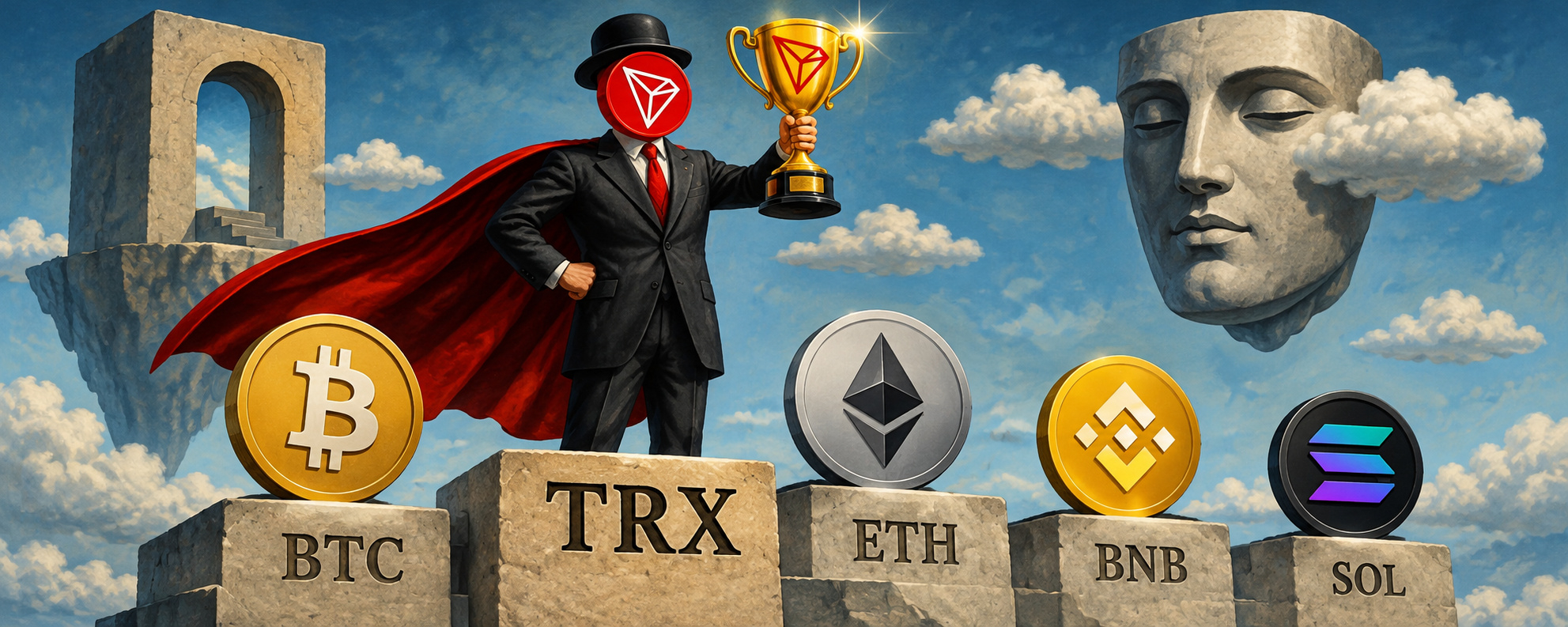

Over the past year, the token has outperformed Bitcoin, Ethereum, BNB, and Solana. Another detail is even more interesting: the publicly traded company Tron Inc. announced a program of daily TRX purchases. But there’s more to this story than corporate demand. TRON has an economy of its own, one that increasingly resembles infrastructure for global payments.
The market paradox
While investors debate when the next altcoin season will begin, TRX is quietly doing something many did not expect.
According to one recent comparison of annual returns as of November 7, 2026, TRX gained around 12%. Over the same period, Bitcoin lost about 13%, BNB 19%, Ethereum 23%, and Solana 29%.
This does not mean that TRX has become technologically stronger than all these projects. But the market does not vote on technology alone. It votes for sustainable demand, network utility, and an asset's ability to preserve value in an adverse environment.
First factor: real purchases
There is a specific corporate player in this story—Tron Inc., a publicly traded company whose shares are listed on Nasdaq.
In its corporate filings, the company disclosed a program to purchase around $50,000 worth of TRX daily for 360 consecutive days. The program began on January 22, 2026.
In its second-quarter filing, the company stated that it had acquired around 25.35 million TRX through this program by June 30. Some of the acquired tokens were staked.
This is no longer just a statement of faith in the project. It is an announced accumulation strategy with a specific budget and timeline.
But there is an important caveat: daily purchases by one company do not mean that the entire market is receiving a constant influx of capital. $50,000 a day is a notable corporate signal, but not enough to determine the price of a major crypto asset on its own.
Second factor: TRON has become payment infrastructure
This is arguably the strongest part of the investment story.
TRON stopped being just another blockchain for issuing tokens a long time ago. Its primary role is moving stablecoins, especially USDT.
According to published data for the third quarter of 2026, the network processed around $2.18 trillion in stablecoin transfers. The average supply of USDT on TRON reached approximately $90.75 billion. The number of stablecoin holders grew to 76.53 million.
That is an enormous level of usage.
For users, speed and transfer costs matter. For businesses, network availability and liquidity matter. TRON has found demand precisely where cryptocurrencies have long ceased to be merely a tool for speculation.
Third factor: token economics
This is where the less obvious part of the story begins.
TRX is used to pay for network resources, for staking, and to participate in governance. Some tokens are burned to pay for network transactions, while the protocol also issues new tokens as rewards.
According to TRON's third-quarter report, around 360.2 million TRX were issued and around 234.5 million were burned. As a result, the net increase in supply was approximately 125.8 million TRX.
This is important. High network activity does not guarantee an automatic reduction in the token supply. If issuance exceeds burns, inflationary pressure emerges.
That is why investors need to monitor not only USDT transfer volumes, but also the balance between TRX issuance and burns.
What the market may be underestimating
TRON has an advantage that is difficult to replicate quickly: users and businesses are accustomed to using the network for stablecoin transfers.
But there is a flip side. High USDT activity does not necessarily mean a proportional increase in demand for TRX itself. The network can handle a high volume of payments, while the token's price depends on the balance of supply, speculative demand, and the overall state of the crypto market.
This is exactly where the line lies between a successful blockchain and a successful investment asset.
Technical picture
On November 8, TRX was trading around $0.3205. The nearest support was around $0.3184, with resistance near $0.3217. The next resistance zone was around $0.3273.
The short-term picture looks better than the medium-term one. The four-hour chart shows signs of recovery, but the daily trend remains weak: the price is below the major moving averages.
This means it is still too early to buy based solely on a strong fundamental story.
Trading plan
Scenario: conditional LONG after recovery is confirmed.
Activation zone: above $0.3217
Entry: after holding above $0.3217 and successfully retesting this level from above.
Stop-loss: $0.3184
TP1: $0.3273
TP2: $0.3330
TP3: $0.3412
Invalidation: holding below $0.3184 after entry. If the price does not confirm the breakout, skip the trade.
Alternative scenario: if TRX loses $0.3184 and cannot reclaim this level, the next zones to watch will be $0.3140 and $0.3087.
Risk per trade: 0.5–1% of capital.
Three scenarios
Bullish: TRX holds above $0.3273, corporate purchases continue, and network usage and demand for stablecoins keep growing. The market may then begin to revalue the asset.
Neutral: the network continues to grow, but the price remains in the $0.3140–0.3330 range. Fundamentals are improving faster than the market valuation.
Bearish: Bitcoin continues to decline, TRX loses $0.3140, and growing supply starts to outweigh demand. In this case, even strong network metrics will not protect the token from a broader sell-off.
Conclusion
Many have noticed an interesting anomaly: TRX managed to outperform several of the largest cryptocurrencies over the past year despite a challenging market.
But I would focus not on the return itself, but on the combination of three factors: real network usage for stablecoins, a corporate accumulation program, and a functioning token economy.
At the same time, network success should not be confused with guaranteed growth in its coin. TRON has already proven that it can move large sums of money. Now the market has to prove that this activity can support long-term demand for TRX.
And perhaps the main question here is not whether TRX can outperform Bitcoin again. The question is how many investors are still underestimating the infrastructure used by millions of people every day.
(!) If this article got you thinking, let us know in the comments how you view this consensus right now. And if you want analysis like this without the fluff or hype, subscriptions are always open.