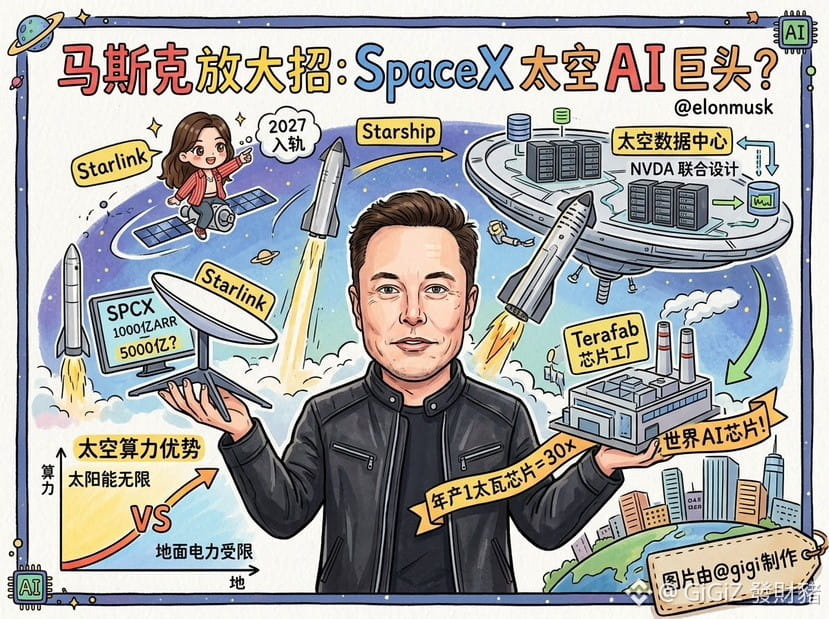

Musk makes another big move: Is SpaceX about to become a space AI giant?
In an interview at the Baron Investment Conference the day before yesterday, Musk talked about SpaceX, Terafab, space computing power, and the future of AI.
A few points are worth noting:
1. SpaceX revenue
Musk expects SpaceX’s annualized revenue to exceed $100 billion by the end of this year, with ARR potentially topping $500 billion by the end of next year. Growth will mainly come from Starlink, rocket launches, and future space computing business $SPCX
2. Terafab chip factory
The goal is to produce one terawatt of chips annually—30 times his forecast for global AI chip production next year. Musk wants to integrate chip design, manufacturing, packaging, and testing, giving himself greater control over chip production capacity.
3. Space data centers
The Starlink computers co-designed with $NVDA are expected to begin entering orbit in the third quarter of 2027. Musk believes that terrestrial AI computing power will face increasing electricity constraints, while space offers the advantage of solar power and could have lower costs in the long run.
What I found most interesting about this interview is that Musk has already laid out an enormous game plan. From chips to rockets, then satellites and AI computing power, he wants to control almost every link in the chain.
Of course, the plan is ambitious, and execution won’t be easy. Whether Terafab can reach mass production on schedule, whether Starship can achieve frequent reuse, and whether the cost of space computing can really come down—all of this still needs time to prove out.
If these projects gradually come together, the potential of $SPCX could indeed be much greater, and it may become an important player in AI infrastructure in the future.
DYOR