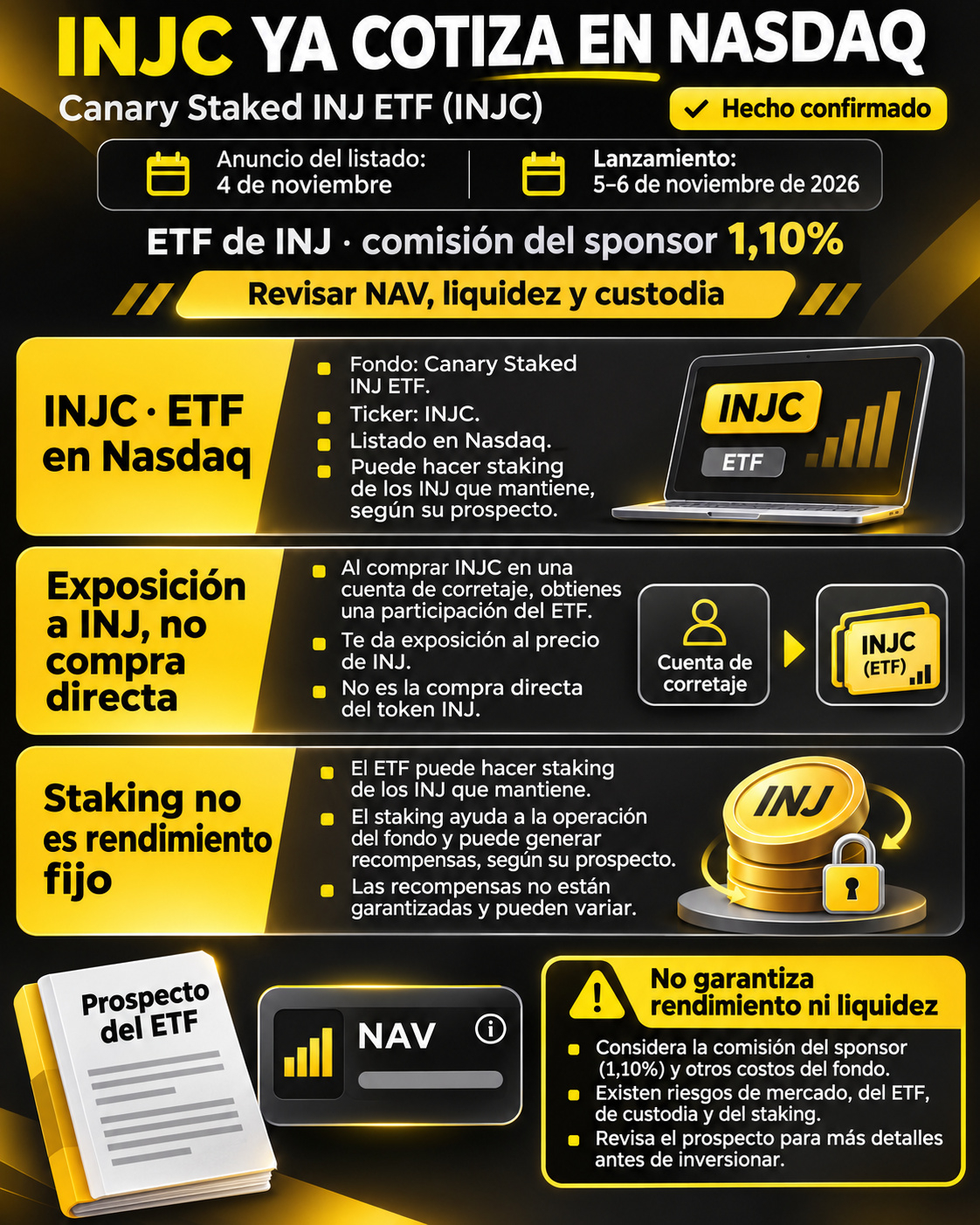
INJC now trades on Nasdaq: what the INJ ETF offers and what it doesn’t guarantee
Confirmed fact: Nasdaq announced on November 4, 2026, that it would begin listing the Canary Staked INJ ETF (ticker INJC) on November 5. Canary announced the launch on November 6. The product aims to provide exposure to INJ through a brokerage account and may stake a portion of the fund’s assets.
This is not the same as buying INJ directly. Canary’s website lists a 1.10% sponsor fee and clarifies that investing in the product is not a direct investment in cryptocurrency. The share price may diverge from the fund’s NAV, while liquidity, custody, the creation and redemption of shares, and staking availability depend on the vehicle and its providers.
Context matters: staking does not mean a fixed return. There is price, counterparty, and custody risk, as well as the possibility that rewards may not offset fees or periods of illiquidity. A Nasdaq listing also does not guarantee demand, returns, or continuous access to the market.
Market snapshot, not a signal: at 01:15 UTC, Binance showed INJ at 8.213 USDT (-1.829% in 24 hours; volume 7.54 million), BTC at 75,830.01 (-0.105%; 397.03 million), and ETH at 2,236.63 (-0.264%; 143.55 million). These movements do not prove a reaction to the ETF or predict future flows.
The educational distinction is between the spot asset, an ETF share, and a staking reward: each layer has different rules, costs, and risks. Before evaluating INJC, it is worth reading the prospectus, reviewing the NAV, understanding the staking policy, and checking how creation, redemption, and custody are managed.
$INJ $BTC $ETH
Educational content. Not financial advice.
#Injective #INJ #ETF #Staking