
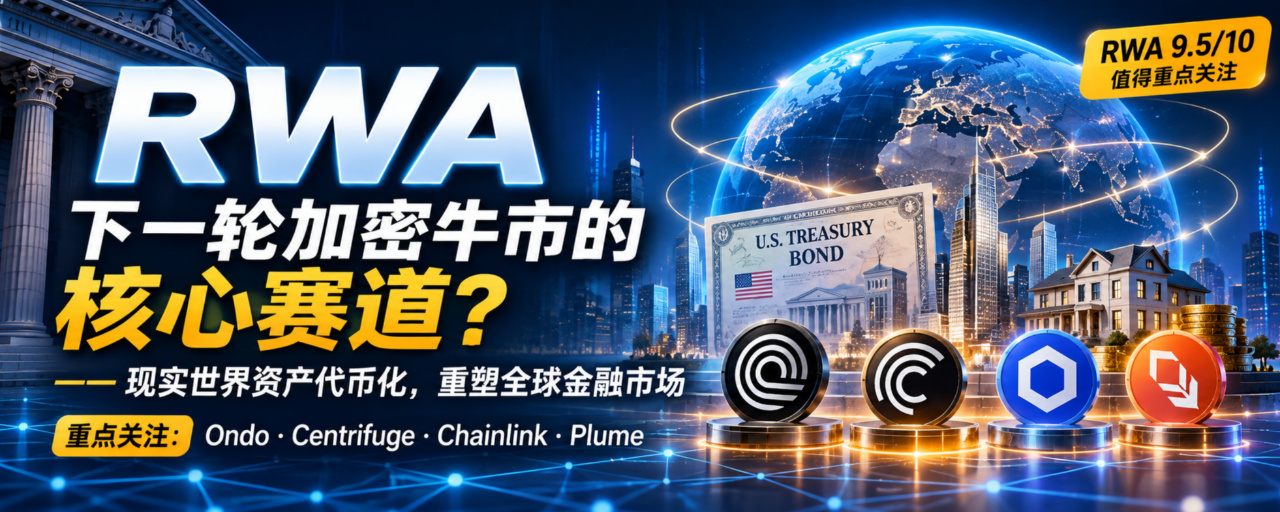

RWA: The Infrastructure Behind the Next Bull Market? Bringing Trillions of Dollars in Traditional Assets Onchain—The Real Story Behind Ondo, CFG, LINK, and Plume
Hey everyone, let’s look back at the major narratives that have taken turns dominating crypto over the years. Doesn’t the rhythm feel remarkably clear? In 2017, ICOs and public blockchains flourished; in 2020, DeFi Summer sparked onchain lending and liquidity mining; in 2021, NFTs, GameFi, and the metaverse were everywhere; in 2023–2024, everyone turned their attention to AI, meme coins, and the Bitcoin spot ETF frenzy. And over the past couple of years, a new trend that more and more people are taking seriously has gradually emerged: institutional finance, stablecoins, and the topic we’re discussing today—tokenized real-world assets (RWA).
Most of the narratives we’ve seen so far have been about creating new assets and new use cases from scratch within the blockchain world. RWA is different: rather than creating something out of thin air, it aims to bring the vast range of financial assets that already exist in the real world onto the blockchain. Treasuries, funds, stocks, private credit, real estate, and gold could all become on-chain tokens. If this takes off, blockchain will no longer be just a place for trading crypto and using derivatives—it will gradually become part of the traditional financial system. That’s why more and more institutional traders see RWA as one of the infrastructure sectors worth watching most closely in the next bull market. Today, we’ll break it down in plain language, without drowning you in jargon.
1. What Exactly Is RWA, and Why Is It Attracting So Much Capital?
RWA stands for Real World Assets. In simple terms, it uses a compliant legal framework and professional custodians, together with smart contracts, to represent rights to real-world assets on-chain.
Here’s an easy-to-understand example. If we want to buy a U.S. short-term Treasury fund, the process is long: find a broker, go through a fund manager and custodian, then use the traditional settlement system. There are many steps and a high barrier to entry. With the RWA model, the process looks like this: an institution holds the underlying real-world asset → sets up a compliant rights structure → issues tokens through smart contracts → accredited investors buy them → ownership shares and transfer records are recorded on-chain → users receive returns and request redemptions according to the rules.
Here’s a crucial pitfall many newcomers get wrong at first glance: receiving a token ≠ directly owning the underlying asset. A token might represent fund shares, a right to returns, or a debt claim—it’s simply an economic interest. The specific rights it confers depend entirely on the offering documents, local law, and custody terms. This is also the most fundamental difference between RWA and meme coins: meme coins rely on hype and storytelling, while RWA needs real assets, legal protections, and ongoing operations to stand on solid ground. Missing any one of these can easily lead to trouble.
I’ve outlined five key reasons why RWA can keep growing, and why institutions are willing to get involved. First, traditional finance is unimaginably large. Compared with U.S. equities, Treasuries, global real estate, and credit markets, the crypto market is just a small pond. RWA doesn’t need to create new demand; it simply brings the enormous pool of existing assets on-chain. Traditional investors can access on-chain products, crypto users can earn relatively stable returns from assets like Treasuries, and DeFi gets a range of high-quality collateral. It’s a two-way bridge.
Second, U.S. Treasuries are the best entry point for RWA. They’re highly standardized, offer stable interest, are liquid, and are globally recognized as a foundational dollar asset. In the past, most of the yield we earned in DeFi came from token incentives and mining rewards offered by projects—returns that were artificial and could disappear at any time. Tokenized Treasuries allow people to earn stable returns from the cash flows of real government debt, fundamentally changing DeFi’s yield structure.
Third, stablecoins have already paved the way for RWA. USDT and USDC have shown that people are willing to hold and transfer dollars on-chain. Stablecoins solve the problem of “having money on-chain,” RWA lets that money buy legitimate assets and earn returns, and DeFi provides financial tools like lending and collateralization. Stablecoins + RWA + DeFi together form an entirely new on-chain financial ecosystem.
Fourth, traditional financial institutions are genuinely getting involved. This isn’t just small operators jumping on a trend—asset managers, custodians, and brokers are all exploring tokenization. Institutions need more than a token issuance contract; they need a complete suite of compliance, KYC, custody, valuation, risk management, and cross-chain solutions. That means opportunities aren’t limited to asset-issuing platforms; infrastructure across the entire value chain could benefit.
Fifth, collateral is the real game changer. Tokenized assets aren’t just something to buy and hold for interest. If regulations allow it, tokenized Treasuries could be used as collateral in DeFi for borrowing, treasury management, and portfolio construction. When assets can be freely combined and reused, RWA will truly become financial infrastructure rather than just an investment product.
2. Where Are the Opportunities Across the RWA Value Chain?
Don’t just focus on which project has the largest asset base when you hear RWA. Let’s break down the value chain—each segment has a different role:
Asset issuance: tokenizes traditional assets. Ondo is a leading example
Asset management: manages asset pools and credit products. Centrifuge is a leading example
Oracles & cross-chain interoperability: delivers data and transfers information across chains. Chainlink
RWA-specific blockchain: designed for compliant asset distribution. Plume
On-chain applications: lending and yield protocols, such as Aave, Morpho, and Pendle
One key point to understand: the ultimate winners in the RWA sector may not be the projects that issue the most assets. Players that control the infrastructure for data, cross-chain transfers, compliance, and asset movement may be better positioned to benefit over the long term. Let’s take a closer look at the four projects people discuss most, explain what each one does, and highlight the risks to watch out for.
Ondo Finance (ONDO): A leader in tokenized financial products
Ondo is currently one of the most prominent names in RWA, focused on bringing traditional financial products such as Treasuries, ETFs, and stocks on-chain. Its best-known products include OUSG, USDY, and tokenized stock and ETF products. Its strengths are tangible: it’s not just making empty promises—its products are being rolled out; it’s working with established traditional financial services firms such as Broadridge to open up institutional channels; and it’s distributing across multiple chains so tokenized assets can reach different ecosystems. According to data published on its website, it has approximately $1.33 billion in TVL and hundreds of thousands of holders, though these figures change over time.
But be clear about one thing: growth in Ondo’s business doesn’t guarantee that the price of ONDO will rise. When researching it, focus on these questions: What governance rights does the token provide? What is the unlock schedule? Where does revenue come from? Can profits be shared with token holders? Will growth in assets under management create real demand for the token? My view: Ondo is a project worth following closely for asset issuance and product distribution, but don’t assume it’s a guaranteed winner.
Centrifuge (CFG): A bridge between real-world credit and DeFi
If Ondo focuses on mature, standardized products like Treasuries, Centrifuge’s main focus is private credit and structured asset pools. Its aim is to connect real-world credit assets to on-chain capital markets. It uses a Hub-Spoke architecture: the central Hub handles valuation, accounting, and redemptions, while individual Spokes issue assets on different chains, supporting today’s mainstream vault token standards. The platform is deployed across more than a dozen chains, has tokenized over $3.5 billion in assets to date, and has partnered with a number of well-known asset managers and index providers.
Private credit has significant potential. In the real world, many credit products have high barriers to entry, lack transparency, and are illiquid. Blockchain can make ownership records and return distributions more transparent. But the risks are just as evident: the underlying assets depend on borrowers’ creditworthiness, and defaults can still happen. Putting them on-chain won’t eliminate bad debt. For CFG, watch the asset pools’ delinquency rates, collateral quality, protocol fee revenue, and whether institutional capital continues to flow in. In short, it’s asset management infrastructure for the deep integration of RWA and DeFi.
Chainlink (LINK): Whoever comes out on top will probably need it
LINK has a unique position in RWA as essential underlying infrastructure. Whether Ondo, Centrifuge, or another issuer grows, they’ll all need to address three questions:
How can asset NAV and valuation data be reliably brought on-chain? How can assets be transferred securely across chains?
How can proof of reserves be verified?
Chainlink’s Data Feeds, CCIP cross-chain protocol, and Proof of Reserve (PoR) are designed to address these very issues.
Tokenized Treasuries need their net asset value refreshed, reserves verified, and assets transferred across chains every day—all of which depend on this kind of infrastructure. The upside thesis is that as the broader RWA market grows, demand for data and cross-chain transfers will rise. But it’s important to stay rational: greater ecosystem usage doesn’t necessarily mean LINK’s price will surge in tandem. Keep an eye on the network’s fee model, staking mechanism, and actual demand for the token. In my view, if RWA becomes a long-term trend, LINK is one of the highest-priority infrastructure projects.
Plume (PLUME): A dedicated blockchain built specifically for RWA
The first three projects build on existing blockchains or protocols. Plume takes a different approach: it’s building a dedicated chain designed for RWA.
Why does it need a separate chain?
Because RWA assets differ from ordinary crypto tokens: many require KYC, restrictions for accredited investors, controls over transfer permissions, redemption approvals, and automatic distribution of returns. General-purpose blockchains aren’t natively designed to handle these compliance rules, which makes implementation awkward. Plume is building a complete ecosystem around asset issuance, distribution, and compliant transfers. The potential is significant, but it’s still in the validation phase. Key things to watch: the value of real RWA assets on-chain, actual trading volume, the number of institutional deployments, and the token unlock schedule. Its growth potential looks good, but uncertainty is also the highest of these four projects.
Here’s a simple ranking of research priorities (not a ranking of potential gains, but an order of how worth they are tracking): LINK > ONDO > CFG > PLUME.
3. When Will RWA Take Off? 5 Key Catalysts
Continued growth in tokenized Treasuries: BlackRock’s BUIDL and Ondo’s Treasury products continue to grow, while more asset managers are entering the market with similar products. This is the most straightforward area to bring to market.
Tokenized stocks and ETFs become available: once compliance hurdles are cleared, stocks and ETFs could be settled and traded on-chain, significantly raising RWA’s potential ceiling.
RWA assets enter DeFi collateral pools at scale: this would be a turning point, transforming them from simple investment products into the collateral backbone of the entire on-chain financial system.
Cross-chain infrastructure matures: institutions operate across different blockchains, and assets and data need to move freely and securely to create a unified market.
Regulatory rules become clearer: RWA is subject to securities and fund regulations. A clear compliance framework is a prerequisite for large-scale capital inflows.
4. Five Major Risks That Are Easy to Overlook—Make Sure You Remember Them
RWA isn’t a risk-free golden opportunity. Many of its pitfalls are harder to spot than those in ordinary DeFi:
First, legal risk. An on-chain token doesn’t necessarily confer ownership. If a custodian or issuer becomes involved in a legal dispute, investors’ rights can easily be harmed.
Second, custody risk. A smart contract can record the number of tokens, but it can’t automatically ensure that the real-world assets actually exist. Independent audits and custody checks are essential.
Third, liquidity mismatch. Tokens can be traded 24/7, but the redemption periods for underlying real estate and credit assets can be long. A wave of redemptions can easily trigger a liquidity crunch.
Fourth, credit risk. U.S. Treasuries are relatively stable, but private credit and real estate carry default risks. Putting them on-chain doesn’t eliminate credit problems.
Fifth—and the pitfall crypto investors are most likely to fall into—is the challenge of value capture for the token. A platform holding billions in assets doesn’t mean its native token will receive a share of the returns.
Before investing, make sure you understand: what will create sustained buying demand for this token? Can business revenue flow through to token holders? If you can’t answer these questions, even the grandest narrative is just marketing.
5. The Three Areas I’ll Be Watching Closely Over the Next 1–2 Years
First, tokenized Treasuries and tokenized ETFs—the areas with the highest certainty. I’ll keep watching Ondo;
Second, private credit and collateral innovation, which will determine whether RWA can become a core part of DeFi. Centrifuge is the one to watch;
Third, oracle data feeds + cross-chain interoperability—the foundational infrastructure for the entire sector. That’s Chainlink. I’m keeping Plume on my watchlist and will pay closer attention as real ecosystem adoption data comes in.
To wrap up, here’s my core takeaway: RWA isn’t a short-term trend that will fade after a quick pump. It’s a long-term infrastructure narrative about the convergence of traditional finance and blockchain. To judge whether this sector is promising, don’t just look at how many assets new projects announce. Ask yourself these five questions:
Are real traditional assets actually being brought on-chain?
Are institutions using them on an ongoing basis?
Are DeFi protocols willing to accept them as collateral?
Can assets move safely across chains?
Can the business generate real revenue and share the benefits with token holders?
Stablecoins brought the dollar onto the blockchain, while RWA aims to bring an entire traditional financial market on-chain. If this works, the opportunities it creates could far exceed what we can imagine today.
⚠️Note: This article is for general educational purposes only and does not constitute investment advice. Projects in this sector face multiple risks, including regulatory, credit, smart contract, liquidity, and tokenomics risks. Please exercise caution.
If you’re interested in trading too, feel free to leave a comment or join the chat room to exchange ideas, learn, and grow together.
