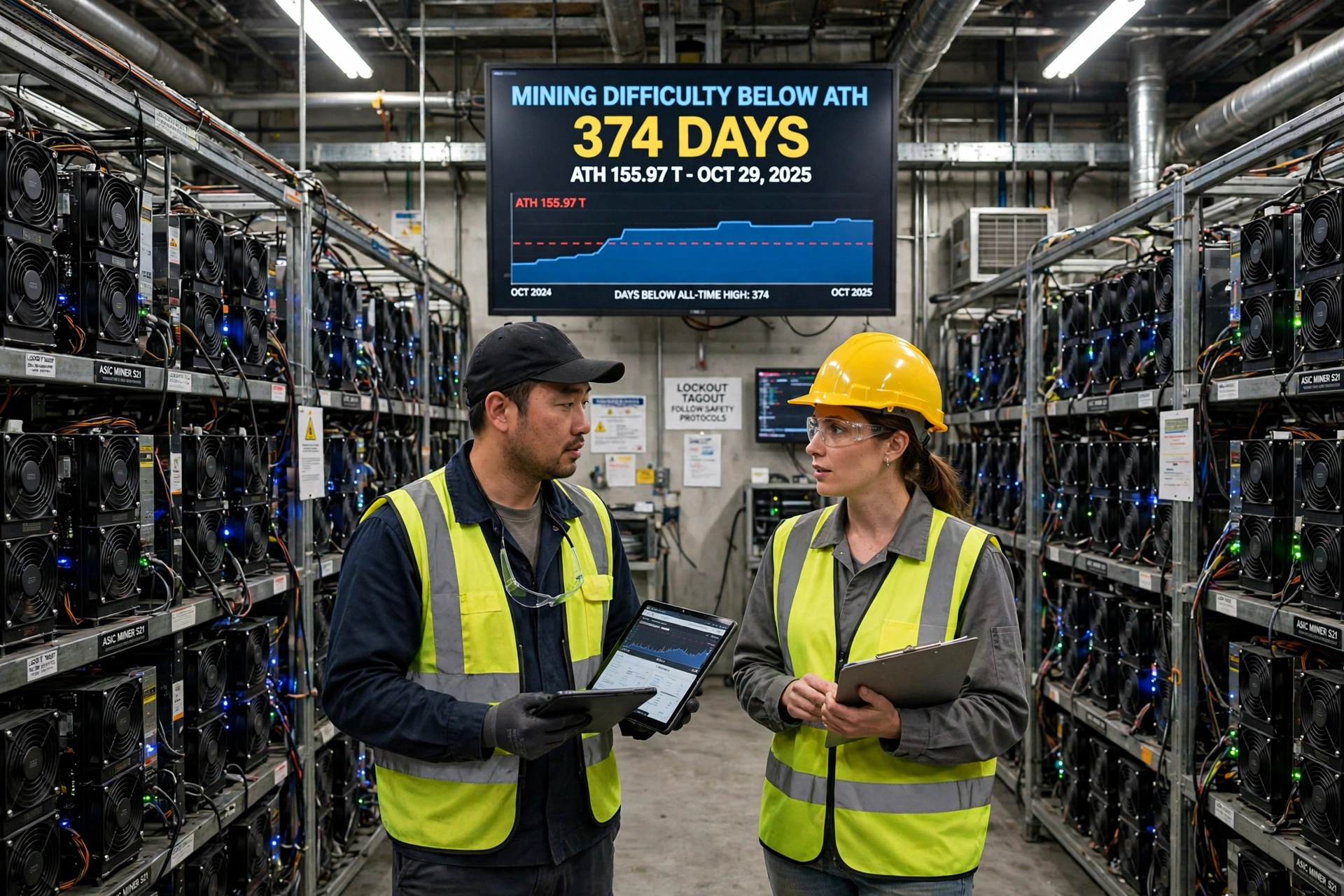
Bitcoin Mining Difficulty Sets a Grim Record: 374 Consecutive Days Below Its All-Time High
Bitcoin network mining difficulty has spent 374 consecutive days below its all-time high of 155.97 T, set on October 29, 2025. This is officially the longest such period in the network’s history, surpassing the 364-day record following the 2011 crash, as well as the 253-day period after China banned mining in 2021.
Mining difficulty measures the level of competition among miners: the higher the difficulty, the more computing power the network attracts. The fact that this metric has been “moving sideways below its peak” for more than a year shows that the mining industry is under significant pressure — with the price of $BTC struggling to stay around 76,000 USDT (currently trading at about 75,854 USDT, down slightly by 0.19% over 24 hours), which is not enough to offset rising operating costs, from electricity to hardware.
The consequences are becoming clear: many publicly listed mining companies have had to sell some of their $BTC reserves to balance their finances, while also shifting their existing power infrastructure toward leasing space for AI servers — a sector currently offering more attractive profit margins than coin mining.
On the positive side, the difficulty not reaching a new high does not mean the network’s security is weakening in the short term — but it does reflect a reality: in this cycle, miners are no longer the steadfast net buyers they once were, and the potential supply from their reserves remains a factor the market needs to watch.
Do you think mining difficulty will break above 155.97 T when the price of $BTC surges again, or will the mining industry continue to contract as AI becomes more appealing?
(Not investment advice)