I just finished reading the October jobs report, and the numbers were definitely stronger than expected.
The U.S. added 165,000 nonfarm jobs in October, compared with market expectations of only around 65,000. The unemployment rate fell from 4.2% to 4.1%. September’s figure was also revised up from an initial 29,000 to 60,000, while August was revised up from 133,000 to 186,000—an additional 84,000 jobs across the two months. The three-month average job gain was lifted to 137,000.
Job gains were also fairly broad-based across industries. Professional and business services added 70,000 jobs in a single month, while health care, transportation and warehousing, and manufacturing also posted gains. It wasn’t just one or two sectors holding things up. As for wages, average hourly earnings rose 0.4% month over month and 3.1% year over year. That’s not obviously out of control, but it can hardly be called a cooldown either.
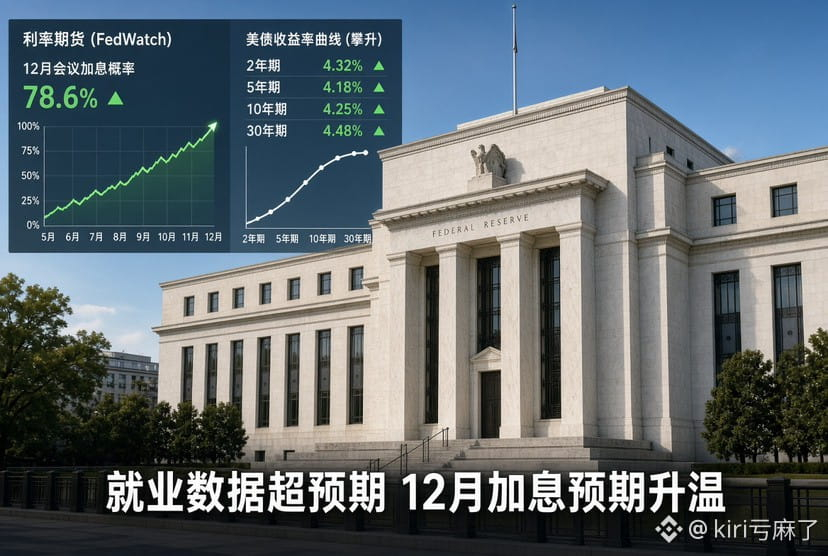
After the report came out, interest rate futures fell, and traders increased their bets on a December rate hike. Before the release, CME FedWatch put the probability of a 25-basis-point hike in December at around 72.8%; it has now climbed above 75%. The market has largely come to see another hike in December as the more likely scenario.
My own feeling is that this report gives the Fed more room to maneuver. Employment hasn’t weakened noticeably, so they can focus more on inflation without worrying as much about the labor market suddenly losing momentum. The Fed just held rates steady in October, and the market has already started moving up its timeline for the next rate hike.
There are also some structural details worth watching in the data. For example, the broader unemployment rate actually rose, the number of people working part-time increased, and the share of the long-term unemployed remains high. That suggests resilience and underlying strains are present in the labor market at the same time. But for now, the market seems more willing to believe that “the economy is still expanding and jobs are still being created” than to read too much into those blemishes.
For trading, the short-term implications are fairly clear: the dollar and Treasury yields will remain under pressure, and valuation pressure on long-duration assets will intensify again. Rate-hike expectations had eased a little amid the midterm elections and a pullback in tech stocks, but now they’ve tightened up again. The next CPI report will be a more important indicator ahead of the December meeting.
Strong employment data show that the economy isn’t immediately sliding into recession, but they also reinforce the prospect of interest rates staying high for longer. So, could things please stop falling? I just want to get back to breakeven 😭
#非农就业数据推升加息预期
The U.S. added 165,000 nonfarm jobs in October, compared with market expectations of only around 65,000. The unemployment rate fell from 4.2% to 4.1%. September’s figure was also revised up from an initial 29,000 to 60,000, while August was revised up from 133,000 to 186,000—an additional 84,000 jobs across the two months. The three-month average job gain was lifted to 137,000.
Job gains were also fairly broad-based across industries. Professional and business services added 70,000 jobs in a single month, while health care, transportation and warehousing, and manufacturing also posted gains. It wasn’t just one or two sectors holding things up. As for wages, average hourly earnings rose 0.4% month over month and 3.1% year over year. That’s not obviously out of control, but it can hardly be called a cooldown either.
After the report came out, interest rate futures fell, and traders increased their bets on a December rate hike. Before the release, CME FedWatch put the probability of a 25-basis-point hike in December at around 72.8%; it has now climbed above 75%. The market has largely come to see another hike in December as the more likely scenario.
My own feeling is that this report gives the Fed more room to maneuver. Employment hasn’t weakened noticeably, so they can focus more on inflation without worrying as much about the labor market suddenly losing momentum. The Fed just held rates steady in October, and the market has already started moving up its timeline for the next rate hike.
There are also some structural details worth watching in the data. For example, the broader unemployment rate actually rose, the number of people working part-time increased, and the share of the long-term unemployed remains high. That suggests resilience and underlying strains are present in the labor market at the same time. But for now, the market seems more willing to believe that “the economy is still expanding and jobs are still being created” than to read too much into those blemishes.
For trading, the short-term implications are fairly clear: the dollar and Treasury yields will remain under pressure, and valuation pressure on long-duration assets will intensify again. Rate-hike expectations had eased a little amid the midterm elections and a pullback in tech stocks, but now they’ve tightened up again. The next CPI report will be a more important indicator ahead of the December meeting.
Strong employment data show that the economy isn’t immediately sliding into recession, but they also reinforce the prospect of interest rates staying high for longer. So, could things please stop falling? I just want to get back to breakeven 😭
#非农就业数据推升加息预期