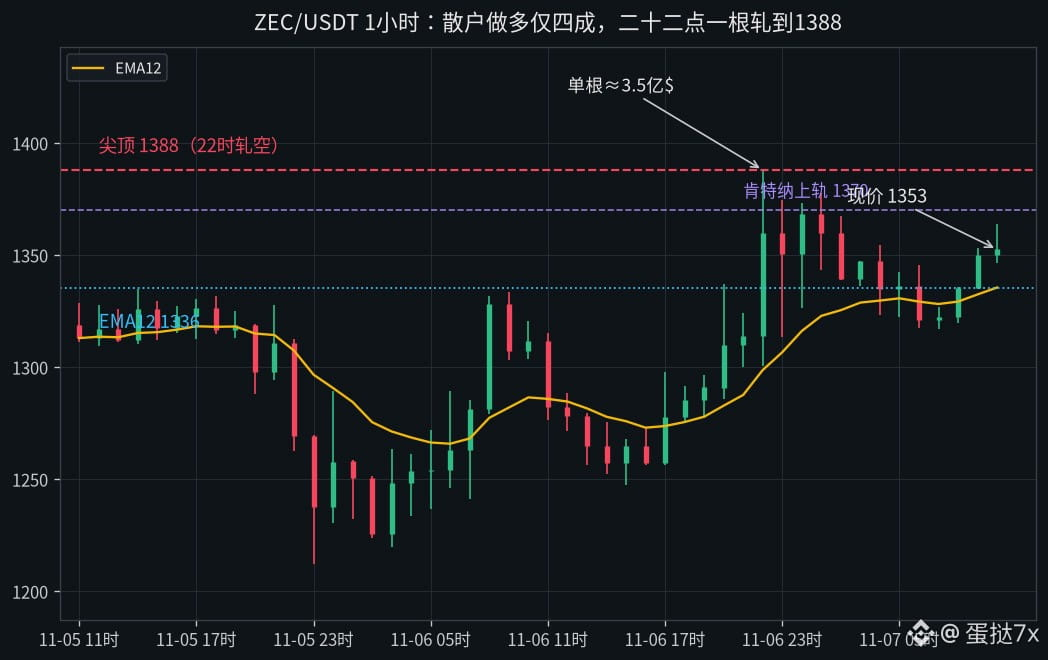
When the retail long-account ratio fell to 38%, $ZEC shot straight up to 1,388—the 22:00 hourly candle climbed from 1,314 to a peak of 1,388, with about $351 million in volume. At 23:00, it plunged from 1,360 back to 1,313 before recovering, with about $300 million in volume. The current price is around 1,355, up about 3.2% over the past day, with roughly $2.34 billion in futures volume. Open interest rose from about 437,000 contracts at 21:00 to a peak of about 453,000 at 23:00, then dropped back to about 441,000 at midnight and is now around 438,000—the new positions added during that spike didn't hold.
The key is the positioning structure. The retail long-account ratio slid from about 43.9% at 20:00 to about 38.6% at 23:00. Even as the short squeeze unfolded, traders crowded further onto the short side; the ratio is still pinned around 40%. Yet large traders' long positions remain at about 58%, while long accounts among large traders are around 40%—the two measures point in opposite directions. Funding stayed capped at the settlement limit of +0.01% all day, with longs continuously paying shorts a small amount. The taker buy/sell ratio only reached 1.04 on the 22:00 squeeze candle, which looks more like short covering than retail chasing longs; by 2:00 a.m., it had fallen to 0.76. The mechanism in a nutshell: traders are positioned short while the price is rising. This leg was driven by short covering, not by a buildup of new longs.
The 1-hour RSI is around 60; the 12-period moving average is about 1,336, the 26-period moving average about 1,321, and the Keltner Channel's upper band is around 1,370 with its middle band around 1,327. The Bollinger upper band at about 1,389 sits right at the peak, and the KDJ J value is around 60. The price is consolidating above the 12-period moving average; after pulling back from the peak, it hasn't broken out to a new high.
I interpret this move around 1,355 as a pullback after crowded shorts were squeezed, not as a new long base. Until open interest expands back above 450,000 contracts and the retail long-account ratio climbs back to 50%, the upside is capped first by the 1,388 peak. If it loses the 1,336 12-period moving average, watch the Keltner middle band at 1,327.
$ZEC #合约数据 #Open Interest