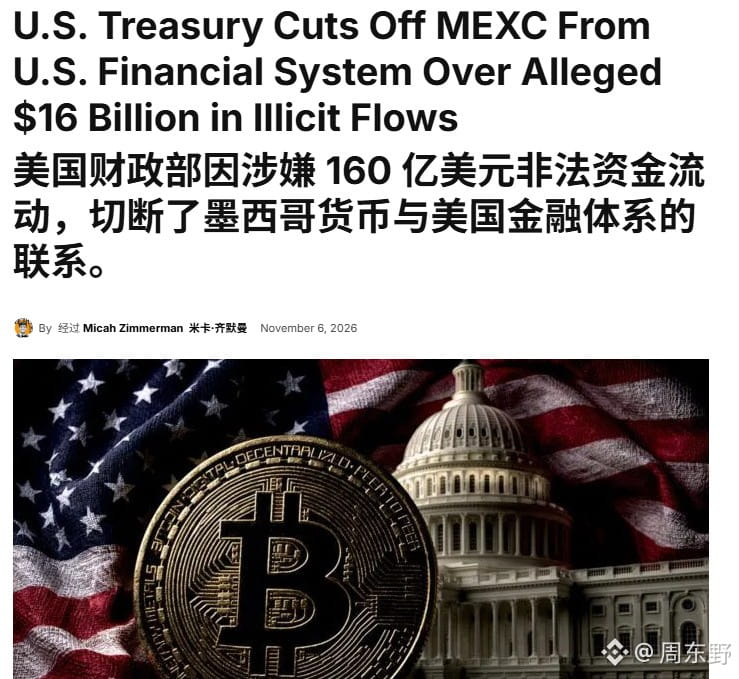
MEXC is really in trouble this time! Banned by the U.S. Treasury over alleged involvement in $16 billion in illicit transactions.
The U.S. Treasury’s Financial Crimes Enforcement Network (FinCEN) has officially issued a 24-page order banning MEXC and ordering it to be completely cut off from the U.S. financial system. The order will take effect 30 days after its publication in the Federal Register. At that point, all U.S. financial institutions will be prohibited from conducting any financial transactions with MEXC, whether in fiat currency or cryptocurrency.
Many people’s first reaction is: “MEXC’s terms of service already prohibit U.S. users. Is this really such a big deal?”
That seriously underestimates FinCEN’s power. Before, the restrictions were about “who can trade on MEXC.” Now, they’re about cutting off “MEXC’s access to financial channels.”
According to FinCEN’s allegations, MEXC processed approximately $16.7 billion in suspicious and illicit funds between 2021 and 2026. These included $1.5 billion linked to the sanctioned Russian exchange Garantex, more than $1 billion in direct transfers involving over 40 Iranian exchanges, and transfers that aided money launderers linked to North Korea.
But the most devastating part of this regulatory action isn’t the “ban” itself—it’s the chain reaction of counterparty risk that follows:
Fiat deposits and withdrawals, as well as banking channels, face a freeze: Even though MEXC’s main operations are overseas, the vast majority of fiat on- and off-ramps, market makers, and banks worldwide rely heavily on the U.S. financial system or use the U.S. dollar for clearing. No compliant bank or major liquidity provider will dare risk secondary sanctions from FinCEN by continuing to route funds to MEXC.
Cross-exchange arbitrage and on-chain liquidity could become fragmented: Once the order takes effect, compliant exchanges such as Coinbase and Kraken are highly likely to block or flag transfers originating from MEXC’s on-chain addresses. This would cut off market makers’ arbitrage channels, potentially leading to a structural loss of depth and liquidity on MEXC.
While FinCEN’s order will not directly freeze MEXC
users’ personal assets or cause the platform to shut down overnight, as global regulatory reach continues to expand, the offshore shield of “pretending not to serve U.S. users” has become completely ineffective.
What’s worth watching next is how quickly global market makers and partner banks sever their clearing ties with MEXC,
and whether this will trigger a new wave of offshore exchanges moving away from the U.S. dollar for deposits and withdrawals.
The U.S. Treasury’s Financial Crimes Enforcement Network (FinCEN) has officially issued a 24-page order banning MEXC and ordering it to be completely cut off from the U.S. financial system. The order will take effect 30 days after its publication in the Federal Register. At that point, all U.S. financial institutions will be prohibited from conducting any financial transactions with MEXC, whether in fiat currency or cryptocurrency.
Many people’s first reaction is: “MEXC’s terms of service already prohibit U.S. users. Is this really such a big deal?”
That seriously underestimates FinCEN’s power. Before, the restrictions were about “who can trade on MEXC.” Now, they’re about cutting off “MEXC’s access to financial channels.”
According to FinCEN’s allegations, MEXC processed approximately $16.7 billion in suspicious and illicit funds between 2021 and 2026. These included $1.5 billion linked to the sanctioned Russian exchange Garantex, more than $1 billion in direct transfers involving over 40 Iranian exchanges, and transfers that aided money launderers linked to North Korea.
But the most devastating part of this regulatory action isn’t the “ban” itself—it’s the chain reaction of counterparty risk that follows:
Fiat deposits and withdrawals, as well as banking channels, face a freeze: Even though MEXC’s main operations are overseas, the vast majority of fiat on- and off-ramps, market makers, and banks worldwide rely heavily on the U.S. financial system or use the U.S. dollar for clearing. No compliant bank or major liquidity provider will dare risk secondary sanctions from FinCEN by continuing to route funds to MEXC.
Cross-exchange arbitrage and on-chain liquidity could become fragmented: Once the order takes effect, compliant exchanges such as Coinbase and Kraken are highly likely to block or flag transfers originating from MEXC’s on-chain addresses. This would cut off market makers’ arbitrage channels, potentially leading to a structural loss of depth and liquidity on MEXC.
While FinCEN’s order will not directly freeze MEXC
users’ personal assets or cause the platform to shut down overnight, as global regulatory reach continues to expand, the offshore shield of “pretending not to serve U.S. users” has become completely ineffective.
What’s worth watching next is how quickly global market makers and partner banks sever their clearing ties with MEXC,
and whether this will trigger a new wave of offshore exchanges moving away from the U.S. dollar for deposits and withdrawals.