



The U.S. labor market delivered unexpectedly strong signals. Nonfarm payroll growth in October far exceeded economists’ expectations, while the unemployment rate also fell, showing that the U.S. jobs market remains resilient despite high inflation, adjustments in business investment, and ongoing uncertainty over economic policy.
Data released Friday by the U.S. Bureau of Labor Statistics showed that nonfarm payrolls increased by 165,000 in October, exceeding the market expectation of 65,000. The unemployment rate fell to 4.1% from 4.2% in September, also beating market expectations.
Average hourly earnings, closely watched by Wall Street, rose 3.1% year over year, above the market expectation of 2.9% and staying above the 3% threshold; the monthly rate edged up to 0.4% from 0.3% previously.
After the data was released, spot gold fell more than $30 in a short period before quickly recovering some of its losses. The U.S. dollar index continued to rise, and markets increased their bets on a Fed rate hike in December. Futures contracts tied to the Fed’s policy rate indicated that markets saw about an 80% chance of a 25-basis-point rate hike next month.
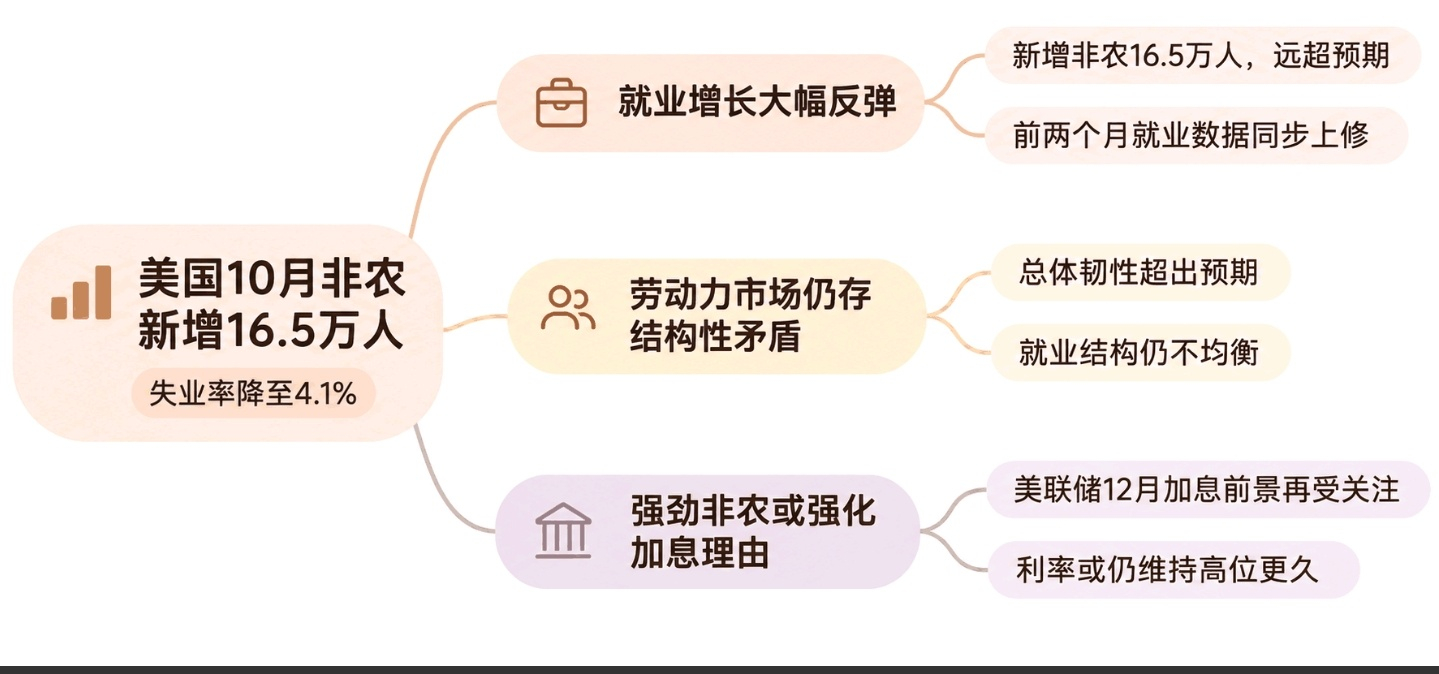
Job growth rebounds sharply, with figures for the previous two months revised upward
The key changes in this nonfarm payrolls report were not only a marked acceleration in job growth in October, but also upward revisions to the figures for the previous two months.
The U.S. Bureau of Labor Statistics revised up the combined number of jobs added in August and September by 84,000. September’s job gains were revised up to 60,000 from the previously reported 29,000. This means the U.S. labor market has performed more strongly in recent months than previously reported, and concerns that job growth had remained persistently weak may need to be reassessed.
Before this report was released, several employment indicators had already pointed to signs of improvement in the labor market. The U.S. Bureau of Labor Statistics’ previously released Job Openings and Labor Turnover Survey (JOLTS) showed that job openings increased in September, hiring picked up, and the number of people quitting their jobs also rose.
Meanwhile, initial U.S. jobless claims remained near historically low levels, indicating that businesses had not yet resorted to widespread layoffs.
Together with the October nonfarm payrolls report, these changes suggest that the U.S. labor market may be emerging from its earlier hiring slump. However, monthly employment figures are volatile, and further data will be needed to confirm a sustained improvement.
Strong payrolls may bolster the case for Fed rate hikes
The employment report was released as the Fed entered a key observation period ahead of its next rate decision. Fed Chair Warsh previously stressed that inflation must continue to move sustainably toward the 2% target, and said current financial conditions could not yet be considered sufficiently restrictive.
Against this backdrop, a surprisingly strong nonfarm payrolls report could ease concerns about a slowdown in the U.S. economy while strengthening the case for the Fed to maintain restrictive policy. Earlier, investors had lowered their expectations for future Fed rate hikes amid a sharp sell-off in global technology stocks, falling oil prices, and increased demand for safe-haven assets.
After the nonfarm payrolls report, markets will turn their attention to other key releases: the U.S. will publish its October Consumer Price Index (CPI) on November 10 and its November nonfarm payrolls report on December 4. The Fed will then make its next rate decision on December 9.
