
Forgive me for being a jinx—unfortunately, I called it: this is a rebound, not a reversal, but there's no need to worry too much!
After the 2006 midterm elections, when both chambers of Congress switched control, the US stock market was mostly volatile, not in a major decline.
Brother Bee's take is that although Democrats control Congress and there is friction with Trump, there is no friction between the two parties.
Also, Brother Bee still believes AI stocks are undergoing a correction, not a bubble bursting.
First, human nature may always be much the same, and people have been saying since last year that the AI bubble was bursting, so any rise would be followed by a correction.
Second, the 2000 dot-com bubble was a crazy surge in stock prices—a bubble in the securities market.
The 2008 subprime crisis involved layers of leveraged products built on top of a real estate bubble. It was more like a bubble in the banking system.
If there is a third one, it probably won't be such a simple repeat.
Third, Brother Bee previously looked at logarithmic charts. Once the exponential effect is taken into account, today's US stock market appears to be experiencing relatively healthy exponential growth. The growth in 2000, by contrast, was bubble-like exponential growth:
笑不活了,我又找到一个AI没有泡沫的证据。
Fourth, look at individual stocks' P/E ratios. A P/E of no more than 20 is generally considered not to indicate a bubble. And US stock market P/Es have been on an upward trend over the past 30 years. Given forecasts of rapid earnings growth, is AI really in a bubble?
NVDA PE (TTM): 23.061
AAPL PE (TTM): 38.74
GOOGL PE (TTM): 14.79
MU PE (TTM): 8.957
SNDK PE (TTM): 6.612
AMD PE (TTM): 88.64
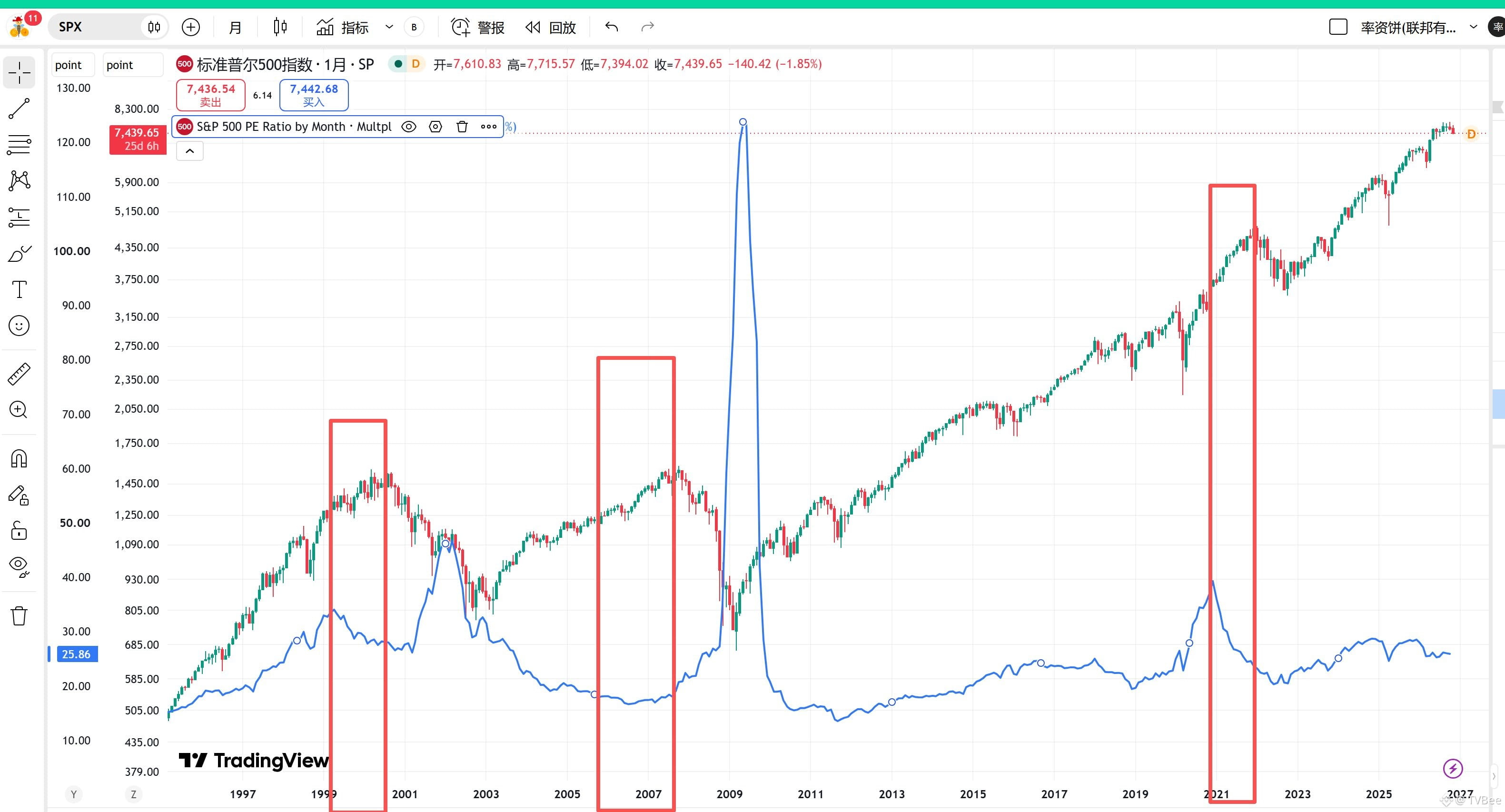
Fifth, in all three historical cases—the dot-com bubble, the subprime crisis, and 2021—there was a period before the major US stock market declines when the S&P 500 was rising even as its PE (TTM) was falling. This was because earnings were growing too fast, bringing future demand forward, and stock prices gradually couldn't keep up. That isn't happening now.
Bubbles also show a pattern after they burst: the S&P 500 falls while its PE rises, because listed companies' earnings fall even faster than their share prices. Of course, as discussed above, earnings had already pulled future demand forward.
There are no signs of this at the moment.
So Brother Bee's view remains unchanged: expect 2–4 months of volatility. If things move quickly, it will start to improve gradually in Q1; if slowly, in Q2.