
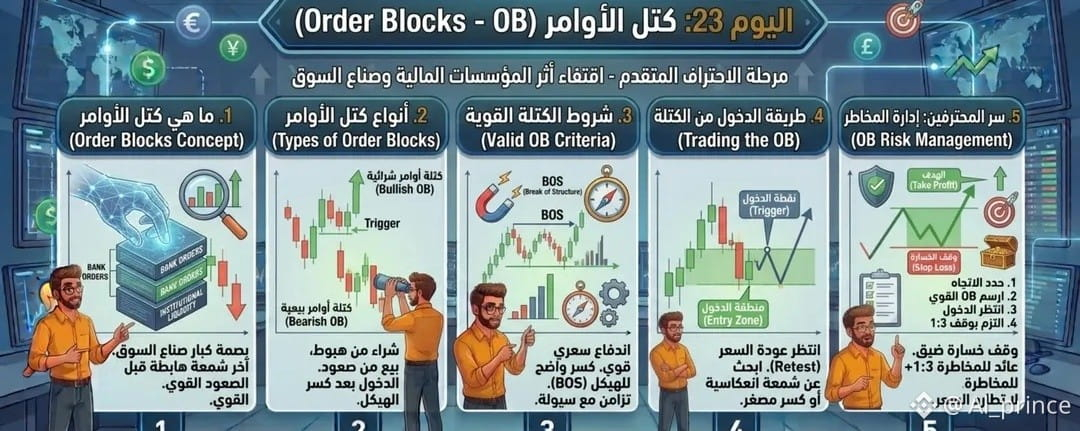

What Are Order Blocks (Order Blocks Concept)
🏦 Concept: The last candle moving against the trend before a strong move (Impulse Move) breaks the structure (BOS).
⚡ The secret: Major institutions leave their “footprint” and pending orders in this candle. Price later returns to test it before continuing in its direction.
2. Types of Order Blocks
📈 Bullish Order Block (Bullish OB): The last bearish (red) candle before a strong upward move breaks a previous high (BOS). Wait for price to return to it before buying.
📉 Bearish Order Block (Bearish OB): The last bullish (green) candle before a strong downward move breaks a previous low (BOS). Wait for price to return to it before selling.
3. Criteria for a Strong, Valid Order Block (Valid OB Criteria)
🎯 Strength of the Break: The order block should be followed by a strong price impulse that clearly breaks market structure (BOS).
🧲 Respect: The best order blocks coincide with previous liquidity zones or key support/resistance levels (confluence).
4. How to Enter from an Order Block (Trading the OB)
⏱️ Patience: Don’t buy or sell just because price reaches the order block for the first time; wait for price to return to it (retest).
🕯️ Confirmation: Watch price action inside the order block, or move to a lower timeframe to look for a reversal candle or a minor structure break.
5. The Professionals’ Secret: Risk Management with OBs
🛡️ Stop Loss: Place it precisely just beyond the low or high associated with the order block.
🎯 Take Profit: Target the next high or low, aiming for an excellent risk-reward ratio (at least 1:3).
📝 Intermediate Explanation (to be written below the post)
How can you follow the trail of big money through Order Blocks?
Banks don’t open all their positions at once:
When large investment funds want to buy or sell millions of contracts, they can’t do it all at once, or they would cause a price spike against their own interests. Instead, they “accumulate” their orders in batches, leaving a clear footprint on the chart—what we call an Order Block.
Hunting in Institutional Zones:
When price rebounds sharply upward, leaving a final bearish candle behind, that candle represents the “scene of the crime”—or, more accurately, the point where institutional orders gathered. When price later returns to test this candle, it often rebounds sharply because institutions are defending their pending orders there.
Patience Is the Key to Success:
Never chase price while it’s moving sharply up or down. Identify the order block on higher timeframes (such as the 4-hour or 1-hour chart),
and let price come to you.
