
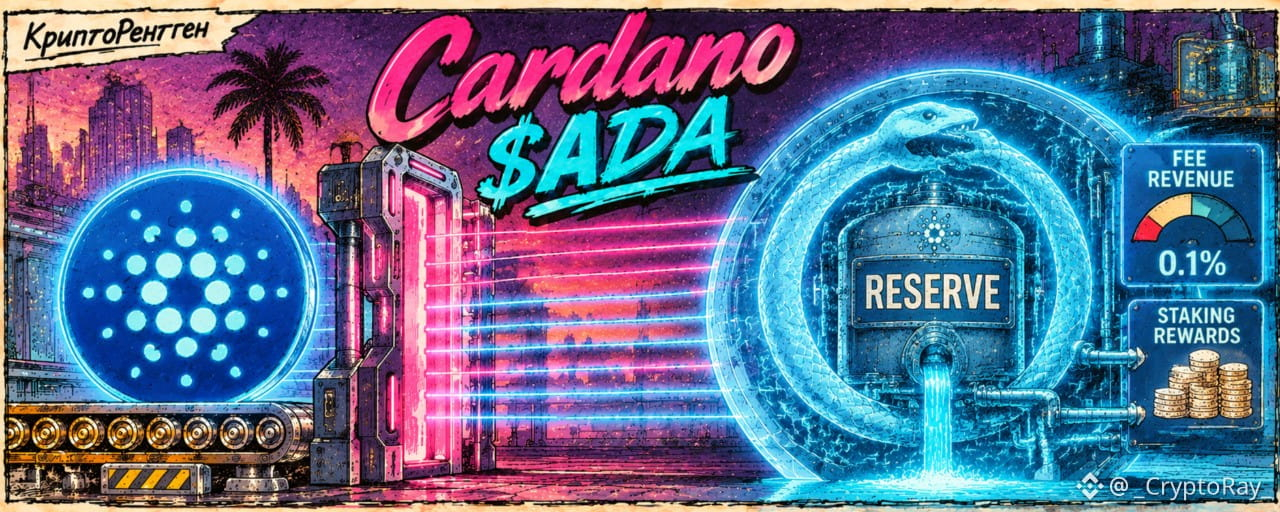

Cardano ($ADA ) is a Proof-of-Stake Layer 1 with delegation, a treasury, and reserve-funded rewards. It is not a project “without an economy”: network fees really do go into the rewards pool.
The main tension is one of scale. Market capitalization is ~$7.0 billion, while daily network fees are ~$1,420 and TVL is ~$52 million. Staker rewards are still funded mostly from reserves, not fees. This analysis is for those studying PoS economics who want to distinguish a functioning mechanism from its scale.
Snapshot: November 5, 2026. DeFi metrics are for November 4.
Technology
Consensus: Proof of Stake, using the Ouroboros protocol. Holders delegate ADA to stake pools, which produce blocks. Delegation does not lock tokens (a widely known feature of the network, but not covered in the files reviewed).
Accounting model: extended UTXO. In practice, this means predictable fees and parallel transaction processing, but a different approach to contract development compared with EVM networks.
Leios is a scaling initiative aimed at increasing throughput. Official materials confirm that it is under development and testing. However, the date “Musashi Dojo, June 23, 2026,” the “10–65x” speedup, and mainnet readiness are not confirmed by primary sources. Leios cannot be declared complete. Even if successful, increased throughput does not create demand by itself; applications and paid transactions are needed.
Tokenomics
Max supply: 45 billion ADA.
Circulating supply: ~36.82 billion (~81.8% of the maximum, my calculation).
FDV: ~$8.55 billion, or ~1.22× market capitalization (my calculation).
Circulating supply cannot be calculated by simply subtracting the reserve from the maximum: the system accounts for reserves, the treasury, and rewards separately. An official supply snapshot for the epoch is needed for an accurate figure. The reserve of ~6.1 billion ADA at epoch 655 appears only in the second document and has not been cross-checked.
How rewards work (official model):
Fees are collected into a common pool.
A portion of the reserve is added to it. The parameter ρ = 0.3% specifies the share of the remaining reserves added to the virtual rewards pool each epoch.
The share goes to the treasury (parameter τ).
The rest goes to stake pools and delegators.
ρ describes the replenishment rule, not a guarantee that exactly 0.3% of the reserve is paid out every epoch.
There is no burn. The model does not include burning. Reserves gradually enter circulation through rewards.
Investors
Cardano was funded through a public sale in 2017–2018, with some tokens allocated to IOHK, Emurgo, and the Cardano Foundation. This is widely known project history, but it is not covered in the materials reviewed.
On-chain and market data
Market data:
Price (CoinMarketCap): ~$0.1900
Market capitalization: ~$7.00 billion
24-hour trading volume: ~$196 million
Volume / market capitalization: ~2.8%
Rank: #15
DeFi and activity (DefiLlama, November 4):
TVL: ~$52.27 million
Stablecoins: ~$56.08 million
24-hour DEX volume: ~$1.37 million
24-hour fees: ~$1,420
Active addresses: ~14,000
Transactions: ~26,200
What this means:
A DeFi ecosystem exists, so the data cannot be “unavailable.”
TVL ≈ 0.75% of market capitalization (my calculation): that is very low for a network valued at $7 billion.
Fees of $1,420 per day amount to around 7,500 ADA per day (my calculation). According to Bitquery, the average per epoch during the period studied was ~45,000 ADA, which is consistent in terms of order of magnitude.
The materials contain no comparisons with competitors, so I will not make one.
The full picture
Facts
Fees are distributed. The claim that “fees do not go to network participants” is incorrect.
According to Bitquery, over 73 epochs through September 2026: fees were ~3.3 million ADA, rewards were ~493.7 million ADA, and the ratio was ~0.668%. This is a historical sample drawn from secondary publications.
493.7 million ADA cannot be described entirely as new issuance: rewards also include fees.
On average, rewards per epoch were ~6.8 million ADA, and fees were ~45,000 (my calculation).
Rumors and unverified claims
“A third of activity is bots, meaning fake demand.” Unverified. Bitquery’s classification includes high-frequency addresses and batchers, which may serve real users.
The decline in transactions from ~90,000 per day (2022) to ~25,000 (2026) appears only in the second document. The decline is worth noting, but it cannot be equated with an equally large drop in demand.
Claims that Leios is “complete” or “10–65 times faster” are unverified.
Strengths and weaknesses
Strengths
A functioning rewards model: fees, reserves, the treasury, and delegators are connected through an official mechanism.
A 45 billion cap and no inflation beyond the built-in schedule.
Delegation without locking tokens lowers the barrier to participation.
A measurable DeFi base: TVL ~$52 million, stablecoins ~$56 million.
Liquidity and a rank of #15: trading volume of ~$196 million per day.
Weaknesses
Fees amounted to ~0.67% of rewards during the period studied, meaning the network depends on reserves.
TVL is ~0.75% of market capitalization: DeFi is small relative to the valuation.
DEX volume of ~$1.37 million per day limits market depth.
The decline in transaction activity warrants attention.
Leios is unverified, and increased throughput alone does not create demand.
Reserves are declining: once they are depleted, the question arises of whether fees can cover rewards.
Sources
Cardano Docs — monetary policy
DefiLlama — Cardano
CryptoSlate — fees and rewards (Bitquery)
