
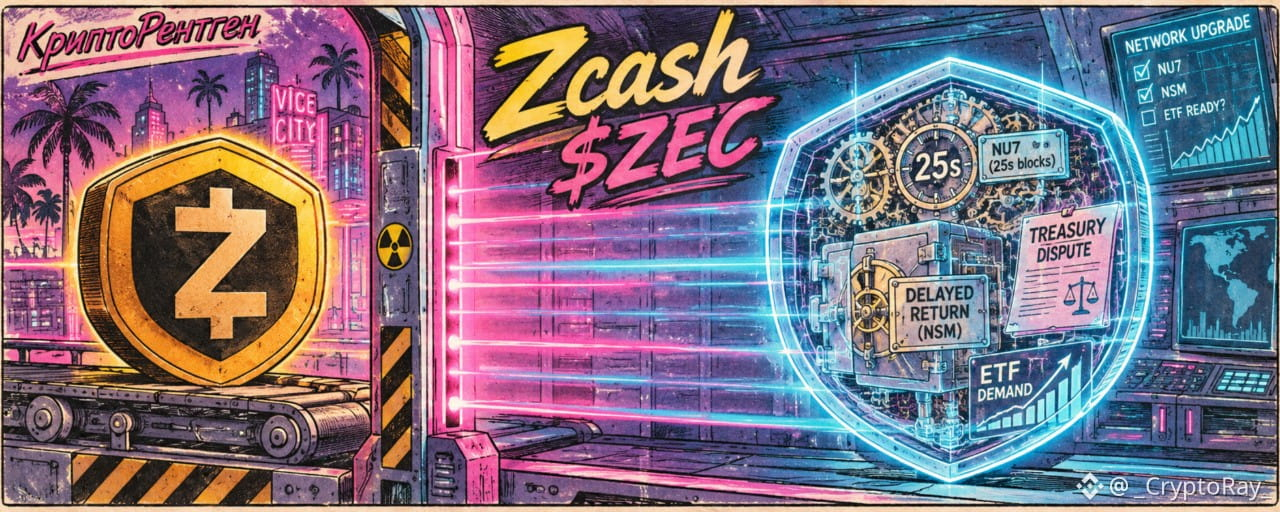
Zcash ($ZEC ) is a PoW blockchain for payments with optional privacy. Transactions can be transparent or shielded, meaning the sender, recipient, and amount are hidden.
The main conflict right now is that the network has three events happening at once: the NU7 upgrade, with blocks three times faster; a dispute over development funding (ZCG); and a spot ETF from Grayscale. All three affect the asset’s demand, supply, and accessibility, but none proves that its price will rise.
This analysis is for those studying privacy coins, PoW economics after subsidy reductions, and the institutional infrastructure around ZEC.
Snapshot: November 5, 2026. Figures are from aggregator snapshots, not a single unified quote.
Technology
Consensus: Proof of Work. The network is not moving to PoS, and NU7 does not change that.
Privacy: shielded transactions conceal participants and amounts. Privacy is optional, so the network also supports transparent transfers.
What NU7 changes (according to the upgrade description):
The target block interval is reduced from 75 to 25 seconds.
The block reward falls by a factor of three, keeping daily issuance roughly unchanged.
Some fees are temporarily taken out of circulation (Network Sustainability Mechanism, NSM) and returned as future rewards, starting around February 2031.
Legacy v4-format transactions are disabled.
Activation status. Mainnet activation is tied to block height 3,543,405, not a date. The expected date, around November 5, remains a forecast. Until reaching this height is confirmed, the upgrade cannot be described as complete.
In practice: faster blocks reduce the wait for the first confirmation, which matters for payments. The trade-off is that the network has more blocks and nodes face a greater workload.
NSM is not a burn. Tokens are not destroyed permanently; they are deferred and returned to miners as future rewards.
Tokenomics
Maximum supply: 21 million ZEC. Circulating supply is about 16.95 million (~80.7% of the maximum, my calculation).
Halving: the mechanism remains in place. According to the second of the source documents, the next halving is expected in 2028, but no source is cited there.
Estimated issuance: about 1,800 ZEC per day, or ~657,000 ZEC per year (around 4% of the current supply). This is an estimate, not a protocol constant: reward rules change with upgrades.
Burning: there is no regular burn. The only mechanism resembling a withdrawal is the NSM, and it is reversible. The return period begins around 2031.
There are no dividends. ZEC is not a stock and does not confer a right to an organization's profits.
Investors
Zcash launched without a pre-mine. In its early years, part of the block reward went to founders, early investors, and teams (Founders' Reward); later, this was replaced by development-funding schemes. This is well-known project history, but it is not covered in the materials reviewed.
The names of funds, round sizes, and entry prices were not found in the materials reviewed. Instead of classic investment rounds, two things matter more today: funding through ZCG and institutional demand through ETFs.
Market and institutional infrastructure
Market data:
Price (CoinMarketCap): ~$1,200
Price (another aggregator): ~$1,306
Market capitalization: ~$20.34 billion
Circulating supply: ~16.95 million ZEC
24-hour trading volume: ~$923 million
Volume / market capitalization: ~4.5%
Rank: #10
ZCSH - The Zcash ETF (Grayscale). Trading began on NYSE Arca on August 25, 2026. This product provides spot exposure to ZEC. Fund data as of November 2:
assets under management: ~$671.9 million;
holdings: ~590,446 ZEC, approximately 3.5% of circulating supply (my calculation).
The existence of an ETF guarantees neither capital inflows nor price growth.
The inside story
Facts
On November 3, Zcash Community Grants declined to advance a proposal to redirect around 98,000 ZEC to the NSM.
These 98,000 ZEC were not a single transfer. The figure included 36,200 ZEC from the treasury, a reduction in future funding, and further changes through the 2032 halving.
No automatic transfer took place after the proposal was rejected. The question of long-term funding remains unresolved.
The price rise (about 10.5%, according to one publication's headline) coincided with the proposal's withdrawal.
EU regulation: Article 79 of Regulation (EU) 2024/1624 restricts anonymous accounts and anonymizing mechanisms at financial intermediaries. It does not ban private ownership or self-custody of ZEC.
Rumors and insider information
The claim that the rise was caused solely by the proposal's withdrawal is unverified. Market conditions and expectations around NU7 may also have affected the price.
The claim that there are no exchange-traded products with ZEC is incorrect: ZCSH exists.
The “#8” rank and “largest privacy coin” status are unverified without a ranking methodology (the first document gives rank #10).
The sources do not verify the 60% of fees allocated to the NSM and 40% to miners split, or the claim that 8% of issuance goes to ZCG (~144 ZEC per day). These figures appear only in the second document.
Strengths and weaknesses
Strengths
A hard cap of 21 million and a clear issuance model.
Optional privacy. A shielded mode alongside a transparent mode for compatibility with infrastructure.
NU7 cuts the block interval by two-thirds, which is beneficial for payments.
The ZCSH spot ETF, with ~$672 million in assets, expands access for institutional participants.
High liquidity: around $923 million in daily trading volume.
Weaknesses
NU7 activation has not been confirmed, and the risk of technical issues remains.
Development funding remains unresolved. ZCG's rejection of the proposal has left the issue open.
Regulatory pressure on intermediaries in the EU limits access to privacy assets.
PoW economics: network security depends on rewards and fees, while the NSM defers some fees until 2031.
Liquidity concentration and high volatility.
The materials contain no verified on-chain usage metrics, so demand for private payments cannot be assessed from the data.
Sources
Zcash Foundation - Zebra 7.0.0 release (NU7)
Grayscale - The Zcash ETF
Crypto.news - ZCG rejects proposal
