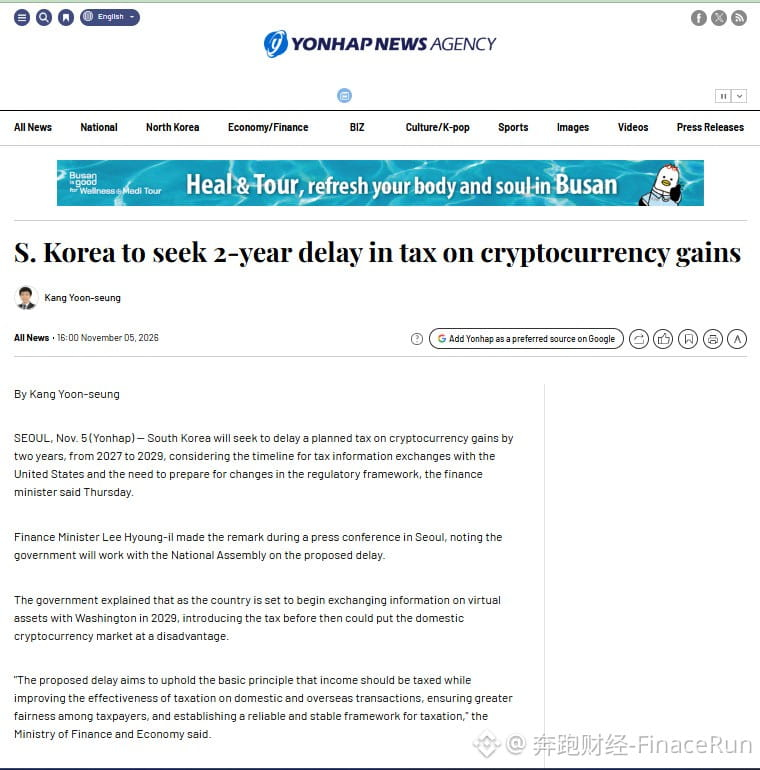
South Korea Delays Crypto Tax Again Until 2029, Plans to Introduce Loss Carryforward Deductions
Nov. 5 — South Korean Finance Minister Lee Hyoung-il said at a press conference in Seoul that the government plans to delay the cryptocurrency gains tax, originally scheduled to take effect in 2027, by two years to 2029, and will consult with the National Assembly to advance related legislation.
The government explained that South Korea plans to begin exchanging virtual asset tax information with the United States in 2029. Introducing the tax before then could put South Korea’s domestic crypto market at a disadvantage.
The delay aims to uphold the basic principle that “income should be taxed,” while improving the effectiveness of taxing domestic and overseas transactions, ensuring fairness among taxpayers, and establishing a reliable, stable tax framework.
Under the current proposal, individuals would pay a 22% tax on annual cryptocurrency gains exceeding 2.5 million won (about $1,869).
South Korea began working toward taxing virtual asset gains in 2020. If this delay is ultimately approved, it will mark the fourth postponement. To refine the tax system, the government plans to form a public-private working group to work out the details of the tax rules and submit an amendment during the regular session in 2027.
In addition, given cryptocurrency price volatility, the South Korean government will study allowing investors to carry forward losses for up to three years to offset future gains, following the approach taken by countries such as the United States and the United Kingdom.
The government also said it will work with the Financial Services Commission to accelerate the drafting of a Digital Asset Act aimed at promoting healthy market growth and protecting users. It pledged to work closely with the National Assembly to ensure that tax rules and enforcement systems are applied fairly.
As global tax information networks expand, South Korea is seeking to balance tax collection and the market through a combination of “taxation + loss carryforwards.”
But is this tax framework, modeled on traditional finance, really suited to the highly volatile crypto industry? Share your thoughts in the comments!
#韩国加密税收