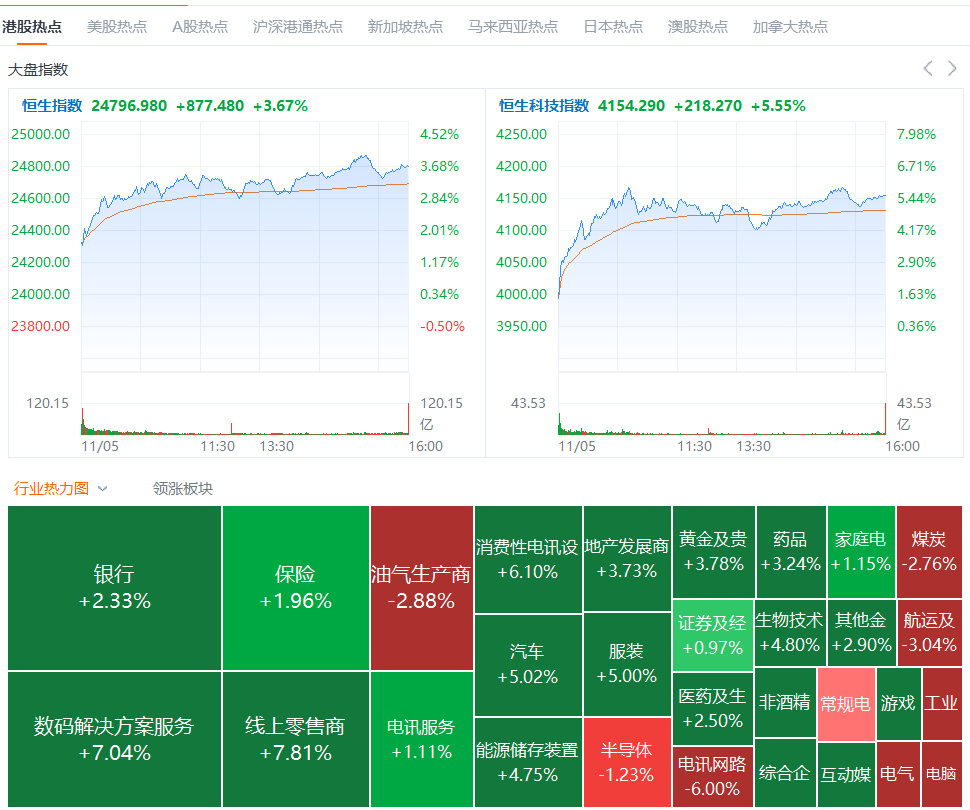

Breaking down Asian stock markets (November 5, 2026): Korean stocks hit circuit breakers, Hong Kong stocks surge, and A-share stocks party?
At first glance, Asian markets went their separate ways today. Underneath, though, they were all reacting to the same thing: the Democratic Party’s “blue wave” took both chambers, putting AI hardware regulation on the table—but each market is digesting it differently.
Korean stocks were the most honest: they simply threw in the towel.
The KOSPI closed down 5.28% at 5383.80. Foreign investors were net sellers of 3.42 trillion won on the day; Samsung fell 7.57%, and SK Hynix fell 9.46%. Both major markets triggered circuit breakers.
But money didn’t flee altogether. Entertainment and culture rose 4.7%, IT services gained 4.5%, and biotech stocks surged across the board. Samsung Epis rose 14%, and SK Biopharmaceuticals gained 12%. Money pulled out of AI hardware and flowed into defensive sectors and story stocks.
Hong Kong took a different path: the indexes staged a powerful rebound, but southbound investors were heading for the exits.
The Hang Seng Index closed up 3.67% at 24796.98, while the Hang Seng Tech Index surged 5.55%. Alibaba rose 8.45%, and Tencent gained 7.17%. The strange part: southbound investors were net sellers of around HK$20 billion for the whole day—a complete disconnect between the index’s sharp rise and the outflow of funds. Money was rotating, not adding exposure: internet leaders were snapped up, while memory, optical communications, and PCBs were sold off. Kingboard Laminates fell more than 12%. Money pulled out of the hardware narrative and poured into platform cash flows and domestic substitution.
A-shares were the liveliest, but the indexes were the most misleading.
The Shanghai Composite rose just 0.10%, yet 4,869 stocks rose across the market, there were no limit-down stocks, and 87% of stocks closed higher. Solar equipment surged 6.23% in a wave of limit-ups; precious metals rose 5.19%. Semiconductors still ranked first, with net inflows of 5.656 billion yuan, while communications equipment, oil and gas, and coal saw money pulled out.
Money moved out of high-dividend stocks and old energy and piled into solar, semiconductors, and nonferrous metals. Small caps stole the show while heavyweight stocks set the stage.
The blue wave set fire to the old AI hardware trade. Money didn’t leave the market; it simply made a forceful move within Asia from “computing hardware” to “software, new energy, and biotech.” $SKHY $KORU $TENCENT #美国10年期国债收益率跌至4.845%