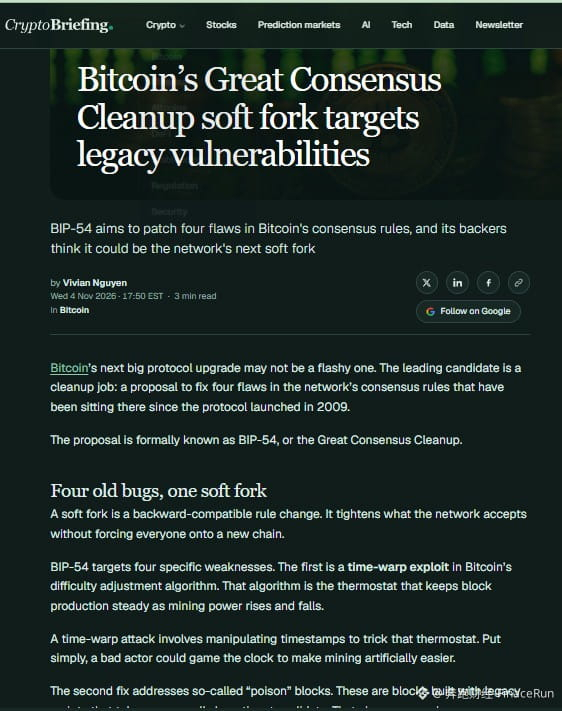
A seven-year-old rules bug is paving the way for a protocol upgrade: Bitcoin BIP-54 consensus cleanup enters soft-fork sprint
November 5 — According to CryptoBriefing, the Bitcoin community is pushing forward with the BIP-54 “Great Consensus Cleanup” soft fork. The proposal has a strong chance of becoming Bitcoin’s next major protocol upgrade after Taproot. Its main goal is to fix four consensus-rule bugs that have persisted since the network launched in 2009.
The proposal was first drafted by developer Matt Corallo in early March 2019 and was officially assigned a BIP number in April 2025. It primarily targets time-warp attacks, malicious blocks with high verification costs, a 64-byte transaction flaw in Merkle trees, and the replay-attack risk posed by duplicate Coinbase transactions.
The accompanying test vectors were merged into the codebase at the end of 2025 and validated on the Bitcoin Inquisition Signet testnet after it launched in February 2026.
At this stage, two major mining pools, MARA Pool and ViaBTC, have already generated Coinbase transactions on the mainnet that are compatible with BIP-54 rules. Corallo estimates that there is about an 80% chance BIP-54 will ultimately be implemented as a soft fork.
Notably, this upgrade is a fix to Bitcoin’s underlying rules. It will not change Bitcoin’s economic model, total issuance, or token mechanics; it will only narrow the network’s attack surface and strengthen its security foundation.
Industry observers say that the BIP-54 “consensus cleanup” soft-fork protocol upgrade is essentially just a code cleanup and will not bring new features to the Bitcoin ecosystem.
What do you think? Is BIP-54—a low-risk, cleanup-focused soft fork that fixes bugs without adding new features—more likely to achieve consensus in the Bitcoin community?
#比特币软分叉 #BIP54协议