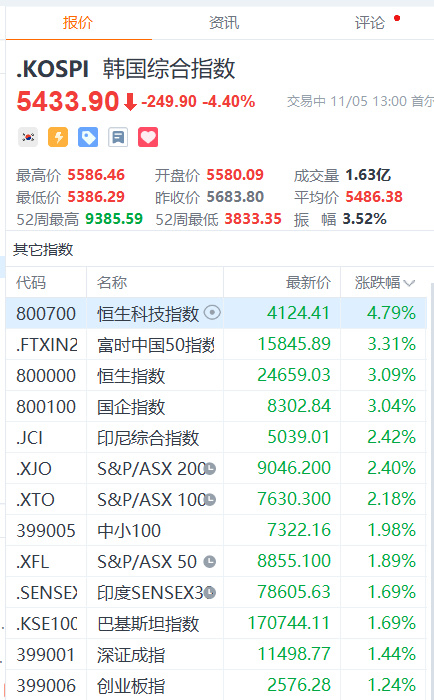

South Korea’s index hit another circuit breaker this morning. What is the market trading?
The Korean market looked like it was about to collapse this morning. The KOSPI fell as much as 5.2% intraday to 5,386 points, triggering a SIDECAR trading halt. SK Hynix was down as much as 9%, and Samsung 7%.
The trigger was the Democratic Party sweeping the midterm elections and Texas turning blue. Expectations of tighter data center approvals undermined the AI hardware thesis. Foreign investors were decisive sellers, with net sales totaling 2.5 trillion won for the day.
Goldman Sachs came out today with a clear call: “Long cloud providers, short semiconductors.” The logic is straightforward: if data center approvals are held up, computing capacity becomes scarce. Cloud providers can raise prices, spend less on capital expenditures, and buy back shares, while expectations for chip orders get marked down.
In terms of trading, a rebound in AI hardware is a chance to cut your position, not add to it.
Until regulatory risks materialize, every bounce in semiconductors is an opportunity for selling pressure to come through. Don’t use “it’s fallen a lot” as a reason to buy. Internet software, by contrast, is worth watching—but don’t buy the whole sector indiscriminately. Kakao surged more than 9% today on earnings and a 150 billion won buyback. That’s the company’s own money speaking, not sector beta. Naver, which moves with the index, has limited upside.
A recovery in AI hardware is about liquidity; a recovery in internet software is about company-specific fundamentals. Manage your position sizes. Don’t bet on a semiconductor reversal; look for software names taking concrete, meaningful action. $KORU $SKHY $SKHYNIX