

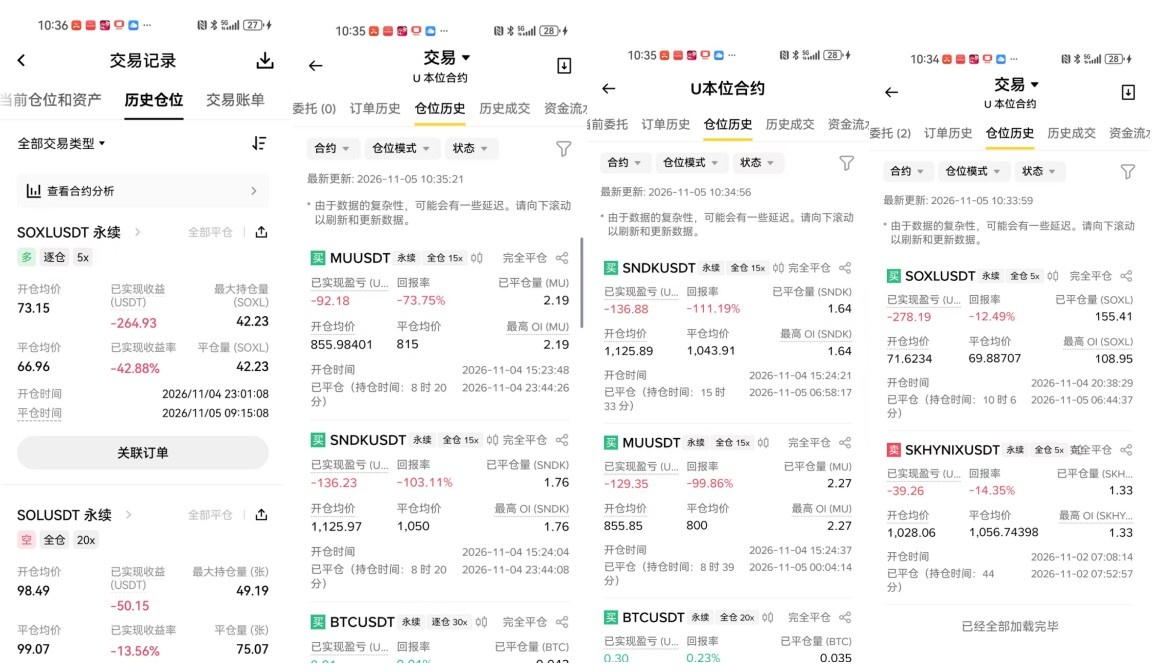
This trade cost me big. Why?
I tried to use this approach to reflect on why I lost so much on my semiconductor and memory trades!
After the midterm elections ended,
the smoothest rebound was still in my home territory: crypto!
And after putting half my money into crypto-related assets,
I used the other half to go long and add to my positions in semiconductors and memory stocks!
The semiconductor trend looked just like the SNDK candlestick chart in my screenshot.
I tried to use this chart to review why I lost so much on this trade,
or, rather, to figure out why I didn't cut my losses at a key level.
Or maybe I should say I’m looking for a more reasonable way to stop out of my trades.
As for entering a position,
As I mentioned in my previous post,
I would enter at this level,
and if I had ten more chances,
I’d still enter 100% of the time.
I just don’t think I had a clear plan for how I’d get out of the trade.
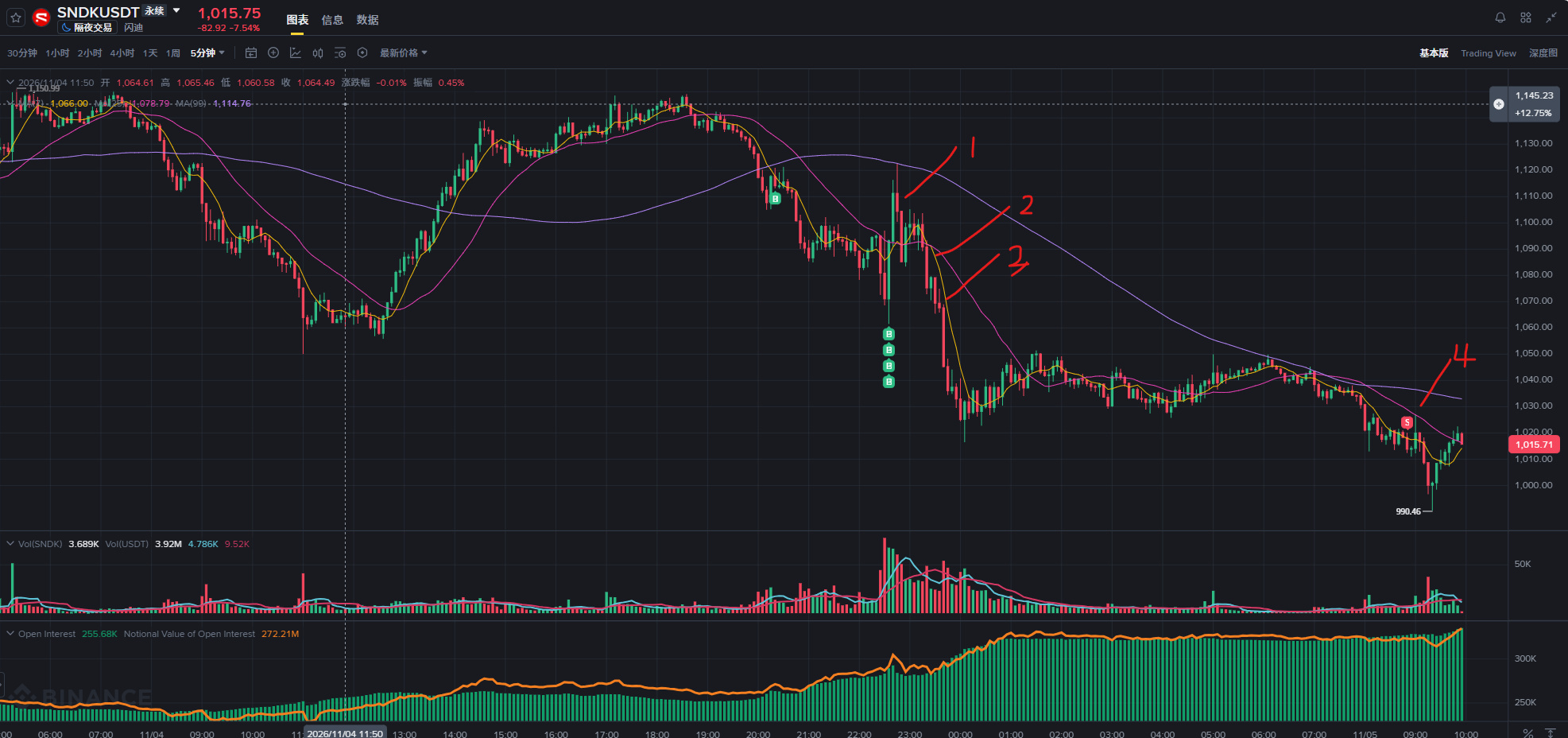
I think the main reasons I lost so much in this trade were as follows:
1) I was extremely confident about where the market was headed,
so I opened a somewhat oversized position. It was so large that even though I had a stop-loss level in mind, I felt the potential loss was more than I could accept. As a result, I didn’t even set stop-losses on some accounts’ trades. That’s a cardinal mistake!
The lesson here is: if the potential loss at my stop-loss level is already more than I can accept, then my position is too large. I need to reduce it immediately!
2) As for the pullback, I didn’t reduce my position appropriately. I think this mainly reflects my lack of experience in this area. Under normal circumstances, based on how things looked, the rally at this level shouldn’t have been so sluggish. SOXL in particular couldn’t even break above its recent minor high, which was a sign to be cautious: this might just be a small bounce, not a powerful rebound. The two big bullish candles during the pullback to level 1 had already shown signs of weakness by their midpoint. I should have at least halved my position at level 2. If a fairly convincing reversal candle appeared later, I could have re-entered.
3) I didn’t set a stop-loss at level 3, and my stop was set relatively far back. The right thing to do would have been to reduce my position by half again. I don’t think I was disciplined enough about stopping out. By level 3, it was already pretty clear that semiconductors and memory stocks were unlikely to rebound the way crypto, especially BTC, had. So I shouldn’t have kept imagining they might catch up just because of the broader market environment. I need to indulge in fewer of these unrealistic hopes. And if I do, I should at least wait for a confirming candle on the right-hand side of the chart.
4) When I got up this morning, I closed out my entire position at level 4. My thinking was: crypto was moving so smoothly, and I didn’t think it was about to stop, so why cling to this deadwood instead of switching to a stronger opportunity with a clearer outlook? So after closing the position, I chose a crypto asset to trade.
5) I really didn’t expect memory and semiconductor stocks to fall this much, especially after they had already dropped so much before the midterm elections. Why did they fall even more smoothly after the election results came in? Looking back, the main reason was the ripple effect of the camp led by Trump—including Musk and Jensen Huang—losing ground in the midterms. For example, SpaceX and NVDA both fell sharply last night. But before the midterms, mainstream media and the public already thought Trump would lose, so these stocks had already fallen a lot. Why did they keep falling after the results were confirmed? That’s hard to predict. All I can say is: respect the market. I accept my losses, but losing this much is definitely something I need to reflect on.
Some thoughts on rolling positions:
Over the past few days, I've been learning about rolling positions and taking long-term trades. After reading “Ten Years, One Dream,” I think I should also use the approach of starting with a small position and adding to it. But I feel I still have a lot to improve: my initial positions are too large, and my entries when adding to them are still poorly timed.
A lot of my trades may still be entered too impulsively, with decisions made too hastily. As a result, I often only realize after placing a trade that the potential loss at my stop is too large.
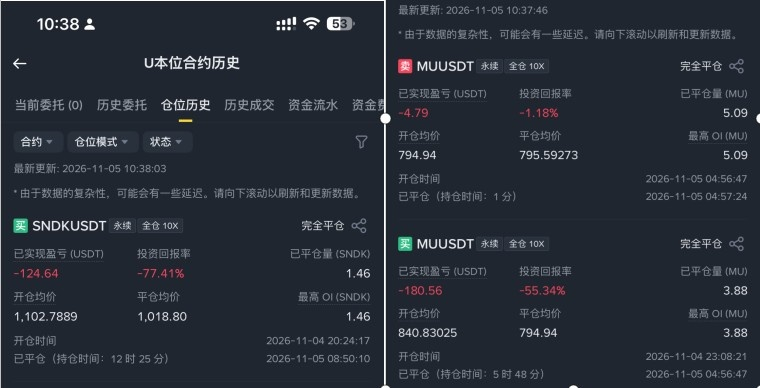
To sum up:
1) Opening trades: I’m too reckless when entering trades. My positions are too large, and the potential losses at my stops are too high.
2) Stop-losses: If I do open a large position, I should reduce it as soon as the market starts moving against my expectations. I can scale out in stages.
3) Adding to positions: I should only add after the market has clearly moved in the direction I expect. Ideally, I should add after price breaks through a major resistance level or when I’m sitting on a substantial profit.
In short:
Size each trade based on the amount I’m willing to lose, and stick firmly to my stop-loss!