
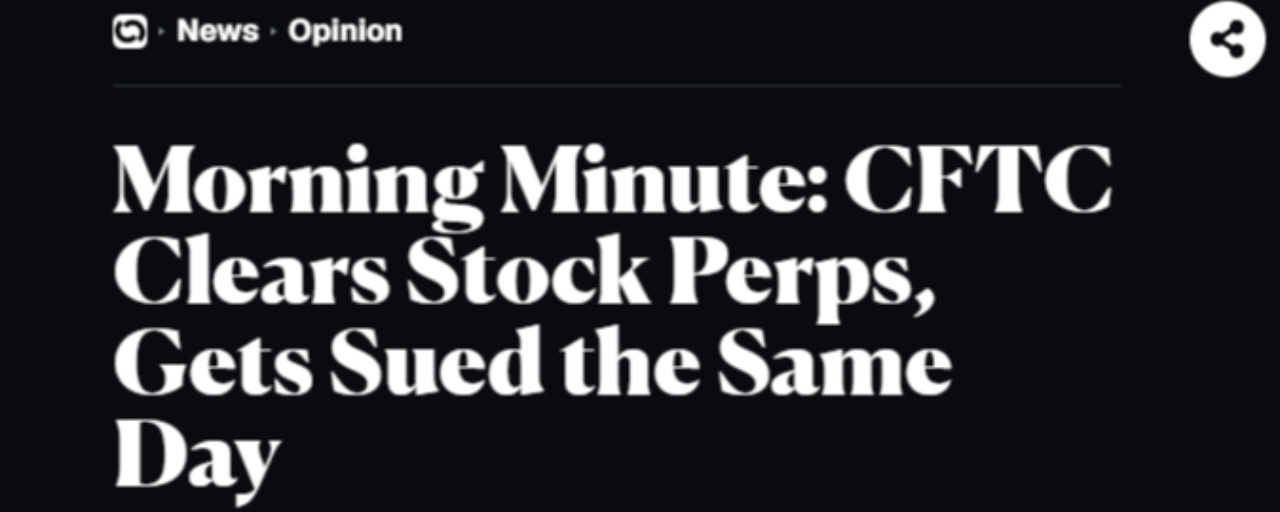

🚨 CFTC approves perpetual stock contracts... and gets sued the same day!
📊 The decision:
• The CFTC allowed trading in Equity Perps (perpetual contracts on individual stocks)
• The approval was "deemed" (without explanation)
• Classification: Security Futures (joint oversight by the CFTC + SEC)
━━━━━━━━━━━━━━━
🚨 The lawsuit:
• Capital Markets Alliance (Cboe + Citadel + Healthy Markets)
• Filed a lawsuit the same day
• Argument: These are "swaps"... under the SEC's jurisdiction
• The CFTC violated the Administrative Procedure Act (APA)
• Demands: Revoke the approval + halt trading
📊 Why does this matter?
✅ A jurisdictional battle between the SEC and CFTC
✅ Investor protection: Stock products should be offered on securities platforms
⚠️ If the CMA wins, these contracts could disappear from the U.S.
⚠️ It could also affect crypto perpetual contracts
💡 What does this mean?
✅ The battle is just beginning
✅ The CFTC says, "The market should be governed by law, not lawsuits"
📊 Follow the case... it could reshape trading in the U.S.
📊 First: The official facts (from the sources)
CFTC decision: On November 3, CFTC Chair Michael Selig announced that perpetual futures contracts on individual stocks (Equity Perps) could trade for the first time on CFTC-registered exchanges.
Approval method: The decision was "deemed approved" under Section 40.3, after the 45-day review period ended on November 2 without objection.
Classification: The CFTC classified them as "Security Futures Products," placing them under the joint oversight of the CFTC and SEC.
Reason: The CFTC says it wants to bring perpetual contracts from unregulated offshore exchanges into the regulated U.S. market.
🚨 Second: Who filed the lawsuit, and why?
The parties: Capital Markets Alliance (CMA), which includes Cboe (a major options exchange), Citadel Securities (the largest market maker), and the Healthy Markets Association.
Timing: They filed the lawsuit on the same day the CFTC announced its approval.
Court: The U.S. District Court for the Southern District of New York.
Main argument: The CMA says these contracts are "security-based swaps," which fall under the SEC's exclusive jurisdiction, not the CFTC's.
Legal argument: The CFTC violated the Administrative Procedure Act (APA) by approving them without a clear explanation and without acknowledging that it had considered perpetual contracts to be "swaps" for years.
Demands: Revoke the approval, declare them to be "swaps," and temporarily halt trading until the case is resolved.
🔍 Third: Why does this matter? (Analysis)
Jurisdictional battle: This isn't just a commercial dispute. It's a fight over who regulates these products (the SEC or the CFTC). If the CMA wins, these contracts could disappear from U.S. exchanges or be transformed into a completely different product.
Investor protection: Cboe says it isn't afraid of the competition (because it can offer similar products). The real issue is investor protection, and that these products should be offered on registered securities platforms, not commodities platforms.
Impact on crypto: If perpetual contracts on stocks are regulated by the SEC, that could affect crypto perpetual contracts too (like those on Hyperliquid and Kalshi). This could reshape trading in the U.S. market.
#Crypto #تداول_العملات_المشفرة #CFTC #SEC #Crypto_Jobs🎯 #Trading