
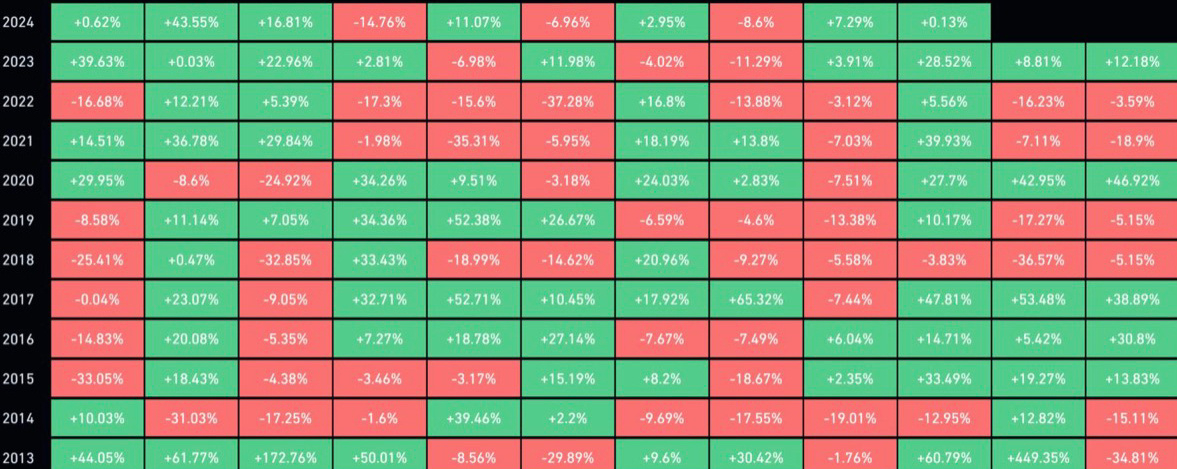

Bitcoin is often said to have:
the claim that September crashes and October surges
and even National Day rallies, Christmas rallies, and Lunar New Year rallies
At their core, they’re all a form of futile pattern-chasing
Historical data does show a tendency, but it’s extremely fragile
It looks “seasonal,” but it isn’t statistically significant.
The sample is too small (only one observation per year), and the fluctuations are too large
Shuffle and rearrange the month labels at random, and this will happen many times
creating the illusion that “a particular month is especially strong.”
Academic research on cryptocurrency markets
has also repeatedly pointed out that monthly effects in cryptocurrency aren’t robust.
More importantly, they’ve already started to break down over the past two years:
• October 2025: -3.9%
• October 2026: about -7.3%
(Two consecutive red Octobers—a first in recent years)
• September 2026, by contrast, closed up about +6.4%
breaking the惯性 that September is always weak
When market structure changes (spot ETFs, institutional capital,
the macro interest rate environment, liquidation mechanisms for leverage)
old calendar effects naturally become unreliable.
Why are these market trends
so easily mythologized?
1. Survivor bias + the desire for a narrative
Market participants are naturally drawn to simple, shareable stories
“Uptober,” “Black September”
are easy to remember, easy to chant, and easy to post about, so they get reinforced again and again
while years when they failed are selectively ignored.
2. Mistaking correlation for causation Q4 was often strong in the past,
but that may simply have coincided with
the halving cycle, easier liquidity, and year-end fund
reallocations, among other factors, rather than
“prices rise because it’s October.”
3. The same goes for holiday market trends: Chinese New Year, Christmas,
and holidays like National Day
may have had some influence when liquidity was low and the market had a simpler participant structure
but today's market trades 24 hours a day
globally, dominated by institutions and algorithms
so these short-term sentiment swings have long since been diluted to the point of
having almost no statistical significance.
A truly useful perspective:
Rather than fixating on whether prices should rise this month,
treat seasonality as very minor background noise
and focus first on:
• The current cycle position (distance from the previous high, time since the halving)
• Liquidity and leverage structure
• The macro environment (interest rates, the dollar, risk appetite)
• The actual flows of funds on-chain and into ETFs
The calendar is just a shadow of the past; market structure is always changing.
Chasing a shadow as if it were real is like trying to刻舟求剑.