Democrats’ retaking the House is essentially settled: NBC estimates around 244 seats, while the Senate is one step from the finish line | Updated Nov. 4, 11:08
The biggest shoe of election night has dropped. At 10:08 p.m. ET on Nov. 3 (11:08 a.m. Beijing time on Nov. 4), CNN and Decision Desk HQ projected that Democrats would regain control of the House; NBC estimated Democrats would win around 244 seats, while CNBC’s election desk projected at least 225 seats for Democrats to at least 160 for Republicans. 218 seats are needed for a majority, and MS NOW made the same projection. To be clear about the sourcing: as of this writing, the Associated Press has not officially called control of the House. The figures above are projections by individual media outlets, not an AP call.
The Senate race hasn’t been called yet, but the balance is clearly tipping: Democrats flipped North Carolina (Roy Cooper won) and unexpectedly flipped a seat in deep-red South Carolina (Annie Andrews defeated Darline Graham), while holding Georgia and New Hampshire. On the Republican side, crypto-friendly Andy Barr won in Kentucky, and Hageman won in Wyoming. Prediction markets briefly put Democrats’ chances of controlling the Senate at around 99% (Kalshi/Polymarket, based on figures from 9:05 p.m. ET).
What does this mean for crypto? First, the facts, then my take. Fact: The CLARITY Act’s procedural motion failed in the Senate on Sept. 15, by a vote of 49–50, far short of the 60-vote threshold. The current Congress expires on Jan. 3, and the bill will die with it. TD Cowen’s view is that it will be difficult to pass the bill over the next two years if Democrats control Congress; Warren is expected to chair the Senate Banking Committee, and Waters is expected to chair the House Financial Services Committee. Democrats will gain subpoena power and may investigate the Trump family’s crypto ties. My take: This means “rising expectations of tighter regulation,” not a “policy reversal.” The president still has veto power, and regulatory easing by the executive branch can’t be directly overturned through legislation. There will be more pressure through hearings and bills will have a harder time passing—that’s all.
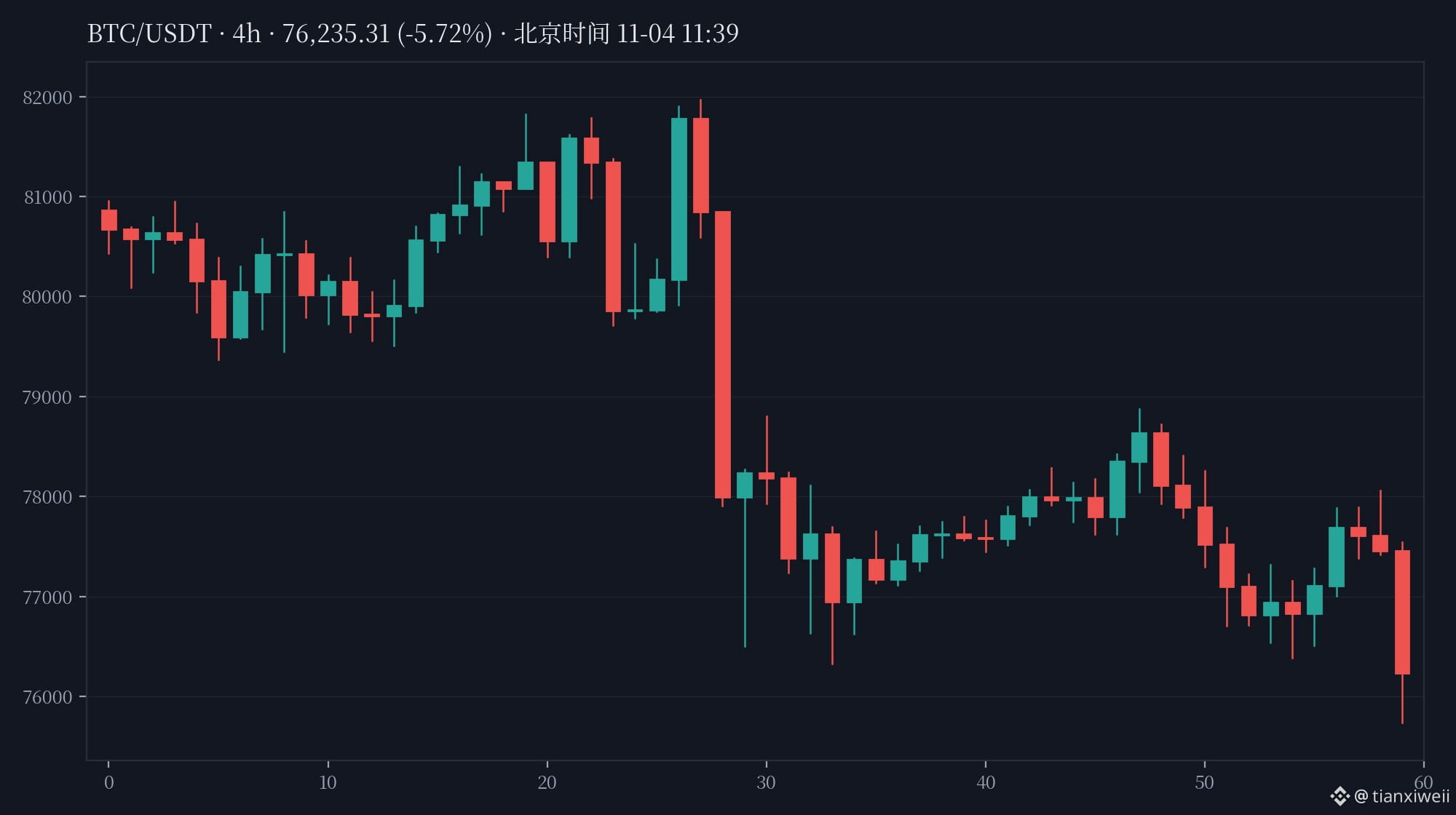
In the markets, $BTC briefly fell below 77,000 on election night (some reports put the decline at around 1.2%, to 76,873). At the time of writing, cross-checking two sources put it at around 76,245, down about 0.68% over 24 hours; $ETH was around 2,243, down about 0.24% over 24 hours. Don’t attribute the whole move to the election: the fallout from the Binance incident and roughly $1 billion in combined ETF outflows over two days were already weighing on prices. The election just added another push.
Here’s what would invalidate this view: If Republicans ultimately hold the Senate, the “sweep” narrative falls apart, and the CLARITY Act still has a narrow window during the lame-duck session. If the AP’s final call differs from the media projections above, this post’s analysis is void.
Risk warning: Vote counting is still underway, and some states may take days or even weeks to confirm their results. Projections are not final certified results, so don’t place trades based directly on prediction-market odds.
Once the Senate race is decided, do you think the CLARITY Act is dead in the water for two years, or can it still be rescued during the lame-duck session?
#美国中期选举 #CLARITY法案 #BTC #ETH