Moxin’s Take | Three days into PoB: UP still has about 16,000 BEM in buy orders queued in the 25-day window
UP launched on 10/31 using @tapeupio’s PoB trading engine. Today is day three. Tonight, the trading page still shows about $286,000 in buy orders sitting in the Bid Reservoir, scheduled to buy in batches over the next 25 days.
First, a quick look at how PoB stretches a launch over time, then what the project and community can each do during that window—and what the official team says it cannot do.
🐋 PoB in one minute
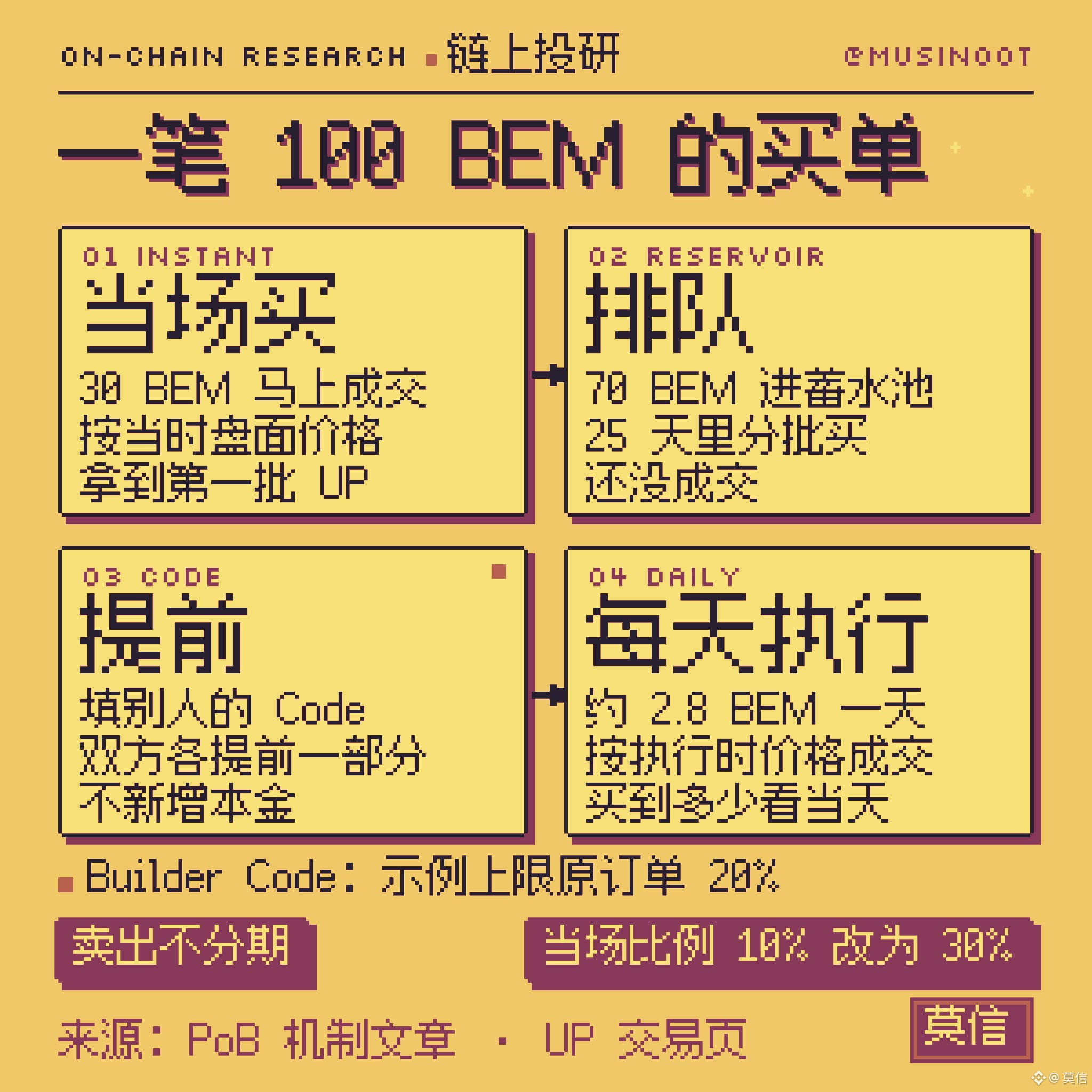
- A buy order is split in two: one portion buys tokens immediately, while the rest goes into the Bid Reservoir and buys daily over the execution period
- The official article’s example is 40% immediately and the remaining 60% over 30 days; on launch night, UP’s trading page showed 10% immediately over 25 days, while tonight it shows 30% immediately over 25 days
- Sells are not staggered; holders can sell immediately
- The total budget stays the same; only the timing of when the money enters the market changes. The queued portion has not been executed and is not under the project team’s control
At 30%, an order of 100 BEM means 30 BEM immediately buys UP, while the remaining 70 BEM continues buying at about 2.8 BEM per day over 25 days. How much UP it buys each day depends on the price at the time of execution.
🐋 Three days after launch: how much is still in the window?
Two snapshots of the trading page:
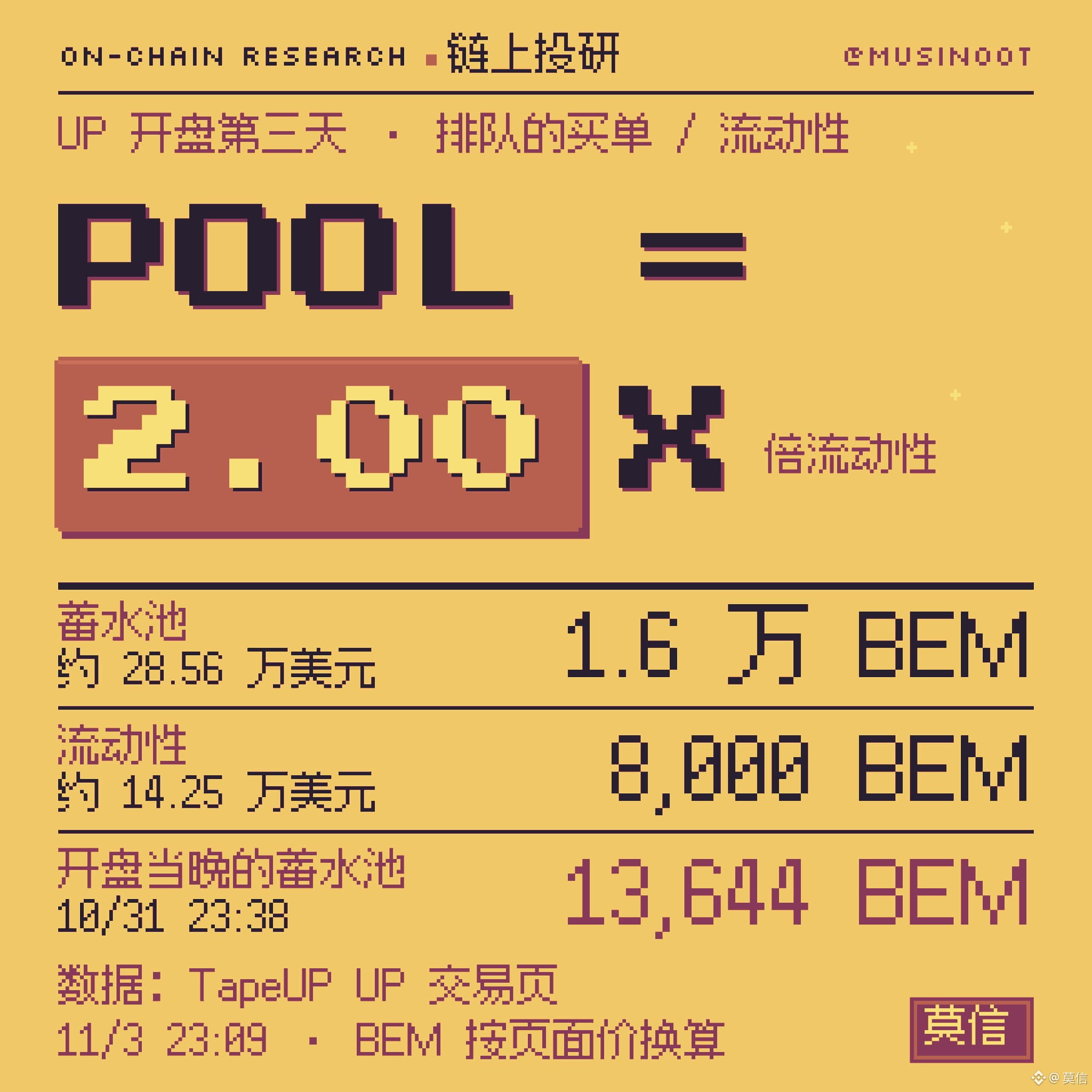
- 10/31 23:38, about one hour after launch: 13,643.87 BEM in the Reservoir, 7,298.91 BEM in liquidity
- 11/3 23:09: about $286,000 in the Reservoir and about $142,500 in liquidity; converted using UP’s BEM and USD prices shown on the page, that’s about 16,000 BEM and 8,000 BEM
The queued buy orders have been executing every day for the past three days, yet the pool has also grown by about 2,400 BEM, meaning new buy orders keep coming in. The Reservoir is twice the size of liquidity.
Over these three days, UP’s internal-market cap passed $10 million at 23:37 on 11/1, and it launched two-way bridging with BNB Chain, making it tradable on PancakeSwap. Tonight, the page shows a market cap of about $5.72 million, down 9.83% over 24 hours.
🐋 Builder Code: building referrals into the execution rules
PoB’s second design is Builder Code. When A places an order and enters B’s Code, a portion of each person’s queued budget can be accelerated.
The official example allows up to 20% of the original order to be accelerated per transaction:
- A’s original order is 100, with 70 still queued; 20 of that can be accelerated
- B’s account has 12 still queued
- A enters B’s Code: A accelerates 20, B accelerates up to 12, for a total of 32
All 32 comes from the balances of existing orders; no new principal is added. Each buy also incurs a 1.5% UP Builder Tax, which goes into the rewards pool and is distributed based on the volume accelerated through referral codes.
The official article also makes clear that Builder Code records community collaboration; it cannot serve as proof of development work. Invitations, trading, and genuine code contributions should be tracked separately.
🐋 A window for projects: choose how long the tail lasts
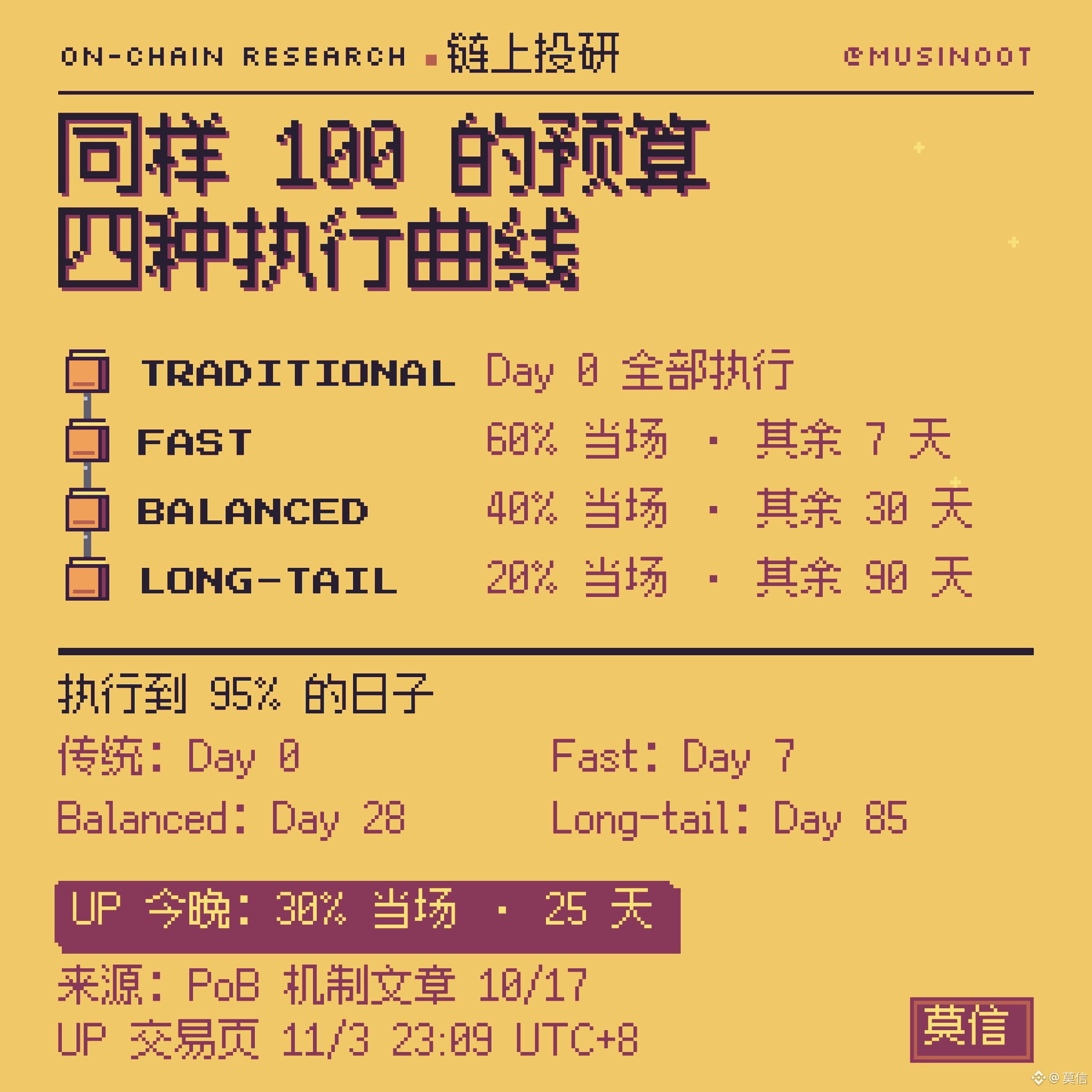
With the same budget of 100, the official team compared four configurations:
- Traditional launch: everything executes on Day 0
- Fast: 60% immediately, the rest over 7 days; 95% executed by Day 7
- Balanced: 40% immediately, the rest over 30 days; 95% executed by Day 28
- Long-tail: 20% immediately, the rest over 90 days; 95% executed by Day 85
Choose a tail that’s as long as the time you need to build the product and attract users. Since its launch, UP has also changed its immediate-execution share from 10% to 30%.
The “Deploy TAP20” entry on the TapeUP website is currently marked Pending. At TAPEOUT BUILDER NIGHT #003 on 11/2, @tapeuptony and @SIMANLABS discussed “from putting the PoB trading engine into practice to planning a one-click deployment solution for general use.” Letting other projects choose PoB parameters when launching tokens is still in the planning stage.
🐋 A window for the community: Metro Stations and a DAO proposal
TapeUP’s “Metro Stations”: mint designated circuits to gain operating rights, with 50% of protocol revenue allocated to two tracks: 40% for validation and 10% for BEM staking. BEM staked across the network went from 8,967.73 on the official 10/21 snapshot to 14,998.68 tonight.
On the TapeOut side, @0x4ae4 posted a TapeOut DAO formation proposal on 11/2, using TapeCode-Test1 NFTs for identity, with one of three entry requirements:
- 20 NFTs
- 10 NFTs + 100 BEM
- 5 NFTs + 100 BEM + 40H of mining-machine hashrate
@TapeOutWorld reposted it this afternoon, calling it a third-party community proposal worth watching. The requirements, launch date, and whether the DAO will be established are all still subject to a foundation decision.
That same day, registration closed for the first cohort of X Layer’s TapeOut Developer Accelerator Program livestream; according to @Blonskr, there will be an online demo show with OKX this Thursday.
🐋 What PoB can’t control
The official article lists these points:
- It does not guarantee prices will rise or prevent selling pressure
- Queued balances are not the same as executed liquidity
- Builder Code acceleration may concentrate some of the budget again on certain days
…
——
See the full version on X: @musinoot