

WorkBuddy Enterprise
2,000 AI accounts
Snapped up by employees on the second day after launch
What’s the hardest part of rolling out AI? A vice president at a company with annual revenue in the tens of billions gave this answer: It’s not the cost or the technology—it’s employees “not knowing what to do with it.”
That’s what Chen Fengwei of China Unicom Huasheng said. Interestingly, this wholly owned subsidiary of China Unicom had no top-down plan and imposed no mandatory performance targets. Yet the number of WorkBuddy Enterprise accounts grew from 100 to 200 to 300, then all the way to 600—all thanks to word of mouth among employees.
Employees aren’t fools—they can tell after one try whether a tool is any good. So today, I’m laying out what WorkBuddy and its enterprise edition can do, along with the numbers. You can do the math yourself.
I. What is WorkBuddy?
WorkBuddy comes from Tencent Cloud’s CodeBuddy team. It’s positioned as an “AI agent desktop workspace for every workplace scenario.” The biggest difference from a regular chat window is that it doesn’t just answer—it gets things done. It breaks down complex tasks, reads and edits local files you authorize, uses software on your computer, and automatically runs multi-step workflows, then delivers a well-structured document, spreadsheet, or PPT.
It’s moved fast this year
January: Opened for internal testing at Tencent, initially serving more than 2,000 employees
March: Officially launched
June: At the Tencent Cloud AI Industry Applications Conference, the enterprise edition and Agent Suite, a suite of office AI agents, were officially launched
September: The open platform launched, bringing in more than 100 ecosystem partners in its first wave. (Plaud, Rokid, Insta360, iFlytek, Anker, and others launched co-branded hardware.)
Late October: Even Tencent News was integrated. According to an Analysys report from June, monthly visits had already exceeded the combined total of the second- and third-ranked products in its category.
It’s easy to get started: download it from the official website and install it—no deployment required. Configure it remotely through WeCom and get up and running in as little as one minute. It integrates seamlessly with WeCom, Feishu, and DingTalk. It comes with more than 20 Skill packs, supports the MCP protocol, and can run multiple Agents in parallel. You can also switch between models freely—Hunyuan, DeepSeek, GLM, Kimi, MiniMax—use whichever works best for you.
II. The personal edition is great, but it’s not enough for a company
Let’s start with one thing: the personal edition is good. Many companies got started when employees installed and began using it themselves. But the personal edition answers the question, “How can one person use AI?” The enterprise edition answers, “How can an entire company use AI?” These are two completely different questions.
Personal edition invitation link:
https://www.workbuddy.cn/events/invite?inviteCode=uhohgym8x
Here’s a table that makes the differences clear:
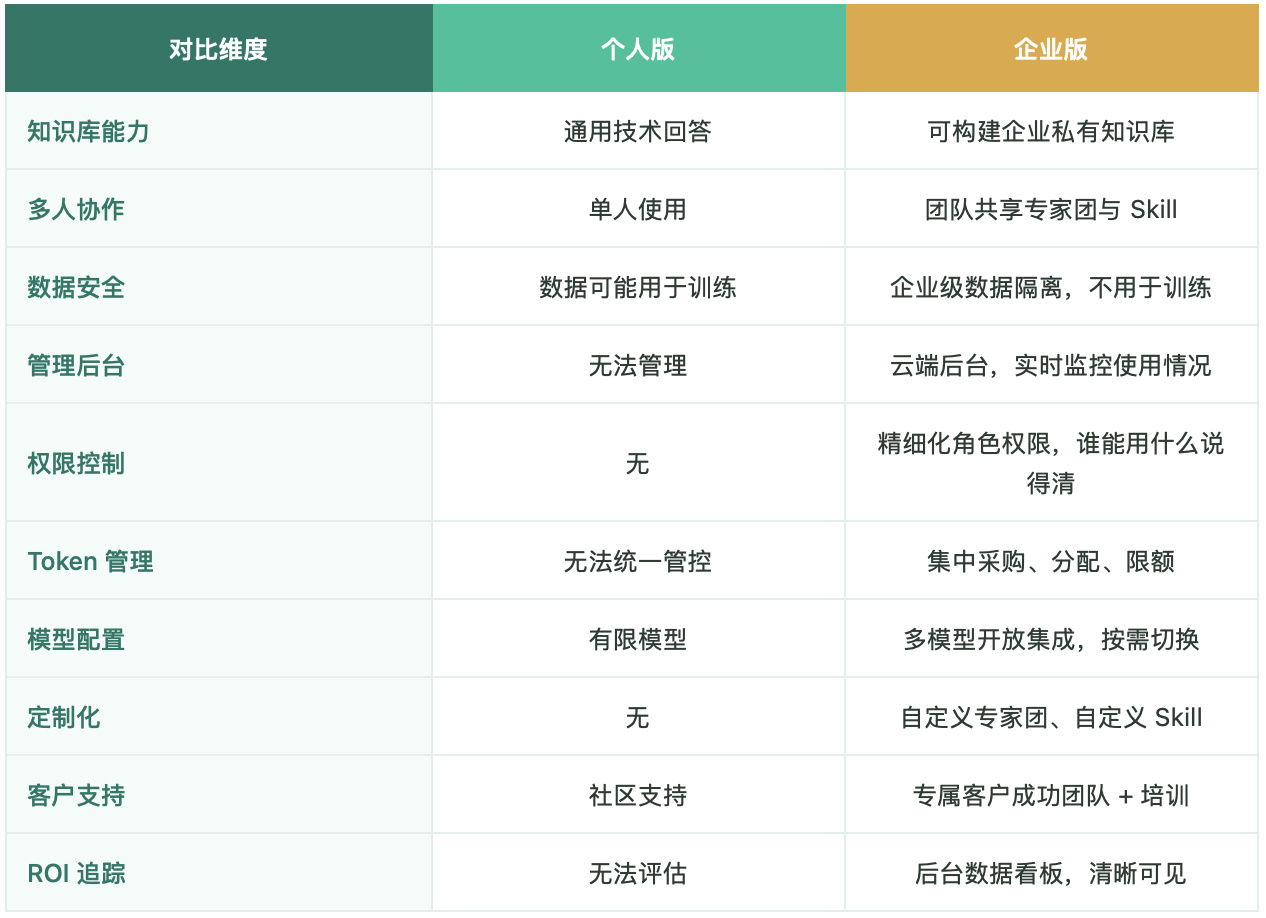
Here are the three most critical differences:
① Data security
When employees use the personal edition to handle company data, that data may be used for training—a risk many business owners don’t even know about. The enterprise edition provides enterprise-grade isolation, and data is not used for training.
② Tokens
With the personal edition, everyone buys their own, so the company has no clear picture of how much is being spent or where it’s going. The enterprise edition lets you purchase centrally, allocate centrally, and set usage limits. You can even post usage figures publicly on your intranet.
③ Knowledge retention
With the personal edition, know-how goes with the employee—when they leave, their experience goes with them. The enterprise edition’s expert teams, Skills, and private knowledge base are company assets that grow richer with use.
III. The real numbers from several companies
Enough talk—let’s look at companies that have already put it into practice:
China Unicom Huasheng
Previously, finance staff in each of the 31 provinces spent two days a month on invoicing and reconciliation. Now, one finance employee, working with RPA tools, can complete invoicing, invoice matching, and reconciliation nationwide in two days—conservatively, that’s a more than tenfold efficiency gain.
On top of that, every month, departments submitted a pile of IT development requests to the Digitalization Department. Each took anywhere from one to three months. Now, AI agents directly handle 90% of those requests, saving real money on both development capital expenditure and operating expenses. Based on an internal review of around 100 cases, repetitive work has become about 10 times more efficient.
C&S Paper
In October this year, it completed training and assessments for 1,200 people. The supply chain transformation was even more impressive: from sales orders and shipping to warehouse selection and production scheduling, the entire process was handed to AI agents to find the optimal solution, achieving cost savings in the four-digit range.
There’s another change that’s less visible: business rules once scattered across outsourcing teams and IT departments are now being captured and retained within the company itself.
Yili
WorkBuddy brings together business data, generates operational strategies, and delivers them to thousands of sales reps. Operational efficiency rose by more than 50%, while A/B testing showed a 26% increase in sales orders—real numbers from the front lines of sales.
Manufacturing
Zhuhai Tianwei Pegasus: Manual packaging-label checks dropped from 244 hours a month to around 5 hours. Month-end cost accounting was cut from 5 days to 4 hours, and more than 50 use cases have been established.
Guangzhou Shisheng Intelligent: PCB material reviews went from 2 days of manual work to half an hour; dynamic inventory and procurement decisions went from 3 days to 2 hours.
Another leading manufacturer used MCP to connect directly to its distributor management system and automatically conduct preliminary reviews of 20,000 claim invoices every month. The day after centralized enterprise edition management went live, employees had claimed all 2,000-plus test accounts, and the number of AI users had grown more than tenfold.
These cases have one thing in common: none of them started from scratch. Each integrated Agents gradually into existing systems and ways of working. Behind China Unicom Huasheng’s remark, “Plenty of Tokens to use,” is a business case that adds up: for a company with revenue in the tens of billions, the savings from efficiency gains far outweigh the investment in Tokens.
IV. A final word from us
We are an authorized Tencent Cloud service provider and a WorkBuddy Enterprise Edition partner. Our authorization chain is legitimate, so businesses can purchase with confidence.
More importantly, we provide FDE (Forward Deployed Engineer) services. There’s a common thread behind all the cases above: installing the tool itself isn’t hard. The hard part is figuring out which use cases are worth pursuing and how to fit them into your own workflows.
That’s exactly what FDEs do: help you identify use cases, build Skills, configure workflows, and provide hands-on guidance until your own employees can run things independently. Zhuhai Tianwei’s “business-led, technology-supported” approach is essentially the FDE model. In six months, they built five business AI agents, all hands-on by business team leads.
If your company is also thinking about
“Where should we start using AI?”
Use-case assessment, edition selection, and hands-on implementation guidance
We’ll walk you through the whole process
Send us a DM or leave a comment | Let’s talk about your business