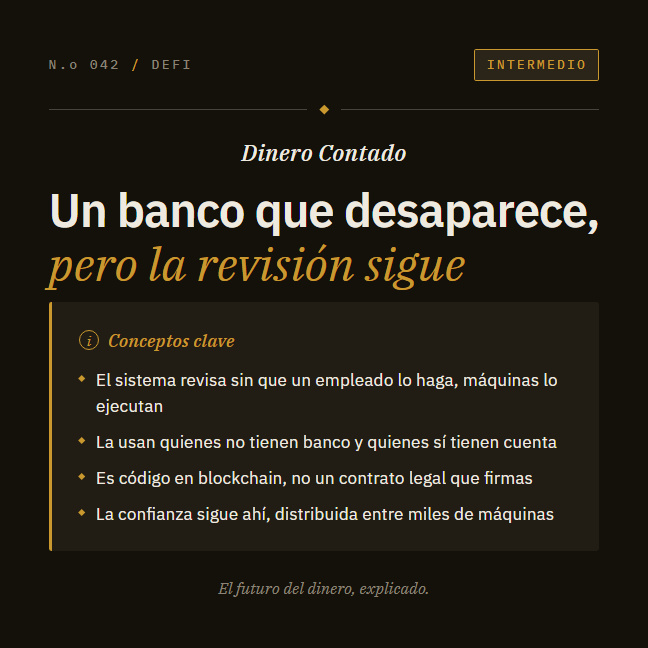
When you take out a loan without going through a bank, someone still checks that you pay on time.
The bank disappears from the picture, but the review doesn’t. Before, an employee approved your loan by reviewing paperwork and your history. Now, that review is done by code running on thousands of computers connected to one another. This code is called a smart contract, and it does something simple: it executes the rules only when they’re met, without anyone having to manually say yes. If you lend 100 and the contract charges a 2 fee, the borrower receives 98. Nobody negotiates that number in an office. It was already written into the code.
This whole system, where money moves and is validated without asking a bank or any other intermediary for permission, is what’s known as decentralized finance.
KEY CONCEPTS
- Thinking that decentralized finance means nobody checks anything is a mistake: the review still exists; it’s just carried out by a network of computers following code instead of a bank employee.
- It’s not a system just for people without access to traditional banking: people with regular bank accounts also use it to move money faster or pay lower fees.
- A smart contract isn’t a legal contract like the ones you sign with a lawyer: it’s code that runs on a blockchain, and what it does is limited to what that code says—nothing more.
This isn’t magic, nor is it the end of trust. It’s the same trust as always, distributed among thousands of computers instead of locked away in a single bank’s vault.
Transparency: Binance may pay us a commission if you trade after clicking an asset symbol or a price link in this post.
#FinanzasDescentralizadas #ContratosInteligentes #Blockchain #Cryptocurrencies