



For a company that makes money from surgical instruments and consumables, what is the last thing it wants to see happen?
A company that has already captured more than 70% of global revenue in the surgical robotics market is now facing the question of how to get more surgeries to use robots.
That company is Intuitive Surgical $ISRG.US , which I’ve recommended several times before. I’ve always believed it’s a medical technology company listed on the U.S. stock market that’s well worth studying and investing in for the long term.
What kind of business has it built that would make a hospital keep paying after buying its robots?
And why do I believe that the advantages it has built up today go far beyond the robots it has already sold?
This article will take a comprehensive look at how ISRG makes money, why its customers find it hard to leave, and how much room AI could create for this business to grow.
I. First, the Business Model
First, it’s important to understand that its apparent core business is an expensive surgical robot, known as da Vinci. But the real core of its business model lies in the range of revenue-generating services built around that robot.
When a hospital buys a da Vinci robot, that is only the beginning of its relationship with ISRG.
The hospital then needs to establish the corresponding surgical workflows, and doctors need to learn how to use the system. So as long as the robot remains in use, ISRG can generate revenue from surgical instruments and maintenance services.
In other words, selling more robots is certainly important to ISRG, but even more important is encouraging each customer to use the machine more often in real-world settings.
These points are the starting place for understanding ISRG’s long-term investment potential.
1.1 The Costs Associated with the Robot
da Vinci robots are mainly used to help doctors perform minimally invasive surgeries in fields such as general surgery, urology, and gynecology.
At this stage, the robot cannot perform surgery entirely on its own. Instead, doctors operate its robotic arms and instruments from a console to assist with the procedure.
For a hospital, purchasing this kind of equipment requires a substantial investment.
According to the latest disclosed data, a da Vinci system typically costs around $600,000 to $3.1 million, depending on the model, configuration, and sales region.
Once a da Vinci robot is installed in a hospital, increased usage leads to ongoing consumption of specialized instruments and accessories. According to third-party data I found:
(1) Depending on the type and complexity of the procedure, ISRG typically earns about $900 to $3,700 in instrument and accessory revenue per surgery;
(2) The annual fee for the company’s equipment maintenance service contracts is typically around $95,000 to $225,000.
1.2 What the Financial Statements Show
The financial statements offer the clearest picture of this revenue structure:
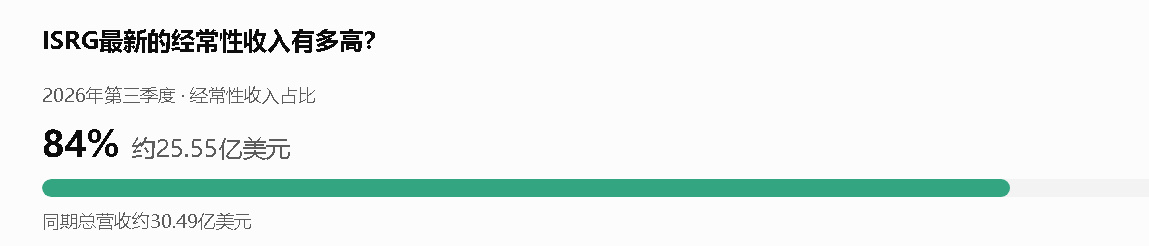
In the third quarter of 2026, ISRG generated $3.05 billion in revenue;
Of that, instruments and accessories accounted for approximately $1.8 billion, or nearly 60% of total revenue. Equipment systems generated about $769 million, while the remaining approximately $482 million came from after-sales services.
There is also a mutually reinforcing dynamic built into this business model.
For ISRG, more surgeries mean greater demand for instruments and accessories. For hospitals, performing more surgeries with the same robot means that the upfront costs of purchasing, training, and maintaining the equipment can be spread across more cases.
Recurring revenue has long accounted for more than 80% of the company’s total revenue. In other words, after a robot is sold, customers continue generating revenue for ISRG as they use it.
So it is more accurate to think of ISRG as a company built around surgical volume, rather than simply a surgical robot manufacturer.
II. The Moat Is Not the Robot Itself
I’ve previously described ISRG as “the ASML of healthcare.”
This comparison doesn’t mean the two companies have the same degree of monopoly power in their respective industries. Rather, they share one key characteristic:
The product is highly complex. Once customers have built an entire production or operating system around the equipment, they are unlikely to switch immediately just because a competitor launches a similar product.
As usage time, frequency, and the number of people served accumulate, all of these become extremely difficult-to-give-up “sunk costs” for ISRG’s customers—and an exceptionally strong moat for ISRG.
Once we understand this, we can see why ISRG has continued to expand steadily year after year despite already having such a large market share.
So just how large is ISRG’s market share?
ISRG currently holds an undisputed leading position in the surgical robotics industry. According to an industry report published in October 2026:
The global surgical robotics market was worth approximately $12.6 billion in 2025, with ISRG accounting for about 76.2% of revenue.
Moreover, this figure is not limited to the soft-tissue surgical robotics segment where da Vinci operates; it also includes other types of surgical robots, such as orthopedic robots. If we look at individual segments, ISRG’s market share would be even higher.
This also means that ISRG’s leading position is not reflected solely in its installed base: it has in fact captured more than three-quarters of the entire surgical robotics market’s revenue.
Even more astonishing is that robotic surgery itself has yet to become widespread.
ISRG’s surgical robots were developed before the AI era as we know it today. Just think how much more efficiently, with today’s AI models, ISRG could improve the autonomy and utilization of each machine.
So ISRG’s future growth will not depend entirely on taking market share from competitors. It can also come from shifting more traditional surgeries to robotic assistance, or even fully autonomous procedures—a much bigger opportunity to grow the industry’s overall revenue.
III. Future Growth
In terms of business scale and profitability, ISRG is already a well-established, highly profitable company.
Even after completing a large-scale share buyback in the third quarter, the company still held approximately $6.8 billion in cash, cash equivalents, and investments.
This means it has ample resources to continue investing in the development of next-generation robots and expanding into more medical applications.
At the same time, more importantly, the company is also working to make robotic surgery easier to adopt.
The fifth-generation da Vinci, approved in 2024, introduced technologies such as force feedback, helping doctors better sense the force exerted when instruments contact tissue. It also uses AI to analyze surgical procedures and instrument-operation data, helping doctors improve their technique.
The company is also developing features such as voice control and automated control of the fourth robotic arm, with the aim of further reducing the burden on doctors during surgery.
In the past, da Vinci could only be described as a sophisticated mechanical system operated by doctors. Beyond the cost of the equipment, there was also a certain [barrier to entry] for doctors learning to use it.
But with the help of AI, ISRG could have:
(1) Lower barriers to learning and use, potentially bringing in more doctors and hospital customers;
(2) Greater equipment utilization, potentially enabling existing robots to perform more surgeries.
As I’ve already explained, ISRG is precisely the kind of company that makes money as surgical volume grows. It doesn’t need to invent a new business; it just needs to use AI to scale up the business it already has.
Second, it can make robotic surgery more affordable.
I wrote about this in detail in my previous earnings analysis. If you’re interested, you can jump straight to: ISRG Third-Quarter Earnings Analysis
ISRG has already announced plans to extend the permitted number of uses for some surgical instruments starting in the first half of 2027, and to introduce usage-based pricing.
Why?
Because it wants to enter more cost-sensitive markets for routine surgeries.
Cost is an unavoidable consideration. Hospitals have no reason to use robots regardless of the expense simply because they are more advanced.
But if the cost of using robots gradually declines, alongside improvements in operating efficiency and doctor training, hospitals may have even stronger incentives to adopt robotic surgery.
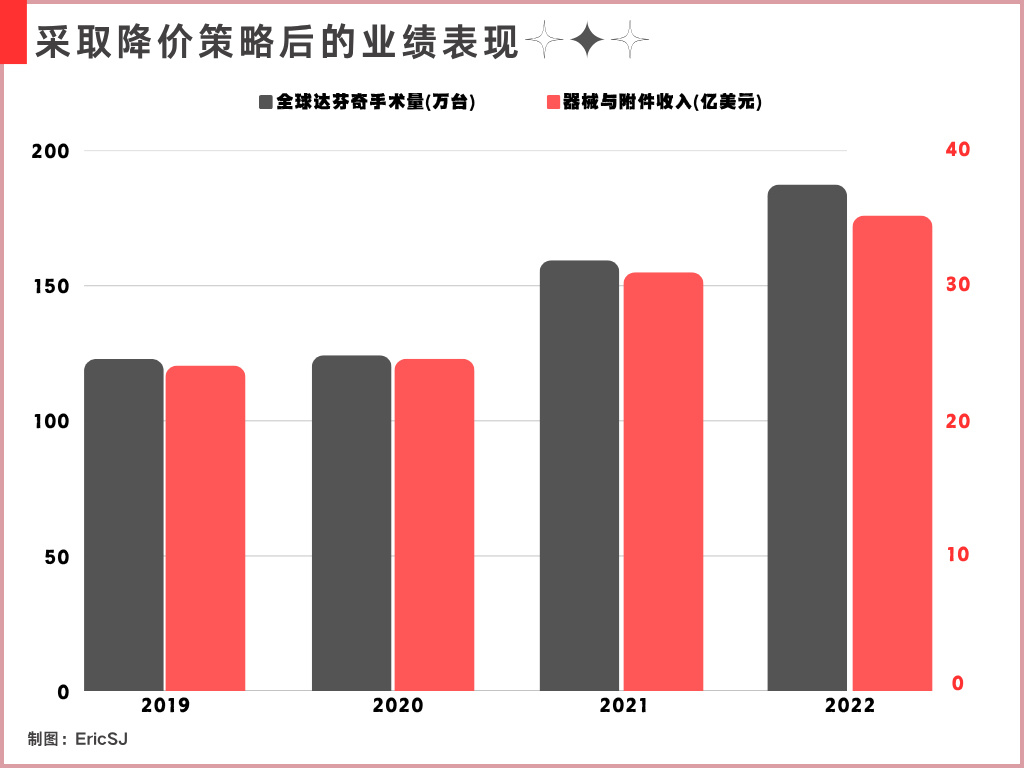
Over the past two decades, ISRG has proven that it can sell robots and build a business model that generates recurring revenue as surgical volumes grow—and the moat created by this model is highly durable.
Now, with the support of AI in this new era, this model has a new avenue for expansion.
From an industry-wide perspective, robotic surgery is still far from fully established, even though ISRG already accounts for more than 70% of global surgical robotics revenue.
For a company, few things are more ideal than having an overwhelming lead in its industry while that industry still has plenty of room to grow.
So, in my view, ISRG is a high-quality investment with steady performance and strong growth potential—not just in the healthcare sector, but across the broader market.