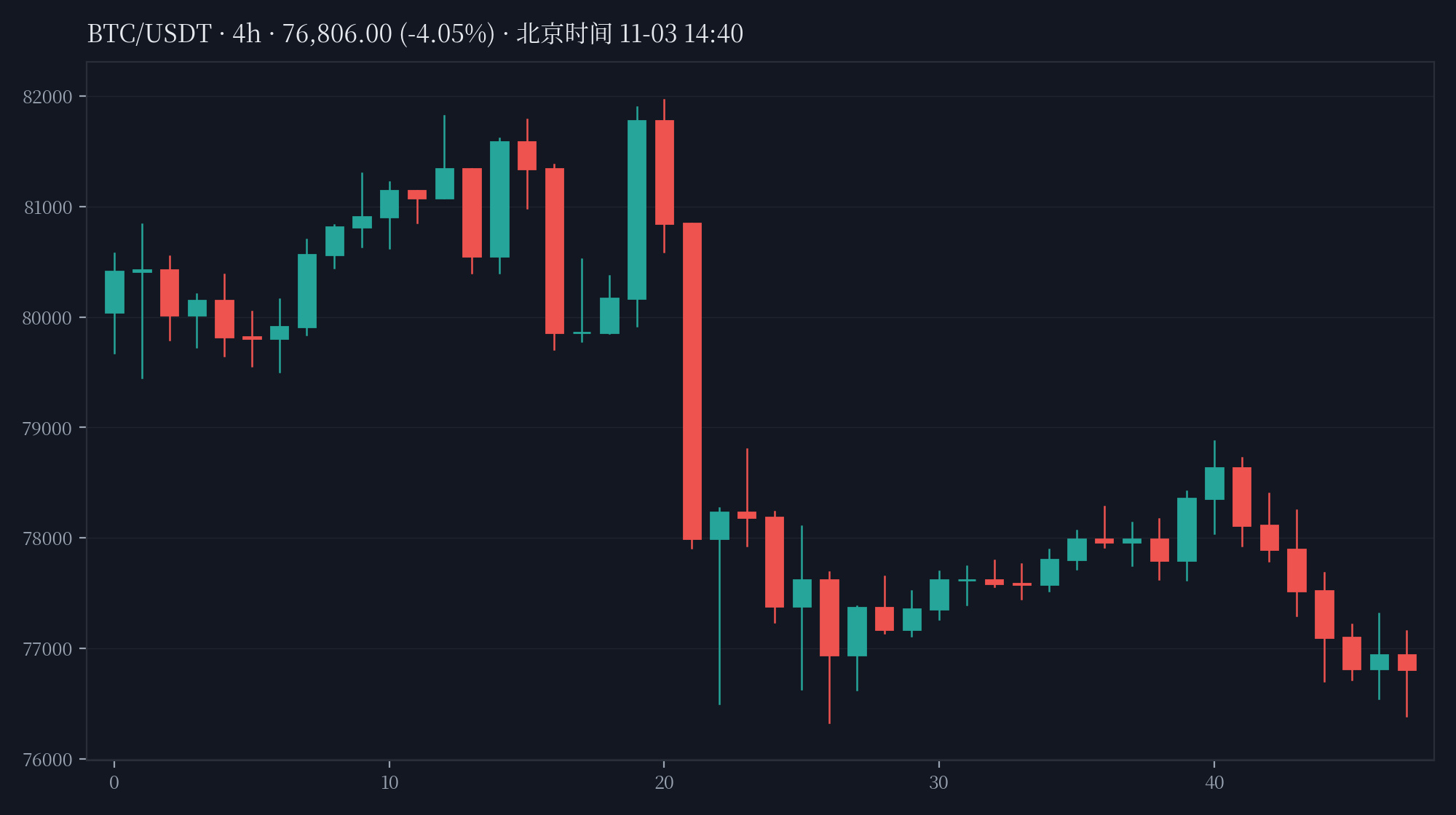
Binance’s SAFU Bitcoin wallet has been cut in half, leaving only about 7,500 BTC; no timeline yet for replenishment | November 3
There’s a new entry in the ledger for Binance’s $6.3 billion hack: it’s not that more money was lost, but that Tuesday’s on-chain review has, for the first time, established how much of the emergency fund itself has been used.
First, the facts: CoinDesk checked mempool.space data today (published at 13:36 Beijing time) and found that Binance’s publicly disclosed SAFU Bitcoin wallet had just over 7,500 BTC as of Tuesday, worth about $580 million at roughly $77,000 per BTC. Four transfers on October 31 cut the balance in half, from 15,000 BTC. Cointelegraph’s November 2 report independently confirmed the same transaction: Binance confirmed that 7,499 $BTC was transferred on October 31, describing it as a partial use of SAFU.
What’s really worth watching isn’t the “cut in half” figure, but a gap in the replenishment rules: SAFU’s terms say that if the fund’s market value falls below $800 million because of $BTC price fluctuations, it will be topped back up to $1 billion—but this rule covers price fluctuations only, not funds being spent. On October 31, Binance pledged to restore the fund to about $1 billion, but gave no timeline and didn’t say how much had been drawn from the futures insurance fund.
Don’t conflate these three things: First, 7,500 BTC is just the Bitcoin portion of publicly disclosed SAFU, not the fund’s total value. Second, using SAFU means Binance is covering the losses with its own money; it doesn’t mean the stolen funds have been recovered. Third, the second phase of withdrawals began opening gradually at 12:00 noon today (already reported at 12:38); that and “how much is left in the emergency fund” are two separate accounts.
My take: The fact that withdrawals can resume shows that immediate liquidity has held up. But with the emergency fund cut in half and no replenishment timeline, the buffer for the next incident has already become thinner. The November 4 reserve snapshot, which covers more assets, is worth waiting for not just for the snapshot itself, but to see whether it also clarifies SAFU replenishment.
At the time of publication (14:39 Beijing time; cross-checked against two sources, with deviations of ≤0.05%): $BTC was about $76,830 (24h: about -1.73%), and $ETH was about $2,256 (24h: about -1.30%). These are point-in-time price snapshots, not a forecast of market direction.
Risk warning: The above is based on public reports and on-chain data. The timeline for replenishing SAFU and the amount drawn from the insurance fund are subject to Binance’s subsequent official statements. Freezing stolen funds does not mean they have been recovered; don’t interpret “95% already replenished” as “all the money is back.”
Which would you rather see first: A) Binance’s timeline for replenishing SAFU, or B) the broader reserve snapshot on November 4?
$BTC $BNB #Binance #SAFU #SecurityIncident