Apple reported earnings, and despite beating expectations on every metric, its stock fell.
Let’s start with the numbers. Apple reported results for the fourth quarter of fiscal 2026. Note that this is the quarter ended September 26, not the fourth calendar quarter.
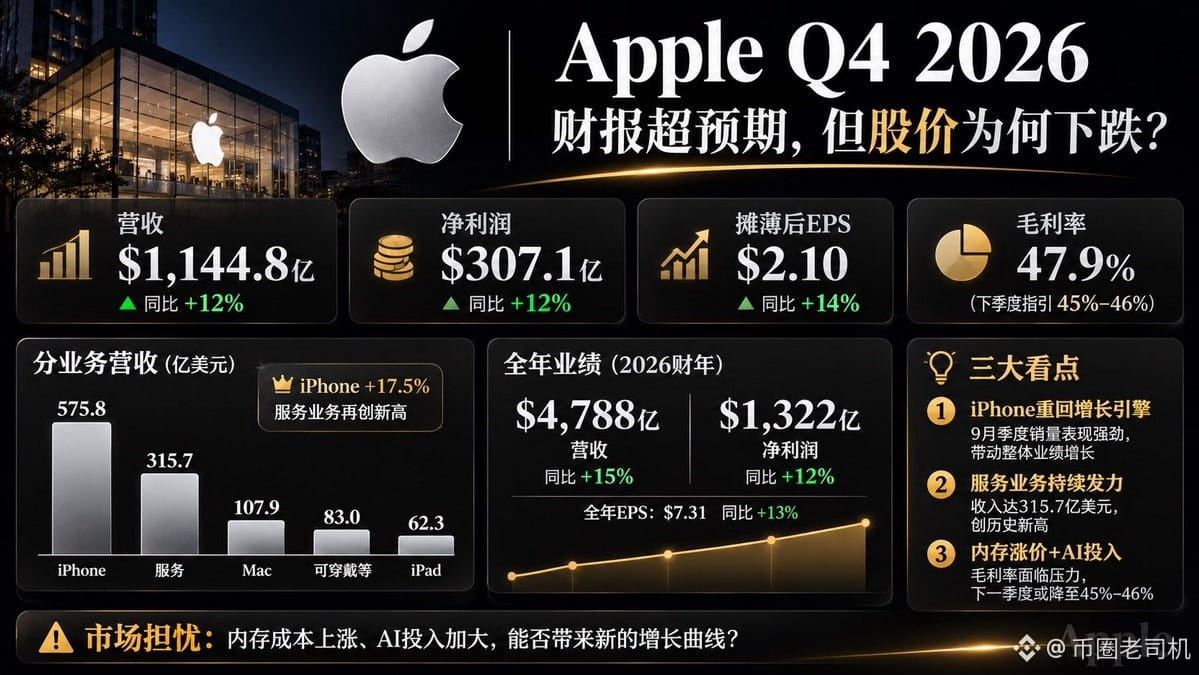
Revenue for the quarter was $114.48 billion, up 12% year over year. Net income was $30.71 billion, up about 12%. Diluted EPS was $2.10, up 14%.
Wall Street had expected revenue of around $113.4 billion and EPS of about $1.99. Apple beat expectations on both.
Full-year revenue was $478.8 billion, up 15% year over year, and net income was $132.2 billion.
Taken at face value, Apple delivered an impressive set of results.
But seasoned investors know there’s more to an earnings report than total revenue.
First, the iPhone is still Apple’s biggest cash cow.
iPhone revenue was $57.58 billion this quarter, up about 17.5% year over year.
Mac revenue was $10.79 billion, up 23.7% year over year.
Services revenue was $31.57 billion, up 9.8% year over year and reaching a new record.
However, iPad revenue was $6.23 billion, down 10.4% year over year, while revenue from Wearables, Home and Accessories was $8.3 billion, down 7.9%.
This points to an important issue: Apple’s growth isn’t coming from a surge across all of its businesses. It’s being driven mainly by the iPhone, Mac and Services.
Services is especially important, with a gross margin of around 76%.
Hardware brings users into the ecosystem; Services keeps generating revenue from them. That’s what makes Apple so formidable.
Second, the biggest risk in the earnings report is actually rising memory prices.
Apple’s gross margin was 47.9% this quarter, which looks solid.
But one detail is easy to miss: tariff refunds added about one percentage point to Apple’s gross margin and $0.05 to EPS.
In other words, excluding this one-time benefit, Apple’s underlying operating margins bear closer watching.
More concerning, AI data centers are consuming huge amounts of memory capacity, driving up memory chip prices and putting cost pressure on smartphone makers.
Apple has considerable bargaining power with its suppliers, but it can’t be completely insulated from the impact.
Management guided to a gross margin of just 45%–46% for next quarter, a clear drop from this quarter’s 47.9%.
That’s what’s really making the market uneasy.
Third, AI could be key to Apple’s next phase of growth, but that potential hasn’t fully materialized yet.
Microsoft, Google and Meta are all pouring money into AI infrastructure.
Apple is taking a different approach: it wants to integrate AI into the iPhone, Mac and its broader ecosystem.
That strategy has advantages. Apple doesn’t need to simply copy other tech companies’ capital-intensive investment model.
But the practical questions remain: Will AI persuade users to upgrade their phones? Will it make them willing to pay more for higher-end hardware?
If AI merely adds a few features without meaningfully boosting upgrade cycles or Services revenue, the market won’t keep paying for the AI story indefinitely.
Finally, why did the stock fall despite results beating expectations?
I think the key reason is that the market is looking ahead to next quarter, not back at the quarter that just ended.
Apple expects December-quarter revenue to grow 7%–10% year over year, with Services growth projected at 8%–9% and gross margin potentially falling to 45%–46%.
Add rising memory costs, investment in AI servers and supply constraints affecting some new products, and it’s natural for investors to reassess the profit potential of the next few quarters.
There’s another noteworthy change: this is the first earnings report since new CEO John Ternus took over.
Apple is at a turning point between one cycle and the next.
Its biggest strengths remain its enormous global base of active devices, powerful brand premium and Services ecosystem.
But the challenges are clear: Can hardware growth continue? Can AI create a new reason for customers to upgrade? And will rising memory costs eat into profits?
A great company isn’t necessarily a great buy at any price.
This earnings report shows that Apple is still highly profitable, but it hasn’t yet proved that it has found a second growth engine for the AI era.
Next quarter, keep an eye on two figures: first, the impact of memory prices on gross margin; second, actual iPhone sales in the December quarter.
These two metrics matter more than simply watching revenue hit another record.
Let’s start with the numbers. Apple reported results for the fourth quarter of fiscal 2026. Note that this is the quarter ended September 26, not the fourth calendar quarter.
Revenue for the quarter was $114.48 billion, up 12% year over year. Net income was $30.71 billion, up about 12%. Diluted EPS was $2.10, up 14%.
Wall Street had expected revenue of around $113.4 billion and EPS of about $1.99. Apple beat expectations on both.
Full-year revenue was $478.8 billion, up 15% year over year, and net income was $132.2 billion.
Taken at face value, Apple delivered an impressive set of results.
But seasoned investors know there’s more to an earnings report than total revenue.
First, the iPhone is still Apple’s biggest cash cow.
iPhone revenue was $57.58 billion this quarter, up about 17.5% year over year.
Mac revenue was $10.79 billion, up 23.7% year over year.
Services revenue was $31.57 billion, up 9.8% year over year and reaching a new record.
However, iPad revenue was $6.23 billion, down 10.4% year over year, while revenue from Wearables, Home and Accessories was $8.3 billion, down 7.9%.
This points to an important issue: Apple’s growth isn’t coming from a surge across all of its businesses. It’s being driven mainly by the iPhone, Mac and Services.
Services is especially important, with a gross margin of around 76%.
Hardware brings users into the ecosystem; Services keeps generating revenue from them. That’s what makes Apple so formidable.
Second, the biggest risk in the earnings report is actually rising memory prices.
Apple’s gross margin was 47.9% this quarter, which looks solid.
But one detail is easy to miss: tariff refunds added about one percentage point to Apple’s gross margin and $0.05 to EPS.
In other words, excluding this one-time benefit, Apple’s underlying operating margins bear closer watching.
More concerning, AI data centers are consuming huge amounts of memory capacity, driving up memory chip prices and putting cost pressure on smartphone makers.
Apple has considerable bargaining power with its suppliers, but it can’t be completely insulated from the impact.
Management guided to a gross margin of just 45%–46% for next quarter, a clear drop from this quarter’s 47.9%.
That’s what’s really making the market uneasy.
Third, AI could be key to Apple’s next phase of growth, but that potential hasn’t fully materialized yet.
Microsoft, Google and Meta are all pouring money into AI infrastructure.
Apple is taking a different approach: it wants to integrate AI into the iPhone, Mac and its broader ecosystem.
That strategy has advantages. Apple doesn’t need to simply copy other tech companies’ capital-intensive investment model.
But the practical questions remain: Will AI persuade users to upgrade their phones? Will it make them willing to pay more for higher-end hardware?
If AI merely adds a few features without meaningfully boosting upgrade cycles or Services revenue, the market won’t keep paying for the AI story indefinitely.
Finally, why did the stock fall despite results beating expectations?
I think the key reason is that the market is looking ahead to next quarter, not back at the quarter that just ended.
Apple expects December-quarter revenue to grow 7%–10% year over year, with Services growth projected at 8%–9% and gross margin potentially falling to 45%–46%.
Add rising memory costs, investment in AI servers and supply constraints affecting some new products, and it’s natural for investors to reassess the profit potential of the next few quarters.
There’s another noteworthy change: this is the first earnings report since new CEO John Ternus took over.
Apple is at a turning point between one cycle and the next.
Its biggest strengths remain its enormous global base of active devices, powerful brand premium and Services ecosystem.
But the challenges are clear: Can hardware growth continue? Can AI create a new reason for customers to upgrade? And will rising memory costs eat into profits?
A great company isn’t necessarily a great buy at any price.
This earnings report shows that Apple is still highly profitable, but it hasn’t yet proved that it has found a second growth engine for the AI era.
Next quarter, keep an eye on two figures: first, the impact of memory prices on gross margin; second, actual iPhone sales in the December quarter.
These two metrics matter more than simply watching revenue hit another record.