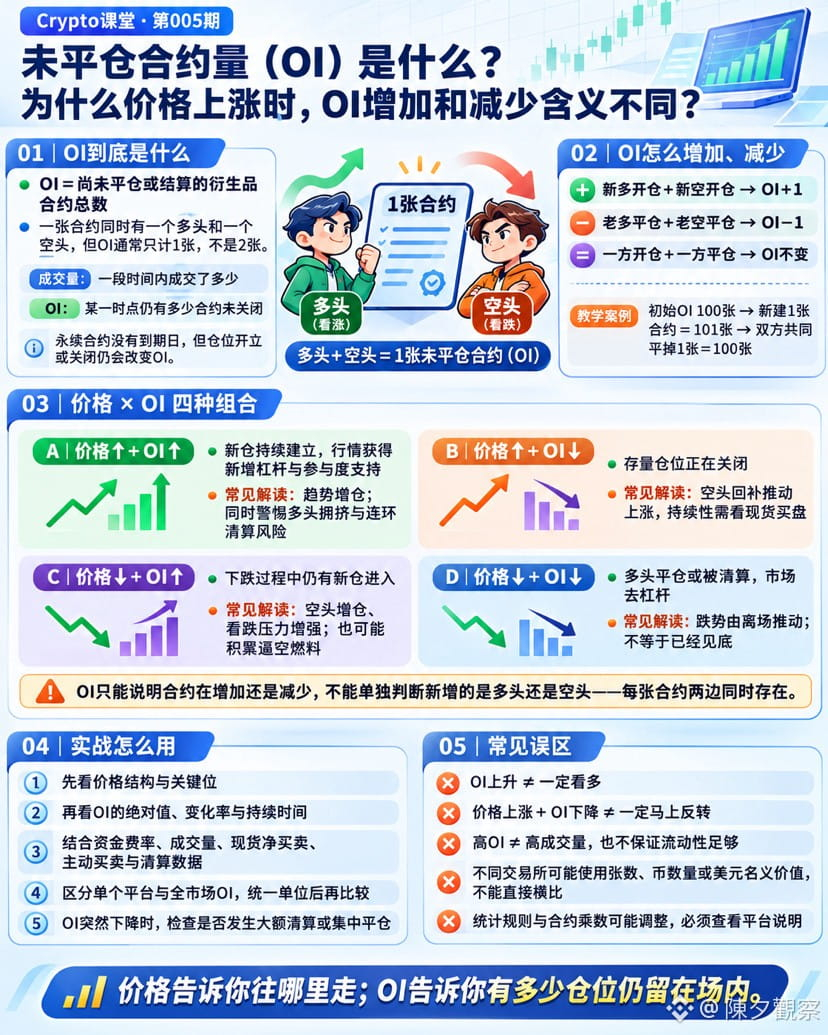
What is Open Interest (OI)? Why do increases and decreases in OI mean different things when prices rise?
📊 If prices are rising, why do increases and decreases in OI reflect completely different market structures?
Open Interest (OI) is the total number of derivatives contracts that have not yet been closed or settled.
Each contract has both a long and a short position, but OI usually counts it as just one contract:
New long opened + new short opened: OI increases
Existing long closed + existing short closed: OI decreases
One side opens a position + the other side closes: OI remains unchanged
Trading volume measures the amount traded over a period of time; OI reflects the number of contracts still in the market at a given point in time.
Common interpretations when looking at price movements alongside OI:
Price rises + OI increases: New positions are being opened, supporting the trend with additional participation, though leverage and the risk of crowded long positions may also increase
Price rises + OI decreases: Existing positions are being closed; the rise may be driven more by short covering
Price falls + OI increases: New positions are still being opened as prices fall, often indicating shorts adding to their positions, though this could also build the risk of a future short squeeze
Price falls + OI decreases: Long positions are being closed or liquidated. The market is deleveraging, but that does not mean the price has bottomed
A rise accompanied by increasing OI generally indicates greater participation from new capital than a rise accompanied by falling OI; the latter may be driven more by short covering.
⚠️ OI only shows whether the number of contracts is increasing or decreasing; on its own, it cannot tell whether the new positions are long or short. Every contract has both sides. In practice, you also need to consider funding rates, spot buying, aggressive trades, trading volume, and liquidation data.
Exchanges may use different units, such as the number of contracts, the number of coins, or notional value in dollars, and their calculation methods may also change. Make sure you are comparing like with like before making cross-exchange comparisons.
Price tells you which way the market is moving; OI tells you how many positions remain in the market.
📅 Coming next
Thursday|Web3 Encyclopedia|Issue 005
“What is a cross-chain bridge? Why can’t assets be transferred directly from one chain to another?”