On November’s first trading day, U.S. stocks showed a stark split: the Dow Jones Industrial Average rose on its own, while the Nasdaq Composite fell for a third straight session and the S&P 500 also extended its losing streak to three days.
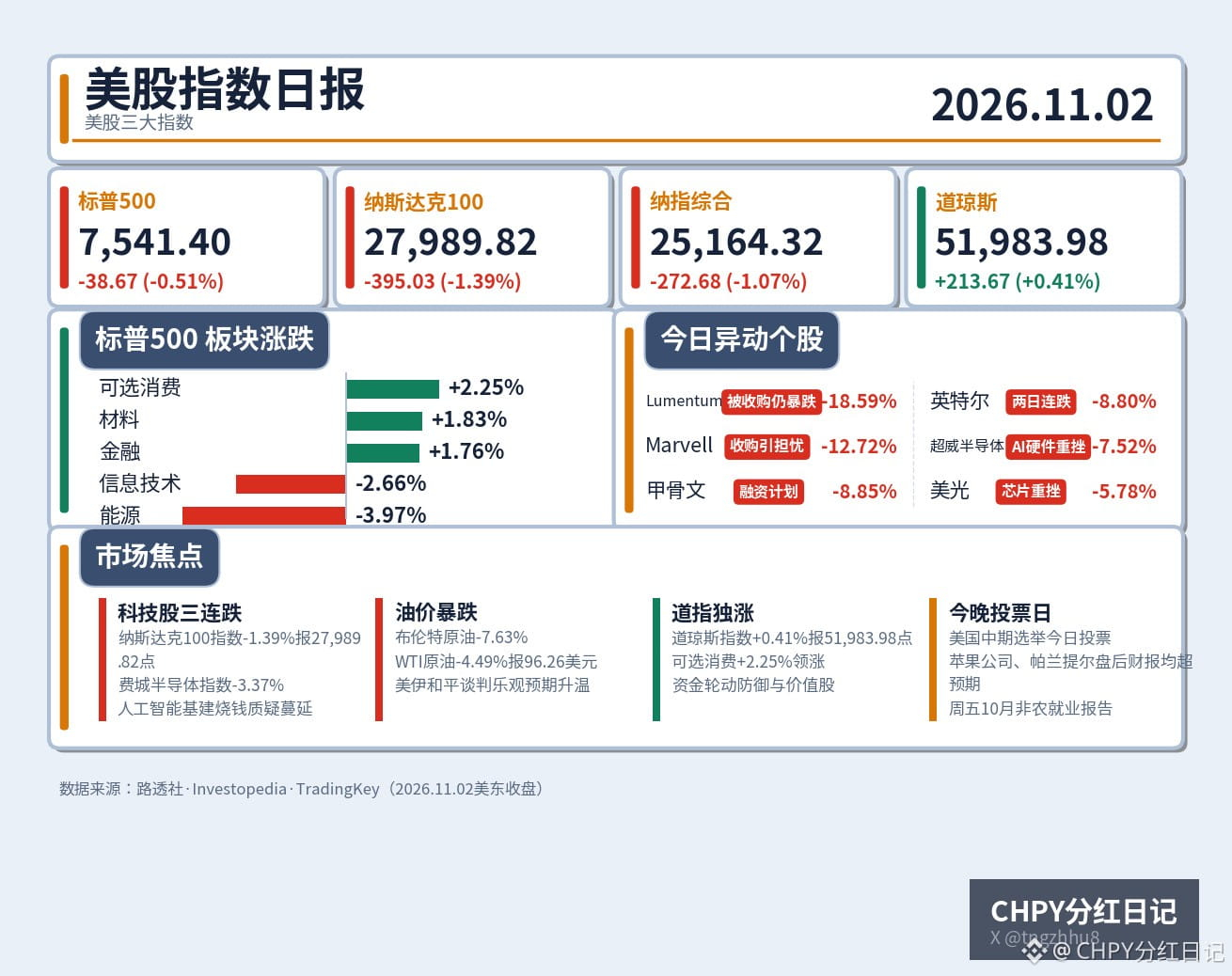
First, the closing figures: the Dow Jones Industrial Average rose 0.41% to 51,983.98; the S&P 500 fell 0.51% to 7,541.40; the Nasdaq Composite fell 1.07% to 25,164.32; and the Nasdaq 100 fell 1.39% to 27,989.82. The S&P 500 posted its lowest close since July 31 and was down 3.55% from its October 6 record high of 7,818.93.
Intraday, things briefly looked like a rebound. All three major indexes opened higher, but tech stocks sank again in the afternoon, wiping out the morning gains. This “surge in the morning, fade in the afternoon” pattern was almost identical to last Friday’s, showing that buyers’ confidence has yet to return.
It’s easy to see where money is flowing by looking at sectors. The biggest gainers were consumer discretionary (+2.25%), materials (+1.83%), and financials (+1.76%); the biggest decliners were energy (-3.97%) and information technology (-2.66%). Defensive and value stocks on one side, growth and cyclical stocks on the other—the market’s attitude is written in sector performance: take shelter first, and see what happens when the storm passes.
The first link in the chain of transmission is AI infrastructure. The central question left hanging from last week’s earnings season remains unanswered: when will the huge investments in AI infrastructure translate into real cash flow? Oracle unveiled a new financing plan, and the market voted with its feet, sending the stock down 8.85%. Marvell Technology announced its $115 billion acquisition of optical components maker Lumentum, and both stocks plunged: Lumentum fell 18.59% and Marvell Technology fell 12.72%. The market clearly doesn’t like the story of “spend more, then buy more.” The Philadelphia Semiconductor Index fell 3.37%; Advanced Micro Devices dropped 7.52%, Micron Technology fell 5.78%, and Nvidia lost 1.26%. Chip stocks bore the brunt of Monday’s sell-off.
Intel had the worst of it. After issuing weak earnings guidance last Friday, it plunged 28.58% in a single session, its worst one-day performance since 1974. On Monday, it fell another 8.80%, losing nearly a third of its value in two days. One company’s earnings report can drag down the valuation logic of the entire semiconductor sector. That’s the fragility of today’s AI narrative: expectations are set so high that there’s virtually no room for error.
The second link is oil prices. Brent crude fell 7.63%, while WTI crude dropped 4.49% to $96.26, triggered by optimism about peace talks between the U.S. and Iran. As the geopolitical risk premium faded, the energy sector fell 3.97%, making it the day’s worst-performing sector. A sharp drop in oil prices is good news for inflation, but Monday was a rough day for energy shareholders.
The third link is why the Dow was able to rise on its own. Industrial, financial, and consumer companies make up a large share of the Dow Jones Industrial Average, while its tech weighting is relatively low. As investors pull out of high-valuation tech stocks, these sectors are where they head first. This isn’t a broad-based recovery; it’s a classic defensive rotation. Money hasn’t left the stock market—it’s just moved to a different seat.
There was some good news, too—two bits of it, both after the close: Apple and Palantir Technologies reported earnings that beat expectations. Apple had fallen 1.5% during the session, but its earnings helped it recover some ground after hours. Still, in Monday’s climate, one company’s strong earnings can’t rescue an entire sector’s mood.
Taking a wider view, the Nasdaq Composite fell 5.3% in October, its worst month since March 2023. The S&P 500 dropped 0.9%, while the Dow Jones Industrial Average actually rose 1.7%. In other words, the divergence didn’t begin on Monday. It persisted throughout October, and November’s first day simply replayed the same scene.
My view is that the nature of this AI-driven pullback has changed: it’s gone from “a correction after too much of a run-up” to “the narrative being put under scrutiny.” In the past, a disappointing earnings report might send a stock down for a day, only for buyers to swoop in. Now, even earnings that beat expectations may not lift a stock. Intel and Oracle are cases in point. The market is starting to do the math in earnest, and selling anything it can’t make sense of. At this stage, a bottom in tech stocks won’t form in a day. Investors will have to wait for an earnings season that proves these investments are generating returns—or for valuations to fall so far that no one asks the question anymore.
In the short term, all the key events are packed into this week: today is Election Day for the U.S. midterms, and the results will shape policy over the next two years. Friday brings the October nonfarm payrolls report. Markets will probably stay cautious ahead of the election, and volatility is likely to remain high. After three straight declines in the Nasdaq 100, a short-term oversold bounce could happen at any time, but whether it holds will depend on whether the election results and jobs data cooperate.
As for positioning, rushing to buy the dip in tech stocks isn’t a good idea. Catching a falling knife is dangerous, and you may not be holding it by the handle. The Dow’s strength and the outperformance of financials and consumer discretionary stocks show that investors are looking for a safety net—but this is a rotation, not a reversal. What’s really worth waiting for is the moment the market chooses a new direction after the midterm election dust settles and the jobs data comes in. Until then, keep positions light and wait—let the bullets fly for a while.
#美股 #U.S. midterm elections
First, the closing figures: the Dow Jones Industrial Average rose 0.41% to 51,983.98; the S&P 500 fell 0.51% to 7,541.40; the Nasdaq Composite fell 1.07% to 25,164.32; and the Nasdaq 100 fell 1.39% to 27,989.82. The S&P 500 posted its lowest close since July 31 and was down 3.55% from its October 6 record high of 7,818.93.
Intraday, things briefly looked like a rebound. All three major indexes opened higher, but tech stocks sank again in the afternoon, wiping out the morning gains. This “surge in the morning, fade in the afternoon” pattern was almost identical to last Friday’s, showing that buyers’ confidence has yet to return.
It’s easy to see where money is flowing by looking at sectors. The biggest gainers were consumer discretionary (+2.25%), materials (+1.83%), and financials (+1.76%); the biggest decliners were energy (-3.97%) and information technology (-2.66%). Defensive and value stocks on one side, growth and cyclical stocks on the other—the market’s attitude is written in sector performance: take shelter first, and see what happens when the storm passes.
The first link in the chain of transmission is AI infrastructure. The central question left hanging from last week’s earnings season remains unanswered: when will the huge investments in AI infrastructure translate into real cash flow? Oracle unveiled a new financing plan, and the market voted with its feet, sending the stock down 8.85%. Marvell Technology announced its $115 billion acquisition of optical components maker Lumentum, and both stocks plunged: Lumentum fell 18.59% and Marvell Technology fell 12.72%. The market clearly doesn’t like the story of “spend more, then buy more.” The Philadelphia Semiconductor Index fell 3.37%; Advanced Micro Devices dropped 7.52%, Micron Technology fell 5.78%, and Nvidia lost 1.26%. Chip stocks bore the brunt of Monday’s sell-off.
Intel had the worst of it. After issuing weak earnings guidance last Friday, it plunged 28.58% in a single session, its worst one-day performance since 1974. On Monday, it fell another 8.80%, losing nearly a third of its value in two days. One company’s earnings report can drag down the valuation logic of the entire semiconductor sector. That’s the fragility of today’s AI narrative: expectations are set so high that there’s virtually no room for error.
The second link is oil prices. Brent crude fell 7.63%, while WTI crude dropped 4.49% to $96.26, triggered by optimism about peace talks between the U.S. and Iran. As the geopolitical risk premium faded, the energy sector fell 3.97%, making it the day’s worst-performing sector. A sharp drop in oil prices is good news for inflation, but Monday was a rough day for energy shareholders.
The third link is why the Dow was able to rise on its own. Industrial, financial, and consumer companies make up a large share of the Dow Jones Industrial Average, while its tech weighting is relatively low. As investors pull out of high-valuation tech stocks, these sectors are where they head first. This isn’t a broad-based recovery; it’s a classic defensive rotation. Money hasn’t left the stock market—it’s just moved to a different seat.
There was some good news, too—two bits of it, both after the close: Apple and Palantir Technologies reported earnings that beat expectations. Apple had fallen 1.5% during the session, but its earnings helped it recover some ground after hours. Still, in Monday’s climate, one company’s strong earnings can’t rescue an entire sector’s mood.
Taking a wider view, the Nasdaq Composite fell 5.3% in October, its worst month since March 2023. The S&P 500 dropped 0.9%, while the Dow Jones Industrial Average actually rose 1.7%. In other words, the divergence didn’t begin on Monday. It persisted throughout October, and November’s first day simply replayed the same scene.
My view is that the nature of this AI-driven pullback has changed: it’s gone from “a correction after too much of a run-up” to “the narrative being put under scrutiny.” In the past, a disappointing earnings report might send a stock down for a day, only for buyers to swoop in. Now, even earnings that beat expectations may not lift a stock. Intel and Oracle are cases in point. The market is starting to do the math in earnest, and selling anything it can’t make sense of. At this stage, a bottom in tech stocks won’t form in a day. Investors will have to wait for an earnings season that proves these investments are generating returns—or for valuations to fall so far that no one asks the question anymore.
In the short term, all the key events are packed into this week: today is Election Day for the U.S. midterms, and the results will shape policy over the next two years. Friday brings the October nonfarm payrolls report. Markets will probably stay cautious ahead of the election, and volatility is likely to remain high. After three straight declines in the Nasdaq 100, a short-term oversold bounce could happen at any time, but whether it holds will depend on whether the election results and jobs data cooperate.
As for positioning, rushing to buy the dip in tech stocks isn’t a good idea. Catching a falling knife is dangerous, and you may not be holding it by the handle. The Dow’s strength and the outperformance of financials and consumer discretionary stocks show that investors are looking for a safety net—but this is a rotation, not a reversal. What’s really worth waiting for is the moment the market chooses a new direction after the midterm election dust settles and the jobs data comes in. Until then, keep positions light and wait—let the bullets fly for a while.
#美股 #U.S. midterm elections