
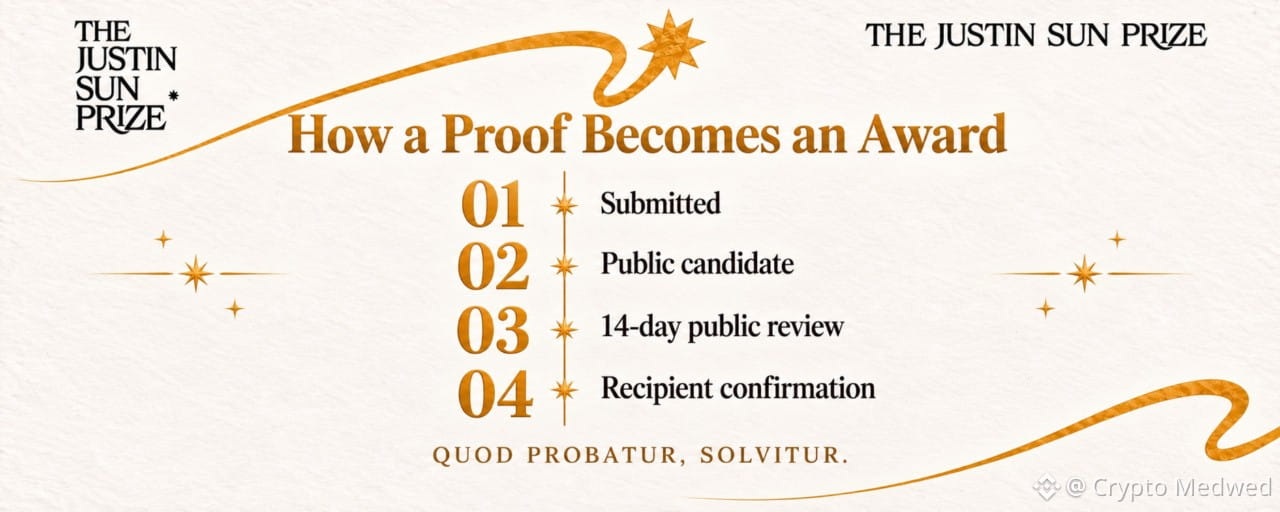

Justin Sun Prize explained how mathematical prizes are awarded. Even if a researcher submits a correct proof, that does not automatically mean they will receive an award. First, the work undergoes a technical review; it then becomes a public claim that anyone can challenge within 14 days.
New clarifications have been published in the official Justin Sun Prize GitHub repository and are intended to make the evaluation of mathematical achievements more transparent.
From proof to official award
The standard Justin Sun Prize procedure, which applies to problems outside the MathDB pilot program, consists of several stages.
Stage one: submission of a mathematical solution.
The researcher submits a complete proof of the problem and proof of authorship.
If necessary, another specialist can prepare a formalization of the proof in the Lean system, which enables software-based verification of the correctness of mathematical reasoning.
The author of the mathematical solution and the author of its formalization may be different people.
Stage two: review and registration of the candidate.
The organizers review the mathematical result, whether the formal proof matches the original problem, and the submitted materials.
After the necessary checks, the work may be added to the public candidate registry.
Importantly, even accepting the materials and merging changes on GitHub do not mean that an award has been granted.
14 days during which anyone can challenge the result
Once a candidate is published in the official registry, a 14-day public review period begins.
During this time, anyone in the mathematical community may submit a reasoned objection.
Challenges may concern:
The mathematical correctness of the proof.
Authorship of the submitted result.
Priority of the discovery or formalization.
The applicant's identity.
Eligibility for the award.
For example, if another researcher can confirm that they obtained the correct solution earlier, the organizers must examine the evidence presented. In determining priority, they consider not only publication or Git commit dates, but also independent evidence of when the work was created.
If a substantiated objection is submitted during the public review, the process will not conclude until the dispute is resolved.
And if a candidate is confirmed to have been replaced by a new author, a separate 14-day period begins for the result in question.
When does a researcher officially receive the award?
Even successfully completing the two-week period does not mean that payment is made immediately.
For the prize to be officially awarded, the identity check must be completed, the recipient confirmed, and the absence of unresolved objections or competing claims established.
Only after all requirements have been met is the result moved from the candidate list to the official laureate registry.
The organizers then announce the award and make the associated payment.
Thus, a public candidate and a confirmed Justin Sun Prize laureate are two different statuses.
And what about the MathDB partnership?
Recently, Justin Sun Prize announced a collaboration with the MathDB mathematics platform, under the scientific guidance of Caltech professor Tony Yue Yu.
As part of the partnership, a pilot program featuring 50 mathematical problems was launched.
The pilot program has a separate process for submitting materials and reviewing solutions, including independent evaluation of mathematical solutions, Lean formalizations, and explanations.
Therefore, the standard GitHub procedure cannot automatically be applied to every problem in the pilot program.
At the same time, public review, establishing authorship, and confirming recipients remain important parts of the award process.
Why does this matter for mathematics and artificial intelligence?
Today, artificial intelligence is increasingly being used to search for mathematical conjectures and construct proofs. But even if AI proposes a convincing solution, that does not mean it is mathematically correct.
Public review allows other researchers to find errors, verify authorship, and assess the priority of results.
Lean plays a particularly important role here, helping to verify the formal correctness of a proof. However, a successful software check alone does not replace expert evaluation of whether the proven statement matches the original problem.
Conclusion
A 14-day public review is the right approach to awarding mathematics prizes, especially when complex problems and substantial cash prizes are involved.
Importantly, a solution is not considered final solely on the basis of the author's claim or a preliminary technical check.
Other researchers have the opportunity to verify the result, present their own arguments, and challenge the priority of the discovery. The organizers also verify the recipient's identity and eligibility for the award.
In the age of artificial intelligence, such a system is particularly relevant: finding a promising solution is only part of the work. Its correctness must also be proved and its authorship confirmed.
If Justin Sun Prize can apply these rules consistently, the initiative could become an interesting example of an open system for evaluating scientific achievements. After all, in fundamental mathematics, what matters most is not the size of the prize, but the reliability of the result.